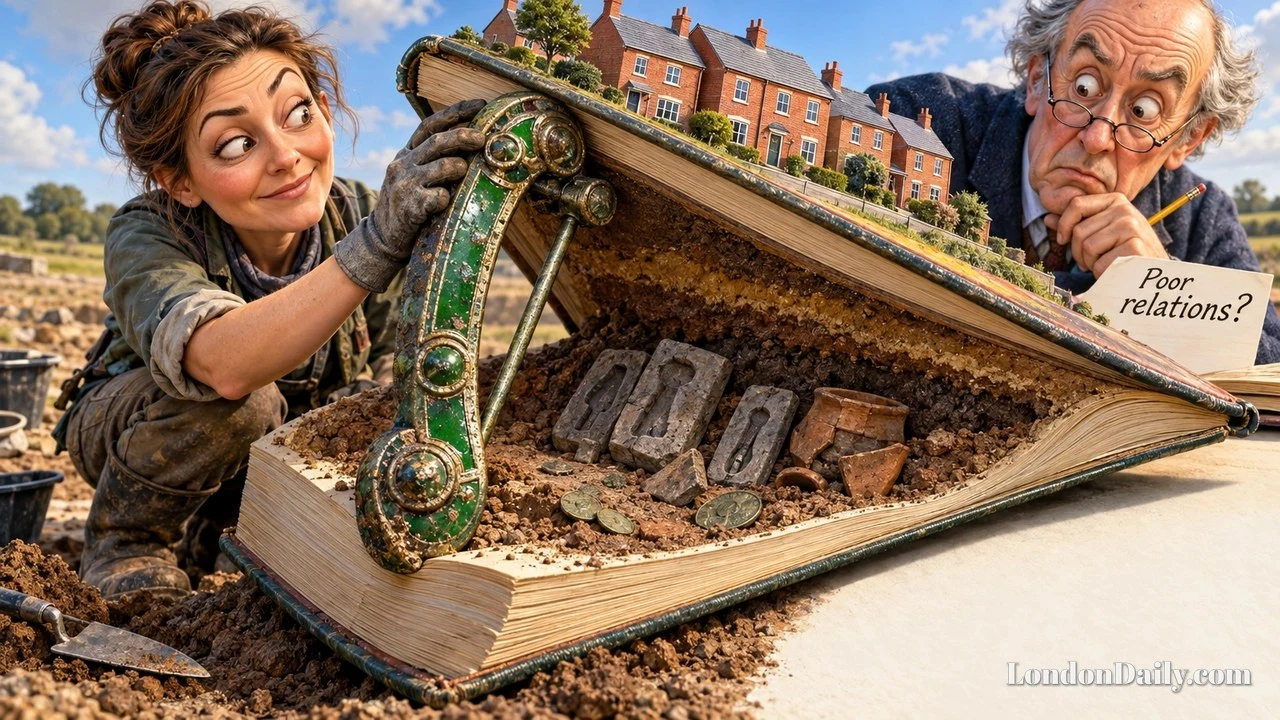
A Roman jewellery workshop discovered beneath a new housing estate in Mancot, Flintshire, is helping archaeologists reconsider relations between the Romans and the region’s native population nearly 2,000 years ago.
Lead moulds, decorative brooches, pottery and coins were recovered from a settlement overlooking Chester. Heneb, the trust for Welsh archaeology, described the collection as one of the largest assemblages of Roman artefacts found in the county.
The unexpected discovery came during mining surveys for the development on Gladstone Way. Archaeologists removed dozens of objects before homes were built over the excavation site. Mapping showed that the settlement extended beneath Mancot, between Hawarden and Queensferry.
Project manager Chris Matthews said the significance went beyond the individual finds. Despite the proximity of the important Roman city of Chester, north-east Wales had, until recently, yielded little associated archaeology. That scarcity had prompted debate over whether relations between Romans and local people had been poor.
Matthews said discoveries at Mancot, Greenfield and Rossett in Wrexham suggested that explanation was probably wrong. The workshop offers evidence of local production and economic connections, rather than simply an absence of Roman activity.
Its lead moulds indicate that craftspeople made a wide range of brooches, drawing on the area’s rich metal resources. Used to fasten clothing, these objects could also be brightly coloured and decorated with animal designs. One recovered brooch still retains green enamel despite corrosion of its metalwork.
The workshop is thought to have supplied Roman society in Chester, while pottery fragments provide evidence of trade reaching mainland Europe. Those connections do not settle every question about relations between communities, but they give archaeologists more substantial evidence to work with.
Matthews said occupation may have begun in the Iron Age, before the Romans arrived, and continued through successive periods. Coins from the reign of Commodus, AD 177–192, and the later reign of Constantine support the interpretation of a long-lived settlement.
Some brooches and moulds have undergone conservation. Further analysis at the National Museum of Wales in Cardiff will examine manufacturing techniques, metal composition and origins before the finds return for display in north-east Wales.
Sophie Fish, museums manager at Gwella, which manages council libraries and leisure services, hopes some of the most interesting objects can be shown at Mold Museum in 2027. The longer-term ambition is to bring together Roman discoveries from across north-east Wales.








Join the conversation