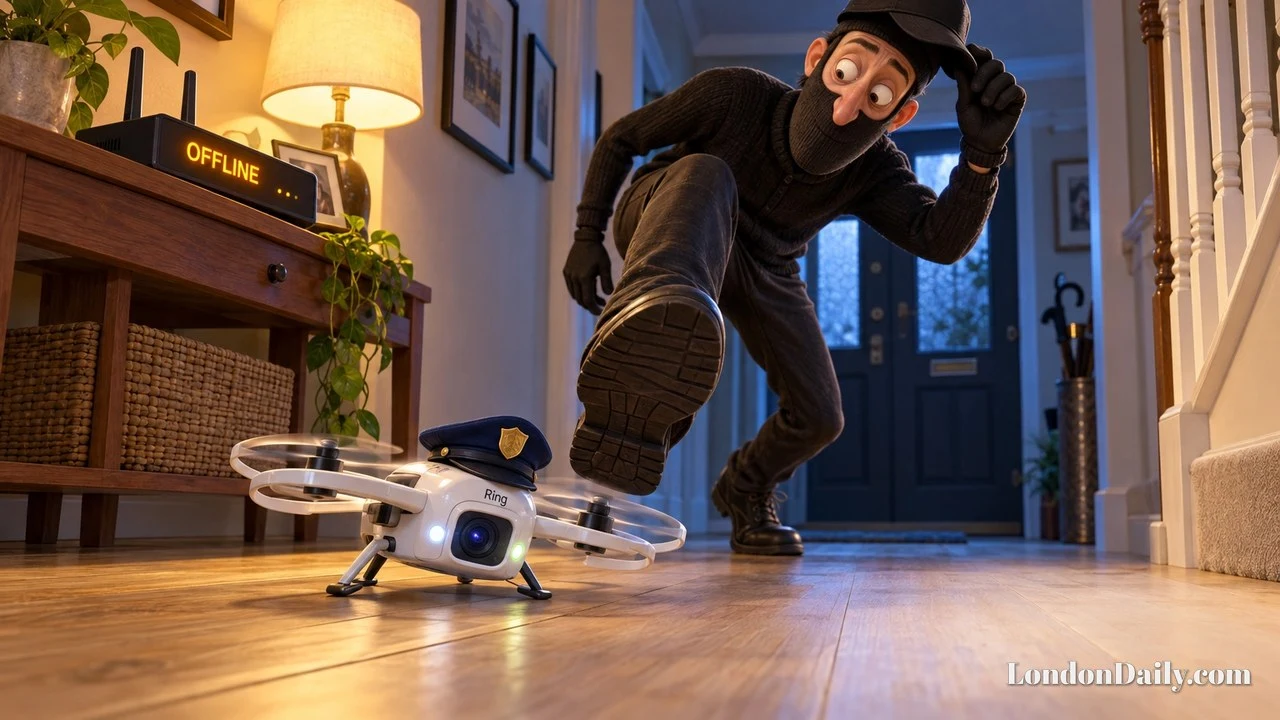
Amazon-owned Ring plans to bring its home security drone to American customers in January after six years of delays, using cloud computing to keep the price at $249.99. The compromise is consequential: without an internet connection, it cannot navigate and must land immediately.
Announcing the Ring Drone Cam in New York this week, the company revived an ambition founder Jamie Siminoff began pursuing in 2016. Its Always Home Cam, unveiled in 2020, never reached widespread commercial sale and was cancelled in 2024. Packing sensors, collision-avoidance processors and a workable battery into a small aircraft costing below $250 had proved unworkable.
The replacement shifts computing to the cloud. At 165g, it is roughly a quarter of the size of the model displayed at CES 2023, retaining only the onboard navigation sensors needed for landing. Ring says AI Pilot and Alexa Home Map allow it to map rooms, follow preset routes, fly upstairs and avoid unexpected obstacles. A 2K camera has a 148-degree field of view; two LED lights provide night-time illumination and deter intruders.
That dependence on connectivity means an outage during a power cut or planned break-in would force an immediate emergency landing. Flights last five to eight minutes. Each airborne minute requires about eight minutes’ charging, with roughly 40 minutes between patrols: mobile coverage, rather than continuous airborne surveillance.
Siminoff says the drone records whenever active and cannot be flown manually. Privacy concerns follow earlier controversy over Ring doorbells being used for local police surveillance without customers’ permission around a decade ago.
Ring’s response includes a dock that physically covers the lens and propeller noise it presents as protection against covert filming. Its TAKE encryption protocol changes keys every five minutes and removes Amazon servers’ access to footage after 24 hours. That limits access while allowing cloud processing; it does not remove the need to process domestic footage remotely.
Ring stresses US assembly as it seeks Federal Communications Commission approval by January under rules introduced in December 2025 barring approvals for foreign-made drones and components over espionage concerns.
Competitors target different markets: Israel’s Indoor Robotics offers Tando with ceiling docking and thermal sensors for businesses and logistics centres; Sunflower Labs’ outdoor Beehive system costs tens of thousands of dollars annually to operate. China’s DJI dominates industrial applications with DJI Dock systems.
The new Ring Robotics brand also includes the $999.99 wheeled Rover Cam, due on 16 December 2026. A cheaper successor to Amazon Astro’s $2,350 business version, discontinued in summer 2024, it offers a retractable 4K periscope camera, siren and half-hour patrols across about 460 square metres. For the household drone, affordability has been achieved by making navigation dependent on the household connection.








Join the conversation