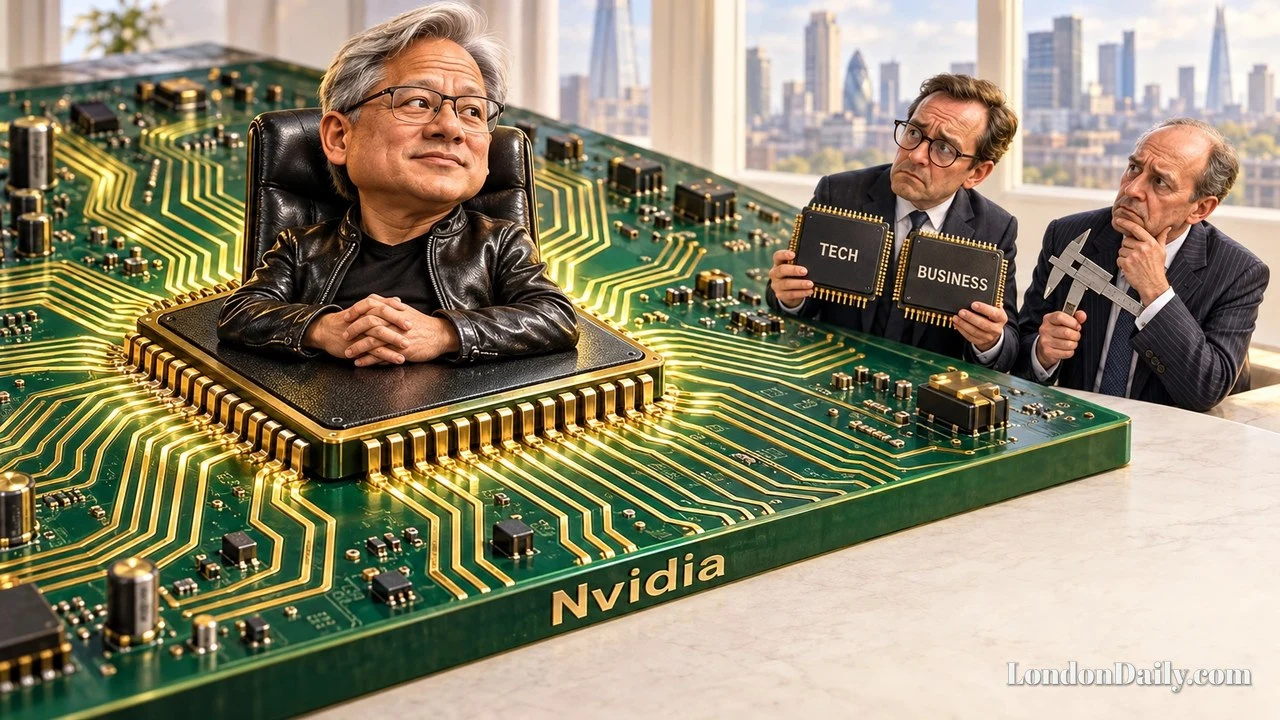
A reported affair and suspicions of espionage could put Jensen Huang’s future at Nvidia in jeopardy, more than three decades after he founded the company. Huang, who transformed a small graphics-card manufacturer into one of the technology industry’s most important businesses, could lose his position over his reported relationship with Chinese businesswoman Alice Huang, who is suspected of spying for Beijing. According to US media reports, Nvidia’s board is now considering the possibility of replacing him. Names being mentioned include senior figures at Nvidia and elsewhere in the semiconductor industry, among them several Israelis who have held prominent roles in the sector.
The challenge for Nvidia is considerable. Huang has led the company since its founding in 1993 and is personally involved not only in business decisions but also in product development and relationships with its biggest customers, including Microsoft, Google and Amazon. Unlike many technology companies, where responsibilities are divided between clearly defined management layers, Nvidia has operated for years with a relatively flat structure and an unusually large number of executives reporting directly to its chief executive. Replacing him could therefore require a change in how the company is run.
The leading candidates: a key CUDA developer and the finance chief
One of the most prominent names in the reports is Ian Buck, an Nvidia vice-president responsible for high-performance computing and large-scale computing infrastructure. Buck joined the company in 2004 and was a central figure in developing CUDA, the software platform that enables graphics processors to carry out complex calculations.
CUDA’s importance extends well beyond the software itself. It helped Nvidia turn its graphics processors into a central tool for training and running artificial intelligence models, creating an entire ecosystem of development tools that competitors struggle to replicate. Buck is also involved in Nvidia’s work with major cloud providers, giving him close knowledge of both the technology and the customers driving its business.
Another name is Colette Kress, Nvidia’s chief financial officer since 2013. Kress has helped steer the company through its years of rapid growth, knows its business well and maintains regular contact with Wall Street investors.
Reports suggest that Kress could be particularly suited to an interim chief executive role if the board prioritises stability before making a permanent appointment. However, she does not have a background in chip development, so such an appointment could require stronger technological leadership alongside her. One possibility that might be considered is dividing responsibility between a business leader and a technology leader, rather than placing both areas in one person’s hands, as Huang currently does.
Three Israelis also in the picture
Israel has a significant presence at the top of the global semiconductor industry, and three prominent figures have experience that could make them relevant to Nvidia’s future.
The first is Michael Kagan, the company’s chief technology officer. Kagan co-founded the Israeli company Mellanox, which Nvidia acquired in 2020 for about $7 billion, and joined Nvidia’s leadership following the acquisition.
Kagan has a deep understanding of the technologies that allow Nvidia to connect thousands of processors into vast computing systems. At a time when the performance of AI computing facilities depends not only on the power of individual chips but also on the speed of communication between them, this is a crucial field. His advantage is his detailed knowledge of both the technology and Nvidia itself. However, he has no proven experience of running a public company on this scale.
Another Israeli name is Eyal Waldman, Mellanox’s co-founder and former chief executive. Unlike Kagan, Waldman has already run an international semiconductor company, overseeing its growth and sale to Nvidia. He knows the data-centre market and its commercial and technological challenges, but he is not currently part of Nvidia’s management.
The third Israeli candidate is Johny Srouji, Apple’s chief hardware officer and a central figure in its chip development. A graduate of the Technion, Srouji has led the development of iPhone and Mac processors over the years and was one of the key figures behind Apple’s transition from Intel processors to its own Apple Silicon chips.
Unlike Kagan and Waldman, Srouji has already been mentioned in media reports as a possible replacement for Huang. He has substantial management and technological experience, but a move from Apple to Nvidia would be unusual. There is currently no indication that he is interested in the job or has received a formal offer.
Could a successor come from a rival?
Several executives outside Nvidia also have relevant experience, most notably Lisa Su, AMD’s chief executive and a distant relative of Huang. Since taking charge in 2014, Su has led a substantial recovery at AMD, turning it into a major competitor in processors for servers and personal computers. In recent years, she has also sought to challenge Nvidia in AI chips.
Su combines engineering and management experience, but the possibility of her leaving AMD for its biggest rival appears particularly complicated. There is also no substantiated report that she is in talks with Nvidia.
Another name mentioned is Rene Haas, chief executive of Arm, who previously held senior positions at Nvidia. Haas knows both the semiconductor industry and Nvidia’s operations. Since 2022, he has led Arm, which develops processor architectures used by numerous technology companies. In his case, too, there is no confirmation of formal talks.
For now, most reports centre on Buck and Kress, both internal candidates. Appointing either could provide continuity, but would leave unresolved how to divide the responsibilities concentrated in Huang’s hands for so many years.
Whoever is chosen, if a decision is indeed made to replace the chief executive, would inherit a company at the heart of the AI revolution, with some of the world’s biggest businesses as customers and direct exposure to the technological struggle between the United States and China. For the first time since its founding, Nvidia may have to demonstrate that it can keep growing without the man who built it.








Join the conversation