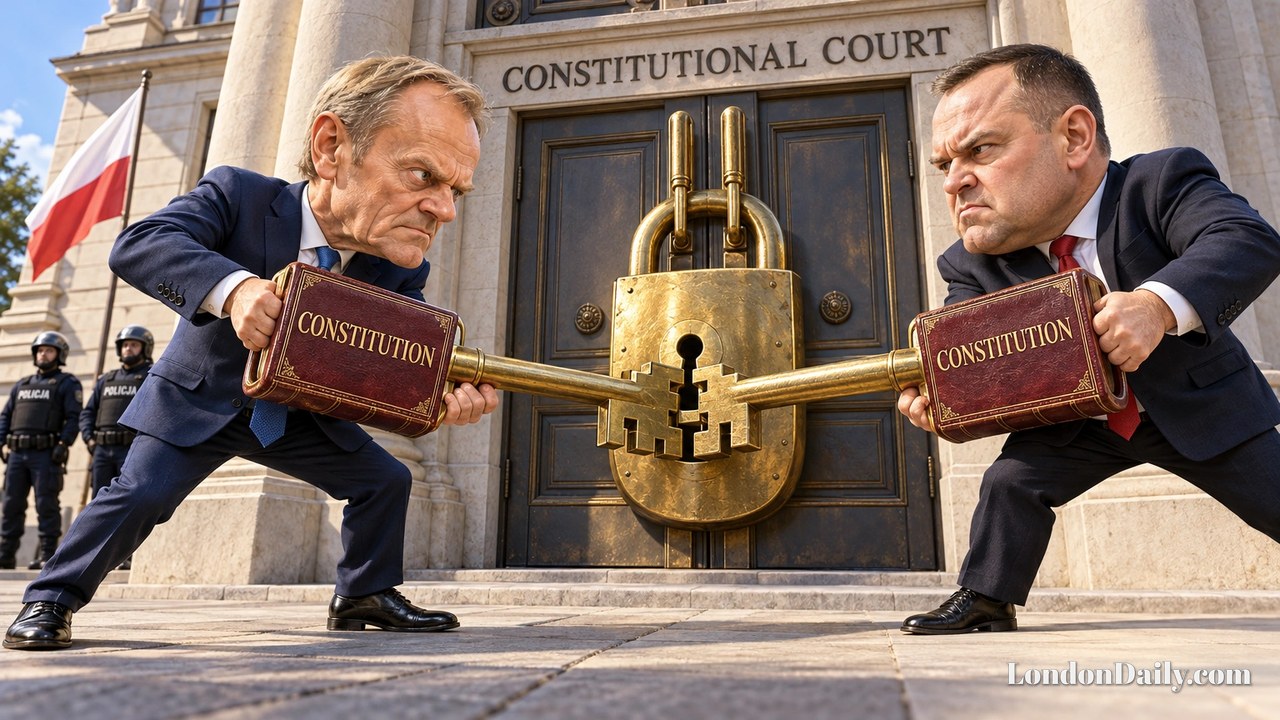
Riot police confronted protesters outside Poland’s constitutional court on Friday night after judges elected by the parliamentary majority suspended its disputed leadership, escalating a decade-long struggle over the court’s legitimacy.
President Karol Nawrocki abandoned his journey to a state visit in Senegal and returned to Warsaw. Hundreds of demonstrators, including opposition MPs, gathered in support of suspended president Bogdan Święczkowski and deputy Bartłomiej Sochański. Three people were reportedly arrested while trying to force entry.
Shortly before 1am on Saturday, Nawrocki passed through the police cordon. Video showed him tussling with security and other judges to enter; he remained inside at 4am. In a statement delivered at 5am, he alleged “a violation of Poland’s constitutional order” and demanded that security forces leave.
The dispute concerns both who may sit on the court and whether its leadership can lawfully be removed. Nawrocki refused this year to swear in five judges elected by parliament. Earlier this month, the Venice Commission, the Council of Europe’s rule-of-law advisory body, said that refusal should not prevent them taking office.
Anna Korwin-Piotrowska, one of those five, said she had assumed the presidency on the basis of her longer judicial experience. Nawrocki said the government’s appointees “were not judges of the constitutional court”.
Experts are deeply divided over the suspension’s legality. Marcin Matczak, a prominent legal expert and outspoken critic of the opposition Law and Justice party, PiS, called its legal basis “non-existent”. Separately, justice minister Waldemar Żurek sought to remove Święczkowski’s and Sochański’s immunity so they could face prosecution for allegedly obstructing the court.
Prime Minister Donald Tusk defended decisive action as necessary to restore the rule of law. Foreign minister Radosław Sikorski argued that the previously politicised tribunal needed a majority of duly elected judges to function again. PiS leader Jarosław Kaczyński denounced an “assault”; opposition leaders and the court’s social media account alleged a coup. Nigel Farage, Liz Truss and Geert Wilders also condemned the move.
The conflict began in 2015 with legally questionable appointments by successive centrist and right-wing administrations. During PiS’s eight years in power, disputes with the EU intensified over judicial independence and rulings favouring Polish legislation over EU law. Since returning in 2023, Tusk has rejected the court’s current legitimacy and sought reforms, repeatedly blocked by opposition-aligned presidents.
Nawrocki, backed by PiS, defeated Tusk’s candidate last year. Parliamentary elections are due next year, with polls giving the populist right a chance of returning to power. US ambassador Tom Rose acknowledged sharply conflicting accounts and warned against confrontation spiralling further. The rival claims to lawful authority remain unresolved.








Join the conversation