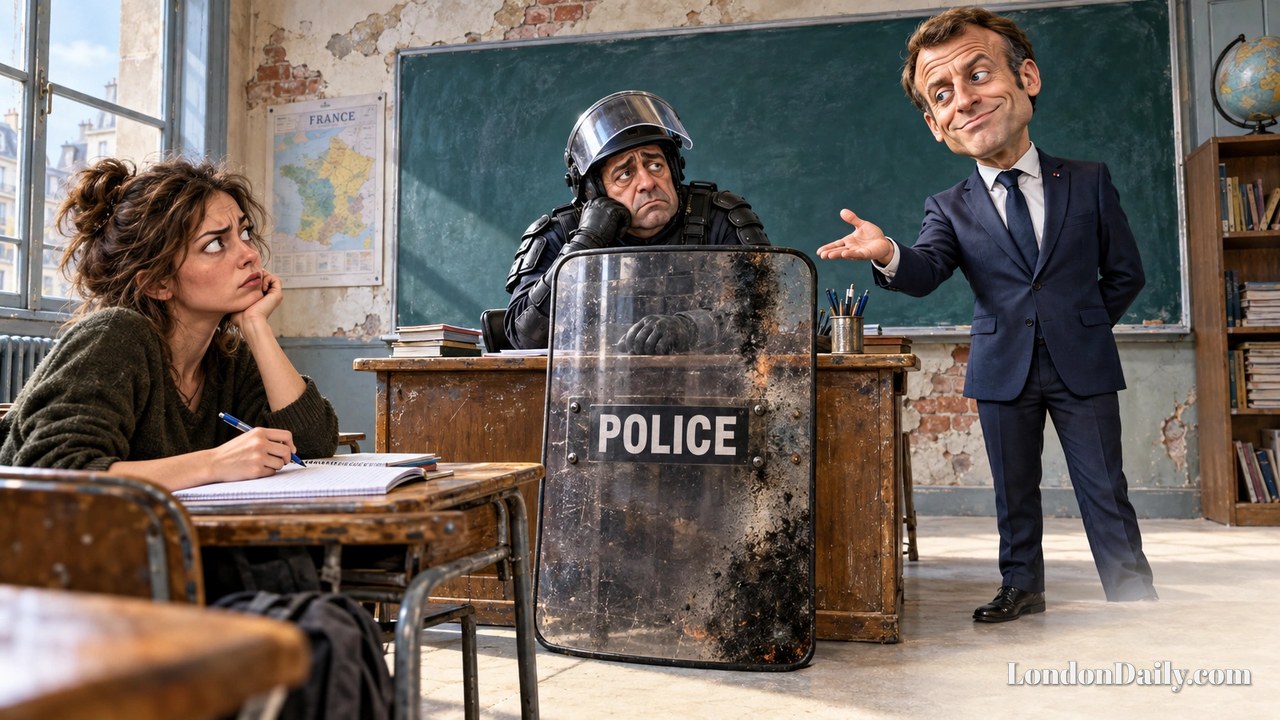
Several police officers were set alight by a petrol bomb in Paris as French demonstrations turned violent for a third consecutive weekend, amid a widening dispute over education, civil liberties and President Emmanuel Macron’s government.
At Porte de Charenton, a riot squad retreated after the attack. Masked people also used hammers to prise up paving stones and throw them at police. Officers later fired tear gas as smoke and small fires appeared across the capital.
Interior minister Laurent Nuñez described a petrol-bomb attack on an officer as “attempted murder”, saying the officer sustained minor injuries. He blamed far-Left extremist groups for attacks on security forces. Police reported more than 290 arrests nationwide on Saturday.
The interior ministry nevertheless said declared marches had proceeded smoothly, while alleging that “radical elements” in cities including Bordeaux, Toulouse and Marseille had tried to reach central areas to vandalise and loot.
Attendance figures differed sharply and covered different reporting points. The ministry recorded about 15,000 nationwide by early afternoon, with 27 arrests by 2pm. A coalition of youth organisations and student unions claimed nearly half a million participants, including 200,000 in Paris.
Authorities deployed 70,000 security personnel nationwide and diverted the Paris march towards the capital’s outskirts. Overnight curfews applied in Place de la République and Les Halles from 11pm to 6am; more than 40 metro and suburban stations closed. Shopkeepers boarded up premises.
Many marchers wore Hallowe’en costumes. Police said children in costume would not be treated as suspects; concealing one’s face with intent to disrupt public order carries a €150 (£125) fine.
The protests began last month over deteriorating school buildings, teacher shortages and a university admissions system criticised as unfair to poorer students. They have since attracted trade unions, “yellow vest” activists and other Macron opponents. Demands now include protecting civil liberties and protest rights after a security clampdown left some demonstrators seriously injured.
Jean-Luc Mélenchon, the hard-Left presidential candidate, joined the Paris march, having accused the government of “taking an increasingly authoritarian turn”. Student unions pledged school and university blockades on Tuesday and Thursday before a union-backed demonstration on 5 November.
Authorities counted about 550,000 marchers on 17 October, when looting and arson caught the government off guard, and 410,000 the following Saturday, when more than 1,300 people were arrested.
Related youth protests have spread elsewhere in Europe. With France near recession and under pressure to curb debt, additional spending is constrained. Presidential elections are less than six months away, with far-Right leader Marine Le Pen leading the polls. Macron said it was “not normal” for France to face such “turmoil” so close to an election.








Join the conversation