London Daily

Focus on the big picture.
Thursday, Oct 22, 2026

Omicron up to 70% less likely to need hospital care

Omicron up to 70% less likely to need hospital care

People catching Omicron are 50% to 70% less likely to need hospital care compared with previous variants, a major analysis says.

The UK Health Security Agency says its early findings are "encouraging" but the variant could still lead to large numbers of people in hospital.

The health secretary said it was "too early" to determine "next steps".

The study also shows the jab's ability to stop people catching Omicron starts to wane 10 weeks after a booster dose.

Protection against severe disease is likely to be far more robust.

The report comes hot on the heels of data from South Africa, Denmark, England and Scotland which all pointed to reduced severity.

The latest analysis is based on all cases of Omicron and Delta in the UK since the beginning of November, including 132 people admitted to hospital with the variant. There have also been 14 deaths in people within 28 days of catching Omicron.

The report shows people catching Omicron are:

*  31% to 45% less likely to go to A&E

*  50% to 70% less likely to be admitted to hospital for treatment

However, a milder virus could still put pressure on hospitals because it spreads so fast.

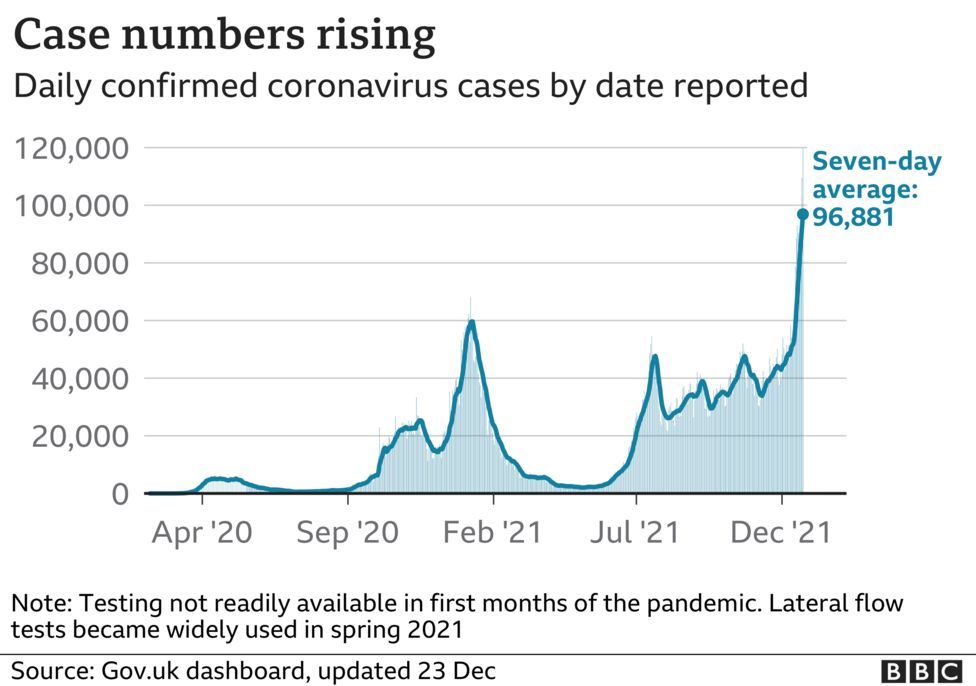
The issue remains that any benefit of a milder virus could be wiped out by large numbers of people catching Omicron. The UK has set another daily Covid record with 119,789 confirmed cases. There were a further 147 deaths within 28 days of a positive test.

There is also uncertainty about what will happen when Omicron reaches older age groups because most of those catching it and going into hospital so far have been under the age of 40.

Hospital admissions increasing


Health Secretary Sajid Javid said the early data was "promising" and government was monitoring the data "hour-by-hour".

But he warned: "Cases of the variant continue to rise at an extraordinary rate - already surpassing the record daily number in the pandemic. Hospital admissions are increasing, and we cannot risk the NHS being overwhelmed."

The government has announced it will not be introducing any new restrictions in England before Christmas but measures could still be introduced if case numbers continue to grow.

Dr Jenny Harries, the chief executive of the UKHSA, said: "Our latest analysis shows an encouraging early signal that people who contract the Omicron variant may be at a relatively lower risk of hospitalisation than those who contract other variants.

"Cases are currently very high in the UK, and even a relatively low proportion requiring hospitalisation could result in a significant number of people becoming seriously ill."

Omicron is thought to be milder due to a combination of our immunity and changes to the virus itself.

The variant is mostly infecting people who have been infected with other variants before or who have been vaccinated. Both give the immune system a head start.

However, laboratory studies have also shown changes in how Omicron infects our bodies. It is better at infecting our airways rather than the deep tissues of the lungs - this could make it easier for the variant to spread, but milder as it is further away from the delicate parts of the lungs.

Prof Ravi Gupta, who performed those studies at the University of Cambridge, told the BBC: "The clinical data on reduced severity fit with lab data suggesting Omicron has shifted its preference.

"Vaccination remains vital to protect against severe disease and also to protect against future variants."

There are also signs that the effect of booster doses is waning.

Two doses of a vaccine were shown to offer limited protection against catching Omicron, which was then restored with a booster dose.

However, the report says this protection drops by between 15% and 25% after 10 weeks. This is still better than having no booster dose and the protection against severe disease or death is likely to be even greater.

There are no suggestions that a fourth dose will be rolled out in the UK anytime soon and there will be discussions over whether to wait for an update vaccine.

In other developments:

*  Official data shows a rising number of NHS staff in England are off work because of Covid

*  A study suggests that half of people with cold-like symptoms actually have Covid

*  Northern Ireland agrees a grant scheme to support hospitality operators affected by the latest restrictions

*  The Welsh government announces that people who have tested positive for coronavirus will not be able to leave isolation as early as those in England


Watch the UKHSA's Dr Susan Hopkins speak about early analysis of Omicron and why it's a cause for "cautious optimism"


Newsletter

Related Articles

0:00
0:00
Close
Department for Science, Innovation and Technology Commits Fifty Million Pounds to Establish Regional Artificial Intelligence Innovation Clusters
Ofgem Directs Major Energy Suppliers to Expand Vulnerable Household Support Funds Ahead of Winter Heating Season
Home Office and National Police Chiefs Council Unveil New Intelligence-Led Strategy to Tackle Organised Immigration Crime Networks
First Minister John Swinney Secures Scottish Parliament Approval for Comprehensive Climate and Green Energy Infrastructure Strategy
National Health Service England and Trades Union Congress Finalize Agreement on Emergency Winter Staffing and Pay Frameworks
HM Treasury and Department for Business and Trade Announce Multi-Billion-Pound Sovereign Investment Pact to Spur Regional Advanced Manufacturing
Bank of England Governor Andrew Bailey Signals Potential for Faster Interest Rate Cuts as Domestic Inflation Pressures Ease Below Forecasts
Parliamentary Inquiry Highlights Urgent Need to Address Housing Shortage as Scottish Completions Hit Eleven-Year Low
United Kingdom and Singapore Sign Comprehensive Financial Agreement to Deepen Digital and Sustainable Market Ties
Greggs Announces Plan to Close Four Manufacturing Facilities and Cut Seven Hundred and Forty Jobs
International Monetary Fund Raises United Kingdom Economic Growth Forecast While Warning of Inflationary Pressures
Energy Security and Net Zero Committee Urges Government to Shift Policy Costs Onto Gas to Lower Household Bills
Housebuilding Across Scotland Plummets to Eleven-Year Low Despite Government Pledges to Tackle National Housing Emergency
Greggs Announces Factory Closures Across Northern England and Scotland Affecting Seven Hundred Forty Jobs
United Kingdom and Singapore Conclude Eleventh Financial Dialogue in Singapore to Deepen Cooperation on Digital Finance and Capital Markets
Energy Security and Net Zero Committee Urges Government to Shift Policy Costs to Gas Bills and Tap Windfall Profits to Lower Consumer Prices
British Broadcasting Corporation Announces Major Cost-Cutting Overhaul to Close Linear Broadcast Services for Television Channels BBC Three and BBC Scotland Alongside Digital Radio Station BBC Radio Four Extra
London Capital Markets Face Renewed Scrutiny After High-Profile Offerings Underperform Post-Listing
Green Party Wins Historic First Westminster Parliamentary By-Election in Gorton and Denton
Environment Secretary Emma Reynolds Unveils Sweeping Regulatory Overhaul for English Water Industry
United Kingdom Health Security Agency Confirms Thirty-Four Cases in Kent Meningitis Outbreak
Ministry of Defence Prepares Heat Pump Subsidy Cuts to Fund Urgent Military Modernization
British and European Union Officials Schedule Long-Awaited Bilateral Leaders Summit for November Twentieth
Bank of England Governor Andrew Bailey Urges Strict Fiscal Credibility to Protect British Bond Markets
United Kingdom Inflation Rises to Three Point One Percent Driven by Escalating Fuel Costs
Profit Warnings Among London-Listed Companies Reach Two-Year High Amid Global Energy Shocks
Chancellor John Healey Signals Targeted Tax Changes on Banks and London Corporate Offices Ahead of Budget
British Government Reallocates Twenty-Five Per Cent of International Climate Finance to Global Biodiversity Projects
Initial British Carbon Border Taxes Set to Undercut Parallel European Union Tariffs on Industrial Imports
Whitehall Prepares National Zero-Interest Loan Initiative to Accelerate Domestic Heat Pump and Solar Adoption
European Union Offers British Automakers Access to Hybrid Vehicle Trade Protections Subject to Strict Regulatory Alignment
British Probation Officers Threaten Widespread Industrial Action After Rejecting Five Per Cent Government Pay Offer
Microsoft Abandons Major British Artificial Intelligence Data Centre Citing Severe National Grid Power Constraints
United Kingdom Inflation Accelerates to Three Point Four Per Cent Ahead of Chancellor John Healey's Inaugural Autumn Budget
Surging Cloned Number Plates Severely Complicate Traffic Enforcement and Police Investigations
Mounting Opposition Challenges Planned Rollout of Autonomous Taxis Across London
Influential Think Tank Urges Rejoining European Union to Navigate Geopolitical Crises
Government Review Recommends Slashing Benefits to Fund Youth Employment Initiatives
Senior Minister Shabana Mahmood Seeks New Law Enforcement Pact With European Union
Airbus Executive Warns Britain Risks Losing Crucial Role in European Space Industry
Exorbitant Electricity Costs Push British Steelmakers to Worst Competitive Position in Three Years
British Food and Beverage Exports to European Union Collapse by Over a Third Since Brexit
Up to Twenty English Maternity Units Face Impending Closure Due to Safety and Staffing Crises
Government Declares Severe Drought Across Southern England Following Record Dry Spell
Corporate Profit Warnings Reach Two-Year High Amid Middle East Conflict and Rising Costs
International Monetary Fund Warns Chancellor John Healey Against Proposed Bank Tax Raid
Northern Ireland Secures Favorable Agricultural Export Agreement with European Union
Scottish Government Approves Major Offshore Floating Wind Farm Near Aberdeenshire
High Speed Two Rail Project Faces Three Billion Pound Cost Escalation on Initial Phase
National Health Service Warns of Winter Capacity Crisis Across English Hospitals
×