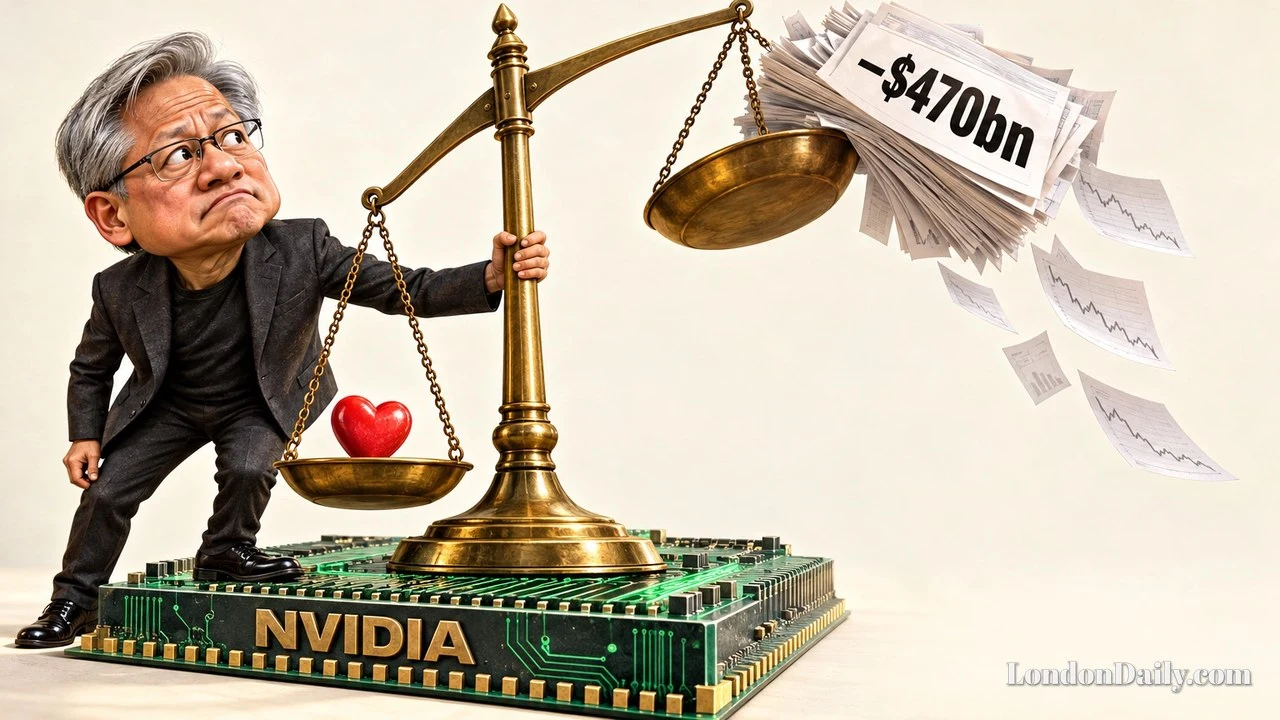
Nvidia has lost more than $470 billion in market value in two trading days after chief executive Jensen Huang acknowledged an affair with a businesswoman whom US intelligence officials suspect of spying for China.
Shares fell 5.53% on Tuesday after losing more than 4% on Monday. Nvidia briefly slipped below $4 trillion for the first time since July 2025, before closing above that threshold. Microsoft briefly overtook it as the world’s second-most valuable company, its first such lead since June 2025. Nvidia had already lost almost 8% the previous week amid mounting reports and wider technology-sector falls.
Huang confirmed the affair on Sunday, telling employees he had betrayed his wife and failed in his responsibilities as chief executive. Alice Huang, who is unrelated to him, is an executive at Megaspeed, a Singapore-based data-centre company and Nvidia customer.
An investigation published on 29 October alleged that US officials had identified her as a Chinese intelligence asset who passed information to Beijing and might have diverted advanced Nvidia artificial-intelligence chips. A subsequent report on Tuesday, citing two people who know her, alleged that the relationship helped channel at least $7.5 billion in Nvidia chips to Chinese companies.
Nvidia’s board has commissioned an independent investigation with external lawyers, but says there is no evidence of a security breach or leaked company secrets. China’s foreign ministry rejected the espionage allegations as smears. Donald Trump said on Monday that the FBI was investigating, while expressing confidence Huang would be fine. Republican congressmen have requested a closed hearing later this month.
The investment question is whether uncertainty damages confidence alone or brings restrictions affecting the wider AI industry. Bank of America cautions against equating allegations with proven business harm. Clear Street warns that governance concerns could compound doubts about infrastructure spending and returns.
Baird’s Tristan Gerra expects Washington to revoke Nvidia’s H200 export licence for China and close south-east Asian shipping loopholes. Raymond James expects stronger congressional support for the MATCH bill restricting chip and manufacturing-equipment sales to China.
Yet Bernstein, Mizuho and Baird retain outperform ratings, with respective price targets of $400, $250 and $500. Mizuho cut its target from $315 while raising earnings forecasts.
Dan Ives puts Huang’s departure risk at 15%, with an 85% chance he stays after a board inquiry lasting perhaps four to six weeks. He warns dismissal could trigger another 25–30% share-price fall.
Results on 17 November will test business resilience: analysts expect roughly $109 billion in revenue. Mizuho anticipates strength from B300 and VR200 launches; RBC expects third-quarter revenue 3–4% above forecasts. Melius argues scarce computing capacity sustains near-term demand, while cautioning that longer-term gains for rivals AMD and Broadcom, whose shares rose this week, remain uncertain.








Join the conversation