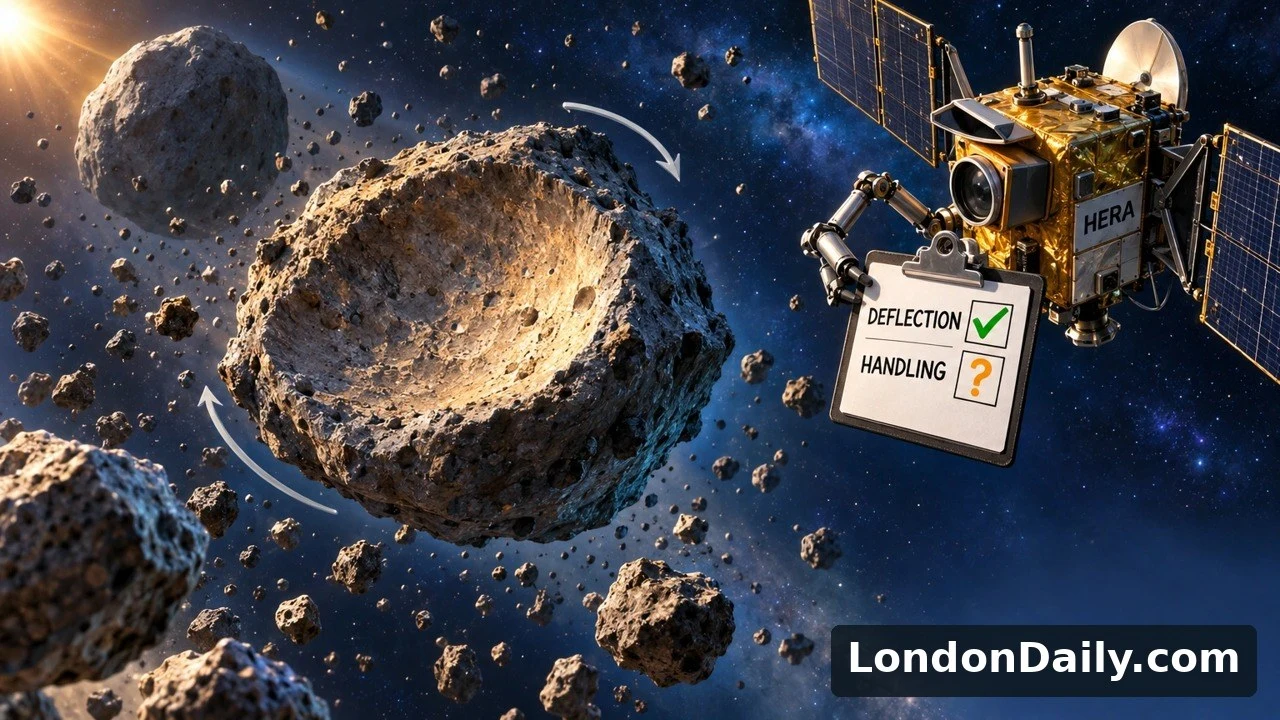
New close-up images suggest Nasa’s collision with Dimorphos flattened one face into a stadium-sized crater and left the asteroid tumbling chaotically, revealing how dramatically a successful deflection can alter its target.
The European Space Agency’s Hera spacecraft has also detected hundreds of previously unknown boulders, each a few metres across, orbiting Dimorphos and its larger companion, Didymos. Neither asteroid posed a threat to Earth.
Four years after the impact, the findings begin to answer a question that Earth-based observations could not resolve: what happened to the asteroid itself when its orbit changed?
On 26 September 2022, Nasa’s roughly half-tonne Dart spacecraft struck the approximately 160-metre-wide Dimorphos at more than 13,000mph, ejecting a vast cloud of rocky debris. The Double Asteroid Redirection Test shortened its orbit around Didymos by about 33 minutes. Nasa had set a success threshold of just 73 seconds.
Hera launched on 7 October 2024 and reached the pair this month after a two-year journey. The car-sized spacecraft has been surveying them from 15–18 miles (25–30km) away.
Dr Patrick Michel, Hera’s principal investigator at France’s CNRS Côte d’Azur observatory, said scientists had debated whether Dimorphos would develop a crater, change shape or remain much the same. The images suggest elements of all three: a crater spans its entire width on the struck face, while the remainder appears relatively unchanged. Mission scientist Dr Michael Kueppers said the impact had also left it tumbling wildly.
The practical significance lies in understanding why the deflection worked as it did. Dr Ian Whittaker, a physics lecturer at Nottingham Trent University, explained that the outcome depends not simply on the spacecraft’s momentum but on the asteroid’s response, including how much material escapes into space.
Dr Michaël Marsset, of the European Southern Observatory, said the known mass, velocity and trajectory of the spacecraft, combined with before-and-after images, offer an unusual opportunity to study asteroid-scale impacts. The collision may also have exposed pristine material beneath the weathered surface.
Hera will move closer over the coming months and release two shoebox-sized satellites, one carrying radar to examine Dimorphos’s interior. Asteroids range from relatively solid bodies to loose rubble held together by weak gravity; a method tested on one cannot simply be assumed to work identically on another.
Warning time remains equally important. Marsset said years or decades could allow a tiny velocity change to avert a collision, whereas months would sharply restrict the options. The Vera C Rubin Observatory in Chile and Nasa’s forthcoming Near-Earth Object Surveyor are expected to improve detection, giving any future deflection mission more time to work.








Join the conversation