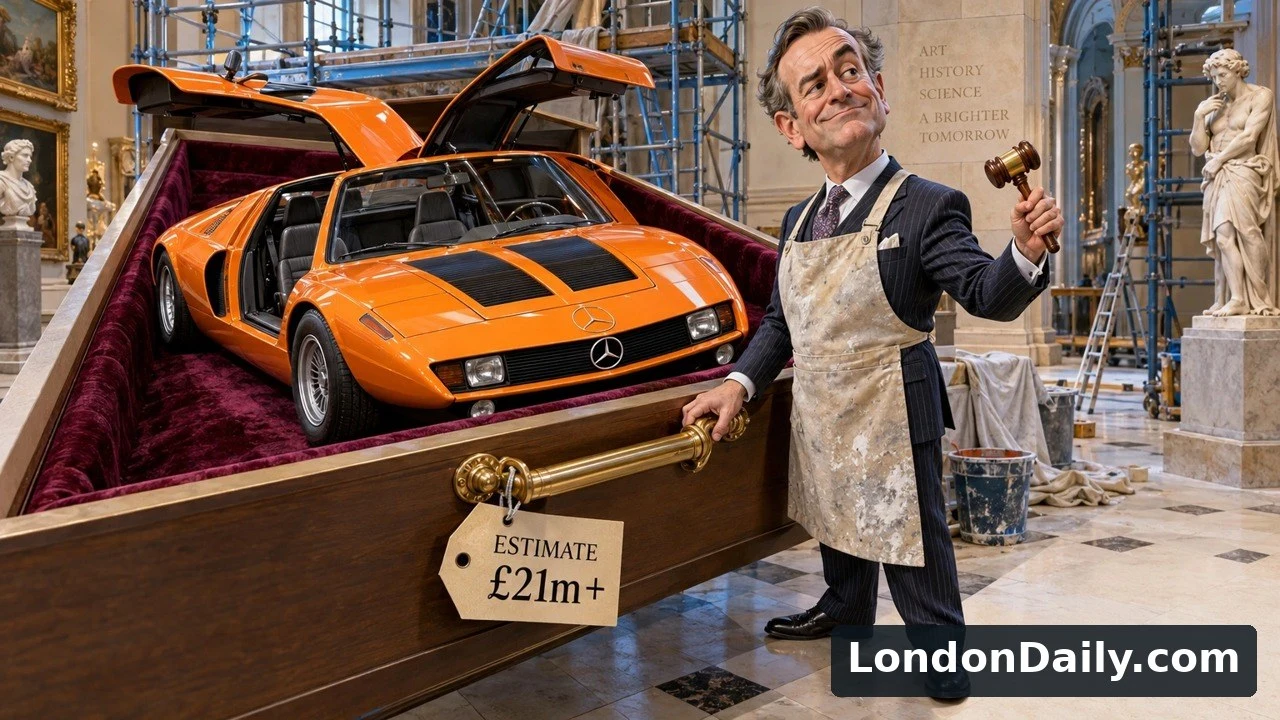
Mercedes-Benz is to sell one of its C111 experimental supercars for the first time, almost six decades after the model’s debut prompted prospective buyers reportedly to send blank cheques. Sotheby’s values the car at more than £21m ahead of its auction at the Palais du Louvre in Paris next February.
Only 17 C111 prototypes were built; the 13 survivors all remain in Mercedes’ collection. The orange example being offered was the third constructed, has covered just over 15,000 miles and was a fixture of the Mercedes-Benz Museum until 2024. Its sale will finance an overhaul of the museum.
Mercedes has pledged not to sell another C111 for at least 25 years, making this a tightly limited departure from its long-standing policy of retaining the cars.
The 186mph model made its debut at the 1969 Frankfurt Motor Show. Its aerodynamic shape, composite construction and rotary power attracted attention, with coverage in magazines including Playboy helping to build its reputation. In 1986, it became the subject of an Andy Warhol silkscreen commissioned by Mercedes-Benz.
Yet the C111’s purpose extended beyond attracting buyers. The prototypes served as test beds for technologies including anti-lock brakes and air-conditioning systems. Mercedes-Benz Heritage chief executive Marcus Breitschwerdt said: “The C111 had a different mission: to push technological boundaries, challenge conventions, and generate knowledge.”
Road-going production was considered, rather than begun and subsequently stopped. High fuel consumption against the backdrop of the early 1970s oil crisis, and the substantial changes needed to meet US regulations, were among the reasons it did not proceed. Enthusiasm from collectors could not resolve those practical obstacles.
The two-seater combined gullwing doors and a mid-rear-mounted Wankel rotary engine with details intended for everyday use: a fully trimmed interior, a then-innovative cassette radio and luggage space for three large suitcases.
The auction also includes a 1938 Mercedes-Benz 540 K Cabriolet A, valued at about £1.7m. One of fewer than 500 540 Ks built, it was among the fastest road cars of the pre-war 1930s. A black 2025 Bugatti Bolide carries a valuation of up to £3.6m.
For the C111’s eventual buyer, one qualification is explicit. The accompanying light-alloy race wheels, used for high-speed testing, are unsuitable for driving because of their age and condition. They are “strictly for static display”: part of the car’s engineering history, not equipment to put back to work.








Join the conversation