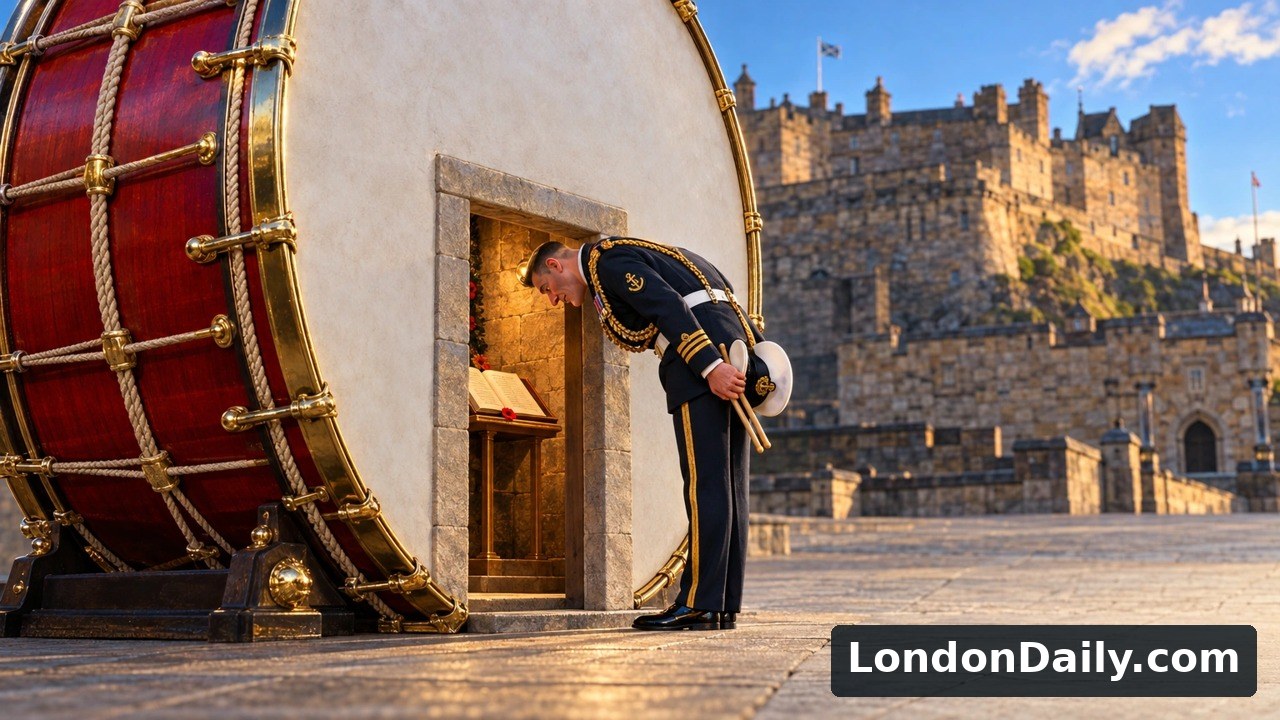
The 2027 Royal Edinburgh Military Tattoo will commemorate the Scottish National War Memorial’s centenary with a production telling the story of the building and those it remembers, performed a short distance away on Edinburgh Castle Esplanade.
The Same Heart Beat will run from 6–28 August, with the Royal Navy as lead service. Performers and projections will bring the memorial’s history into three specially created scenes. Drumming will be central to a show bringing together international military acts and Scottish traditional arts performers, with music presented as a universal bond.
Opened by Edward, Prince of Wales, on 14 July 1927, the memorial gave physical form to Scotland’s grief and gratitude following the First World War. It now commemorates nearly 135,000 Scottish casualties of that conflict, more than 50,000 of the Second World War, and those lost in campaigns since 1945, including the Malayan Emergency, Korean War, Northern Ireland, Falklands War and Gulf War.
The production extends an existing relationship: the memorial has been a Tattoo charity beneficiary since 2017. Jason Barrett, the Tattoo’s chief executive, described telling its story as both a privilege and a responsibility, citing the event’s own military heritage and values.
Creative director Alan Lane said the care devoted to the memorial’s construction and upkeep provided a standard for his team’s work. Its artistic detail, as well as its commemorative purpose, will inform the tribute.
A separate exhibition at the National War Museum, also within Edinburgh Castle, will examine how the memorial came into being. Opening on 5 December, The Art of Commemoration will draw on original architectural drawings, artworks, objects and archival material. It will also consider the memorial’s impact on Scottish identity and its continuing influence on visitors.
Dr Calum Robertson, senior curator of modern and military history at National Museums Scotland, said the exhibition and Tattoo would offer complementary ways to understand the memorial’s origins and continuing relevance.
For Susan Flintoff, the memorial’s chief executive and keeper of the rolls, the show offers an introduction for people who may never have visited. She said: “The memorial was built so that no one would be forgotten, and a hundred years on, that purpose hasn’t changed.” She hopes audiences will go on to see the memorial for themselves.








Join the conversation