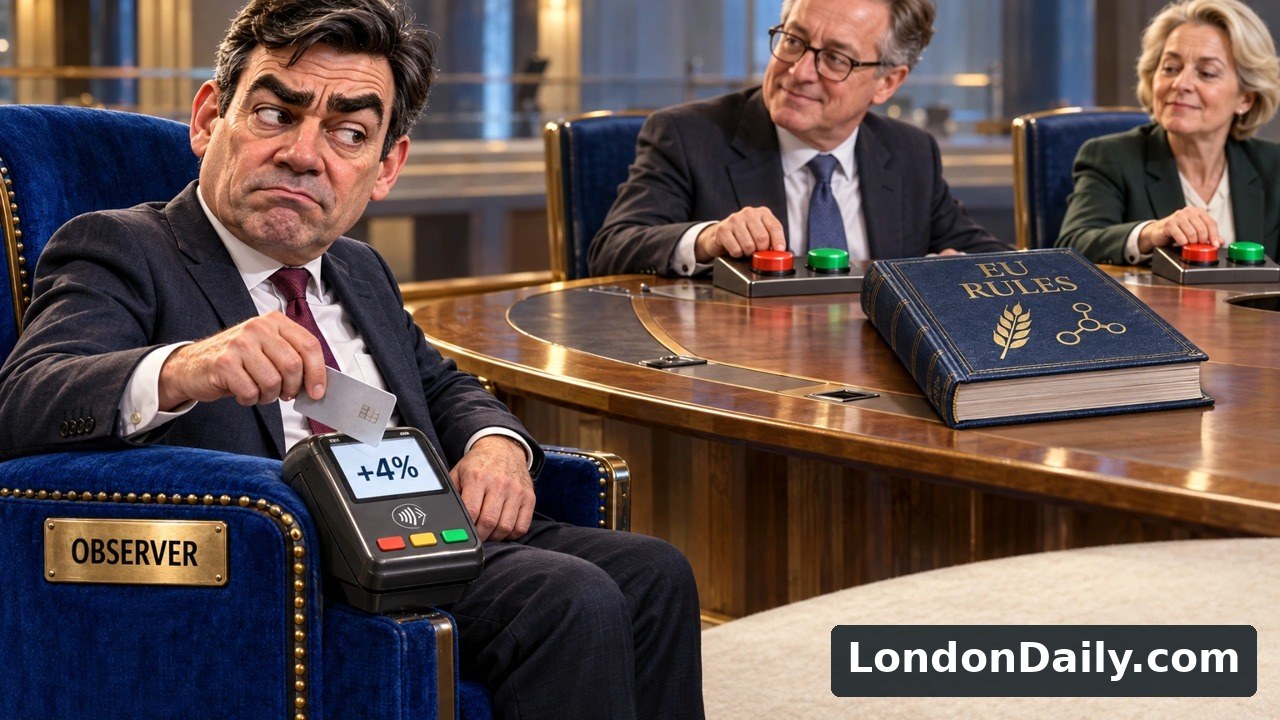
The UK has agreed to pay the EU a 4% participation surcharge on top of its main contribution towards running new food standards and carbon trading agreements, treaty documents show.
The two deals, agreed by Andy Burnham and unveiled last week, are intended to cut red tape for British companies and take effect during 2028. Ministers had already accepted the principle of administrative payments; the treaties now reveal their calculation.
Payments, made in euros, will support three EU agencies and various systems. The main “operational contribution” will reflect the size of Britain’s economy relative to the EU’s, broadly following the formula used to divide member states’ principal contributions to the bloc’s budget. The additional “participation fee” will be 4% of that figure.
No overall estimate of additional costs has been published. Officials expect annual costs in the low tens of millions, saying these would be “massively outweighed” by predicted economic gains. The government forecasts an eventual boost worth billions a year from increased trade, rather than gains already secured.
Ministers point to the Conservatives’ 2021 Brexit trade agreement, which also imposed surcharges on British contributions to relevant EU programmes. They declined to specify fees during negotiations. On Sunday, Foreign Secretary Ed Miliband said the latest agreements were “not about cost to the taxpayer”.
Legal text for a separate youth visa agreement covering 18 to 31-year-olds, also agreed last week, is expected in the coming days. The published fee arrangements concern the food and emissions treaties.
Alongside the financial commitments, the government has published legislation seeking broad powers to incorporate EU laws without a full parliamentary vote for every update. The food agreement would align Britain with scores of EU food-related laws updated since Brexit, as well as future rules.
Ministers argue that taking every change through a full parliamentary process would be impractical. British experts could be consulted as EU laws are drafted, and the UK would have observer status at certain meetings. Neither amounts to the voting rights Britain no longer holds.
Conservative leader Kemi Badenoch accused Burnham of “disdain for the democratic process”, seeking a “blank cheque to install and enact EU law” and asking MPs for extraordinary powers before knowing what the EU would agree.
Reform UK leader Nigel Farage argued that the deals would return Britain to “much of the European Union's single market”. He disputed the growth case, saying European economies were growing more slowly than Britain’s and calling the promised benefit a “myth”.
The payments formula is now clearer. The overall bill remains unpublished, while the proposed powers would determine how future EU rule changes enter British law.








Join the conversation