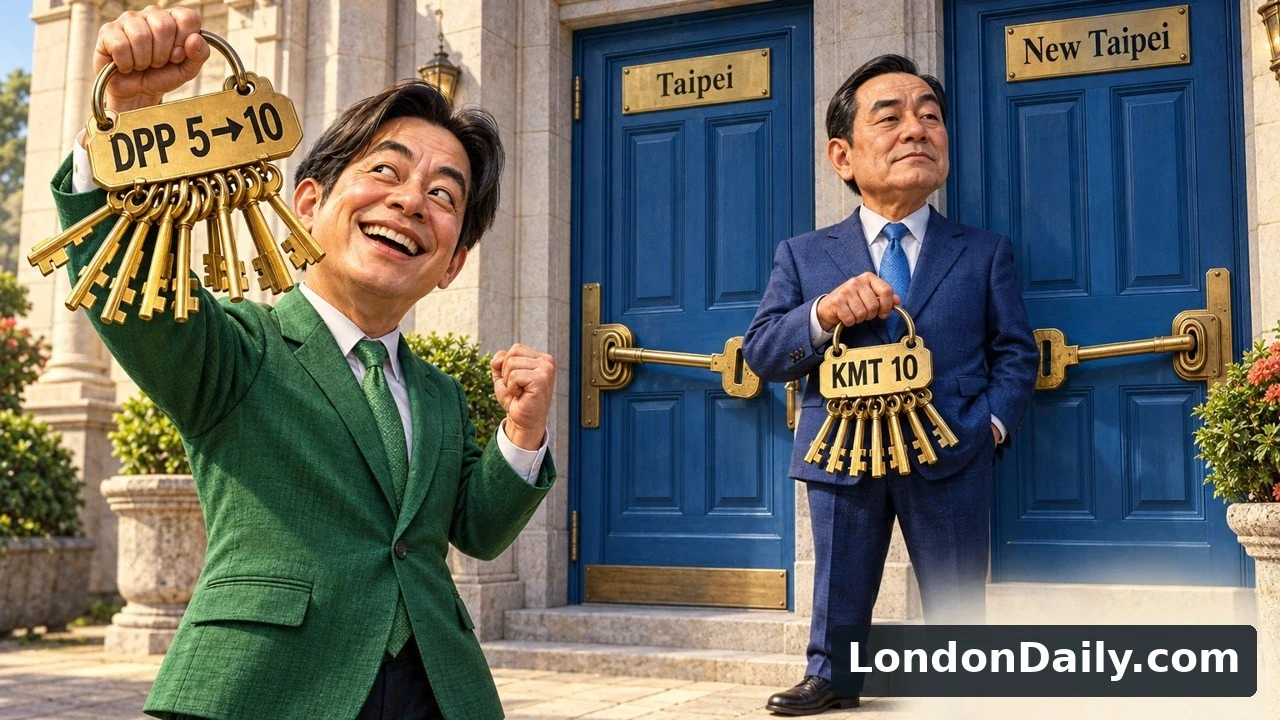
Taiwan’s ruling Democratic Progressive Party doubled its local election wins on Saturday, securing its best result in a decade, although the opposition retained the capital and neighbouring New Taipei.
The DPP won 10 of the island’s 22 mayoral and county magistrate contests, up from five four years ago. The Kuomintang (KMT) also won 10, down from 14. The result substantially expands the ruling party’s local reach without dislodging its principal rival from two important cities.
Housing costs and wealth distribution dominated the campaign rather than relations with China, limiting how readily the outcome can be read as a verdict on Beijing. Nevertheless, the KMT’s preference for closer ties gives its urban strongholds significance beyond local government: the annual Taipei-Shanghai forum remains one of the few major exchanges between the two sides.
“China will be breathing a sigh of relief” over the KMT’s success in Taipei and New Taipei, said William Yang, a senior analyst at the International Crisis Group.
Beijing claims self-governing Taiwan as Chinese territory, a position rejected by most Taiwanese people. The Chinese Communist party regards President Lai Ching-te, who leads the DPP, as a “separatist” opposed to its unification plans. China’s Taiwan Affairs Office had not commented on the results. Lai thanked voters for their support and trust in DPP candidates in a Facebook post, without mentioning China.
In Taipei, DPP legislator Puma Shen conceded to incumbent Chiang Wan-an shortly before 8pm. Thousands had gathered outside Shen’s campaign office; early optimism gave way to disappointment as Chiang’s lead grew. Shen, visibly emotional, received a prolonged standing ovation and promised to keep working. “No matter who wins today, it is a victory for Taipei and a victory for democracy,” he said.
A criminologist turned politician sanctioned by China, Shen co-founded Kuma Academy, which provides civil defence courses preparing Taiwanese people for a possible invasion. Supporter Yan Jing-na, 50, credited him with increasing awareness of Chinese influence and said Taiwan’s interests mattered more to her than party allegiance.
Officials had warned of thousands of suspected misinformation or election-interference incidents. There were also reports of hundreds of China-linked AI-generated videos spreading disinformation about politicians Beijing dislikes. Taiwan’s defence ministry said 33 Chinese warplanes and eight warships encircled the island on Friday. Those reports do not establish how interference affected the vote.
For Shen supporter Zhan Ying-yi, 51, accepting defeat was part of protecting democracy. “After all, we still have the freedom to vote and that is something we should cherish,” he said, while expressing fear that Chinese rule would take that freedom away.








Join the conversation