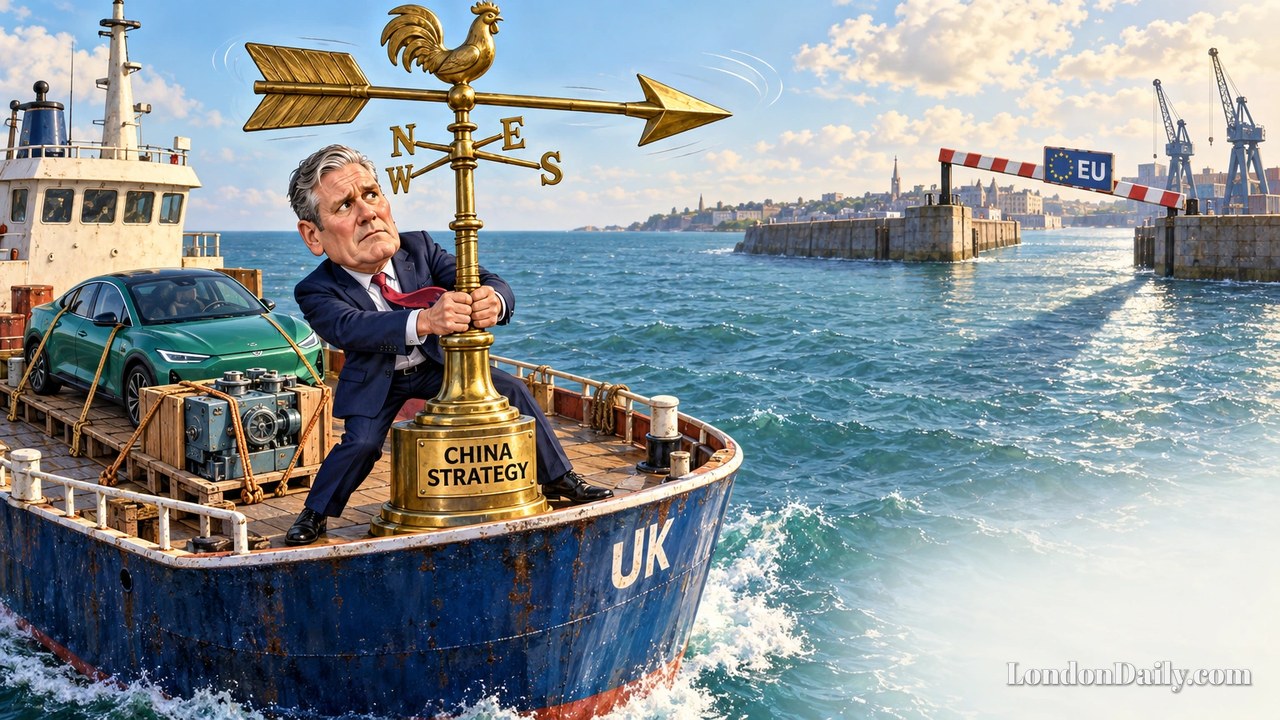
MPs have warned that Britain’s lack of a coherent China strategy is denying businesses commercial opportunities while leaving national security risks unmanaged, with decisions in Washington or Beijing threatening to determine the UK’s course.
The Commons business, innovation, science and trade select committee said Labour had not delivered the strategic, long-term and consistent approach promised in 2024. Its report argues that uncertainty also risks excluding British manufacturers from European Union contracts as Europe strengthens trade protections.
The committee acknowledged substantial benefits from engagement: British businesses operate profitably in China, want to expand and can learn from its leading innovations. Cheap imports, including electric vehicles, also help households facing squeezed incomes. Against those gains stand concerns about cyber espionage, national security and an export boom fuelling fears of deindustrialisation.
Keir Starmer’s official visit in January was the first by a British prime minister since Theresa May’s in 2018, following years of limited engagement. Yet committee chair Liam Byrne said businesses still lacked the consistency needed to plan, with opportunities missed and decisions delayed.
MPs cited March’s decision to block Chinese company Ming Yang’s proposed £1.5bn Scottish wind energy plant after years of negotiations, on unspecified security grounds. Scotland’s first minister, John Swinney, has urged Andy Burnham to reconsider Starmer’s decision. The committee characterised that intervention and the emergency takeover of British Steel from its Chinese owners as reactive, inconsistent and opaque.
It wants investment rules distinguishing industries closed to Chinese investment from those where trade should be encouraged. Alongside a strategy, officials should prepare remedies against unfair competition, potentially including electric vehicle tariffs, which Downing Street has not ruled out.
Byrne argued that Britain should consider dynamically aligning with EU measures, including those tariffs, to secure access for British firms to the EU’s Made in Europe project and guard against Chinese dominance. Without alignment, he warned, new European protections could shut Britain out of its largest market.
Business secretary Jonathan Reynolds has said any electric vehicle tariff decision will reflect the UK’s best interests. That leaves unresolved how ministers would balance access to cheaper imports against industrial protection and European market access.
The EU has imposed tariffs on Chinese electric vehicles, capped Chinese hybrid car imports and is considering a Franco-German mechanism to block imports if China weaponises trade. China curbed rare-earth mineral and chip exports last year.
China is on course to exceed last year’s record $1.19tn trade surplus. Its 2026–2030 five-year plan prioritises expansion in high-value green exports, including electric vehicles, batteries, wind turbines, hydrogen and solar panels, intensifying the strategic choices facing Britain.








Join the conversation