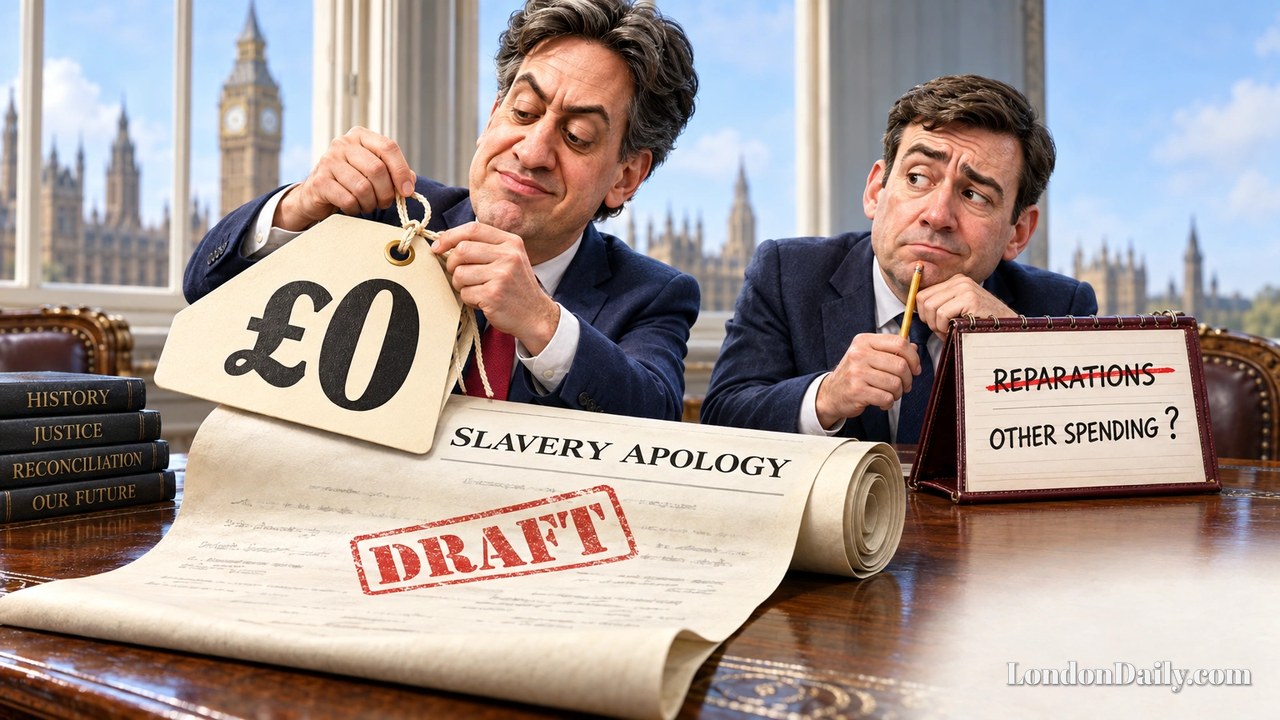
Foreign Secretary Ed Miliband has said a formal apology for Britain’s role in the transatlantic slave trade would not mean higher costs for taxpayers, as ministers begin talks with affected countries.
His assurance goes further than the position set out by Prime Minister Andy Burnham, who has ruled out reparations but declined to say whether the new approach could involve additional public money. That distinction matters: excluding reparations does not, by itself, settle whether other spending might follow.
Burnham has said the government is open to formally apologising. Ministers are beginning what they call a “structured dialogue”, with an apology expected potentially around the G20 summit he is due to host in Manchester in November 2027. Neither the apology nor its timing is settled.
Miliband presented the talks as an attempt to address an unresolved Commonwealth dispute, rather than allow it to continue overshadowing relations. He said the issue had persisted for roughly 20 years and grown in prominence.
He described the 2024 Commonwealth Heads of Government Meeting in Samoa, two years ago, as ending in a verbal confrontation over slavery. He said he was briefed on the difficult legacy of that meeting on his second day as foreign secretary.
Miliband also criticised earlier British governments for what he called a “sweep it under the carpet” approach. In 2007, Sir Tony Blair described Britain’s involvement in the slave trade as a matter of “deep sorrow and regret”. Miliband characterised Blair’s handling as “sorry not sorry”, saying an apology had subsequently been walked back by Downing Street.
That episode still featured in diplomatic discussions, he said, including a recent conversation between Burnham and Barbados’s prime minister, Mia Mottley.
Defending an apology as compatible with national pride, Miliband argued that confronting the past demonstrated strength rather than weakness. After requesting a historical digest, he cited more than three million people transported over a couple of centuries with British state complicity, hundreds of thousands dying during the crossings, and appalling conditions for survivors in the Caribbean and the Americas.
Ministers hope an apology would allow the Commonwealth to turn to other matters. The talks must still determine what that acknowledgement would involve; Miliband’s taxpayer assurance is a commitment about its consequences, not a completed agreement.








Join the conversation