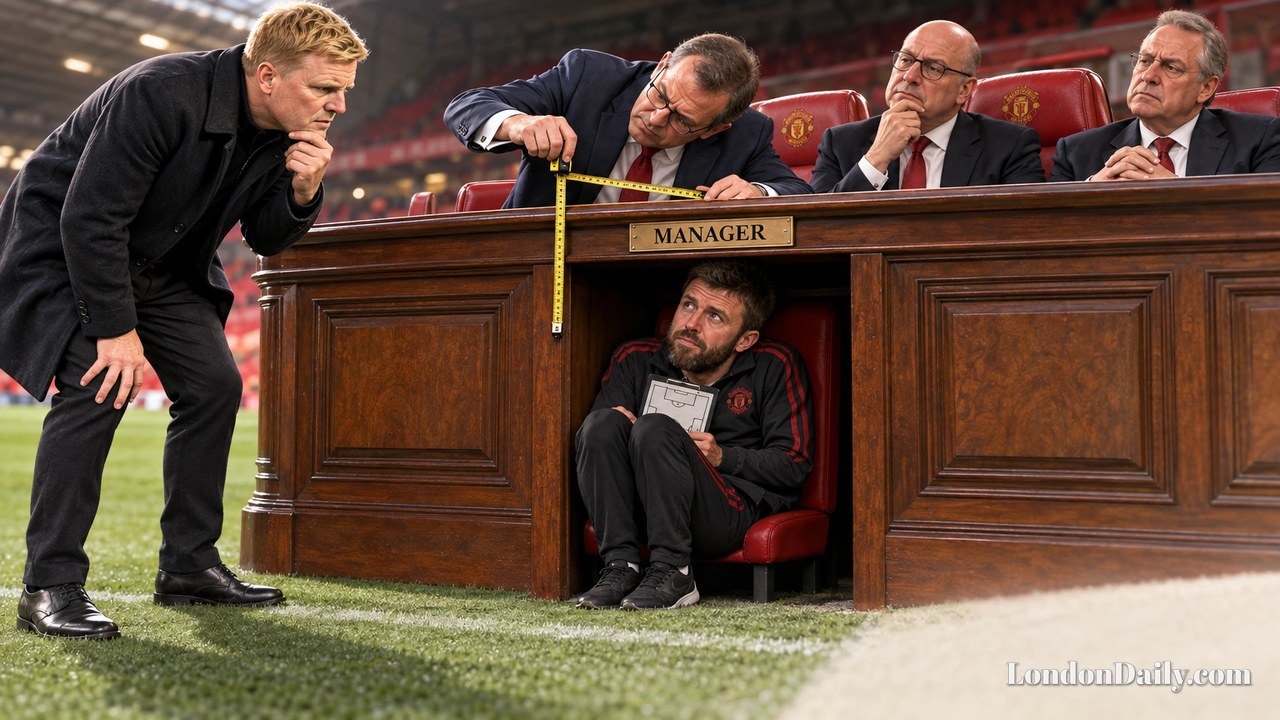
Manchester United are considering Eddie Howe as a possible successor to Michael Carrick, with compensation costs and his place within the club’s football hierarchy among the questions surrounding any appointment. Carrick remains in charge, and Saturday’s match against Chelsea is likely to influence the next decision.
Howe, 48, has been out of work since leaving Newcastle United in the summer. Sporting director Jason Wilcox is thought to favour him, while recruitment director Christopher Vivell is understood to prefer former Bayern Munich and Germany coach Julian Nagelsmann. Chief executive Omar Berrada will assess their recommendations; Sir Jim Ratcliffe and co-chairs Joel and Avram Glazer have the final say.
The financial calculation extends beyond paying off Carrick and his staff. Howe’s confidential departure agreement is understood to require a compensation payment to Newcastle, initially £6m and now reduced to £3m. That declining charge is understood to expire before the season ends, after which he could be appointed without compensation.
Howe’s case rests on sustained improvement. He took Bournemouth from relegation danger in League Two after his January 2009 appointment to the Premier League in 2015, establishing them there before his second departure in 2020. At Newcastle, which he joined in 2021, he turned relegation trouble into two Champions League qualifications and won the 2025 EFL Cup, their first trophy in 56 years.
Some supporters nevertheless argue that he lacks the stature required at Old Trafford. Paul Scholes and Nicky Butt stopped short of backing him on their podcast, despite supporting his potential appointment after Ruben Amorim’s dismissal in January. Roy Keane, Darren Bent, Gareth Barry and Jack Wilshere have supported his candidacy.
The structural question is more concrete. Howe held considerable influence over recruitment at both previous clubs. Bournemouth made substantial profits on Nathan Ake, Callum Wilson and Tyrone Mings; Newcastle sold Bruno Guimarares, Anthony Gordon, Sandro Tonali and Alexander Isak for more than their purchase prices. Dan Burn, Lewis Hall and Tino Livramento became senior England internationals under him.
United’s hierarchy would probably offer less immediate autonomy. Yet Howe has said he is comfortable working with sporting directors, having worked alongside Richard Hughes and Neill Blake at Bournemouth, and Dan Ashworth, Amanda Staveley and Mehrdad Ghodoussi at Newcastle.
Supporters’ dissatisfaction also extends beyond individual managers: Wilcox was targeted during the 3–0 home defeat by Bournemouth. Some argue that United’s structure prevents any manager succeeding, although Erik ten Hag, Amorim and Carrick have all received backing. Any successor would inherit players recruited by six permanent managers with differing approaches. Whether Howe would want that task remains unknown.








Join the conversation