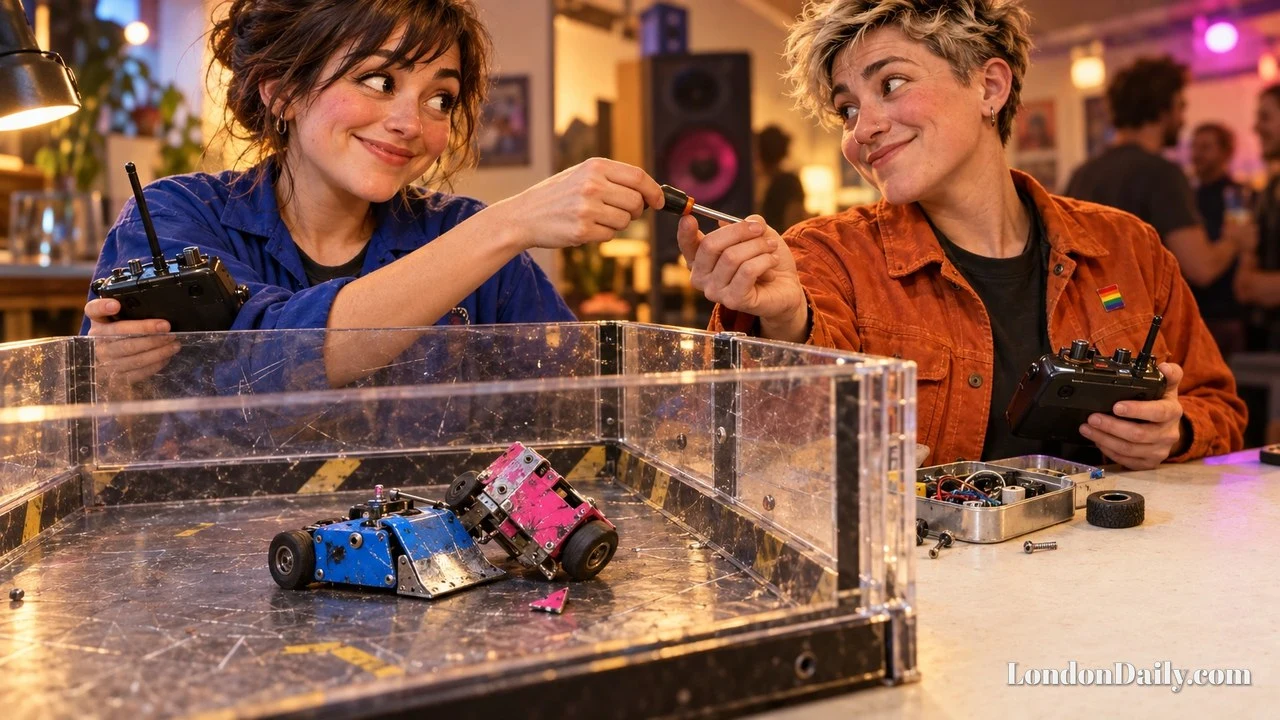
London’s small-scale robot fight nights are offering beginners a way into engineering through a seemingly unpromising activity: breaking things. Alongside the spectacle of tiny machines shoving, flipping and splintering one another, organisers are creating spaces where newcomers can build, repair and try again.
At Rock & Robots in Stoke Newington, held on the second Sunday of each month, antweight machines battle amid indie music, karaoke and a Super Nintendo with two controllers. Started by Eli Gumble, the event combines mechanical combat with the comforts of a deliberately low-budget social night. Its website makes the division of responsibilities clear: “The fighters are robots, please don’t hit each other here.”
The nostalgia is obvious. Small machines, cheering spectators and improvised-looking armour recall the appeal of Robot Wars. But the more consequential feature may be who gets to take part rather than who wins.
The Queer Robot Fighting League, launching in Hackney at a vegan venue, explicitly targets beginners. Its founder wants to challenge the assumption that engineering belongs to men. “As a femme queer myself I am no stranger to being told that I can’t do so-called manly things like engineering,” they say, “and I wanted to create a space where people can dip their toes in without that sentiment.”
That ambition gives the destruction a practical purpose. Combat creates a concrete engineering problem: build a machine that can withstand another machine. When something fails, there is something specific to investigate and repair. The league presents that cycle as an approachable introduction to electronics, rather than an activity requiring expertise before anyone is allowed through the door.
In Wood Green, vegan venue Karamel has also hosted beetleweight bouts, describing Live Robot Fighting as an “experimental event to prove that, yes, we can put on robot fights in the city”. Together, these events place robotics in social settings rather than behind the doors of a specialist laboratory.
The boundaries matter. In San Francisco, Robot Entertainment Kombat staged what it billed as the world’s first human-robot fight, involving influencer Frankie LaPenna and a six-foot humanoid machine. The robot was remotely operated through a virtual-reality system, not acting autonomously. The California State Athletic Commission reportedly issued a cease-and-desist warning against unsanctioned combat events involving humans.
London’s miniature contests offer a different proposition: machines take the blows, while people do the building. Their appeal need not depend on grand claims about artificial intelligence or the future of work. A broken robot can provide a modest, useful starting point: a fault to understand, a repair to attempt and a reason to come back next month.








Join the conversation