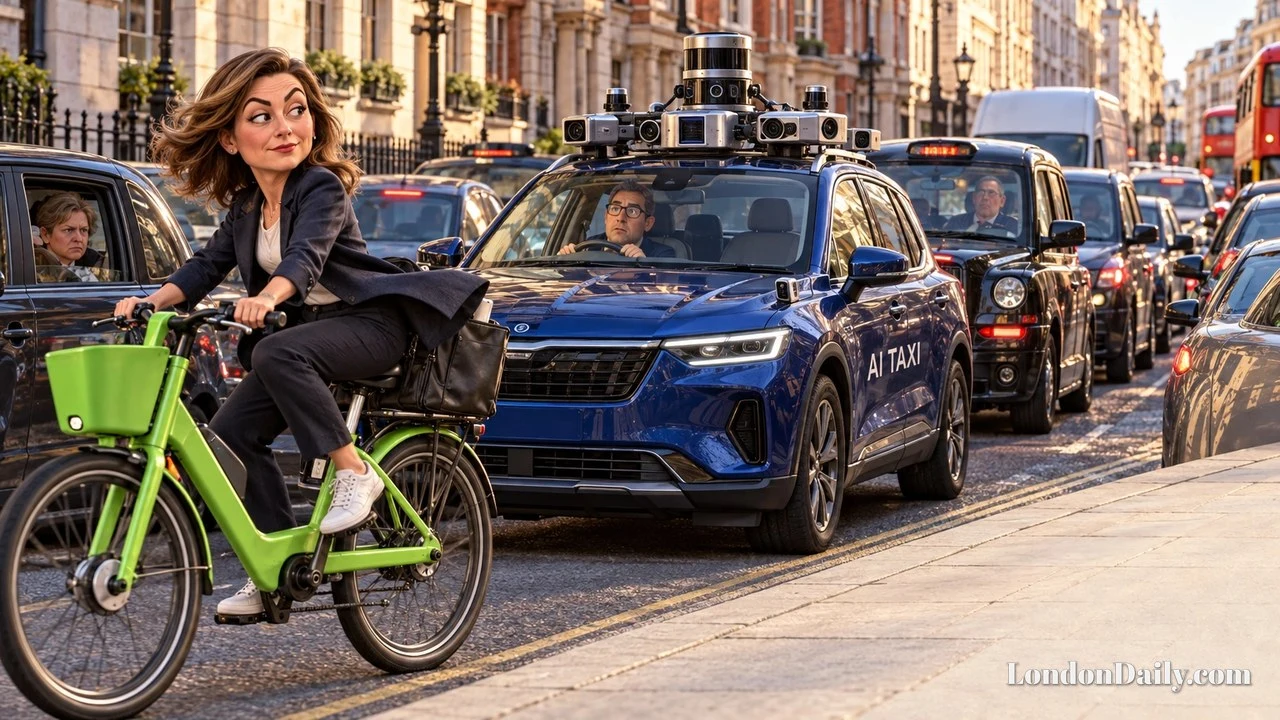
A London preview of Uber and Wayve’s autonomous taxis ran into a familiar obstacle: traffic. With the car still absent two hours after a scheduled Westminster pick-up, Wayve vice-president Kaity Fischer escaped the gridlock on a Lime bicycle before arranging the demonstration ride.
A 200-strong Just Stop Oil sit-down protest in Parliament Square and a collision involving a black cab and double-decker bus on the Embankment had brought surrounding traffic to a crawl. The delay illustrated a distinction that matters beyond the demonstration: navigating London and moving swiftly through it are different challenges.
More than 100,000 London residents have joined the Uber Wayve waiting list. Passengers requesting UberX, Uber Electric or Uber Comfort may be matched with a supervised Wayve vehicle at no extra charge, with fares displayed upfront. Transport for London’s private-hire licensing requirements still demand a qualified driver who remains responsible throughout the journey.
The preview vehicles are electric Ford Mustang Mach-Es fitted with Wayve’s AI Driver and surrounding sensors; fully integrated Uber Wayve cars will be made by Nissan. On the eventual journey to Victoria, the car stopped for an elderly couple, negotiated a narrow gap between a van and coach, and gave way to a bus.
Wayve says its system learns from experience rather than relying on traditional high-definition maps or hand-coded rules. Fischer argues that London requires calibrated assertiveness: “Too conservative, especially in a city like London, and you’re not going to move anywhere.” Excessive aggression, she said, could undermine confidence in safety.
The pedestrian challenge is substantial: Greater London records 24 million walking trips daily, accounting for 38 per cent of journeys, alongside more than 1.5 million bicycle rides. A separate incident involving a Waymo car entering a Harlesden police cordon requires an important qualification: the company said it was being driven manually, with its initial analysis pointing to human error.
Green councillor Amandine Alexandre questions the wider environmental case, citing computing systems’ demands on energy- and water-intensive data centres. She also warns that empty taxis circulating between fares could worsen congestion.
The wider transport ambitions extend skywards. Joby Aviation displayed a full-scale electric air-taxi model beside Tower Bridge, proposing on-demand flights for up to four passengers, with promised speeds of 200mph and a 100-mile range.
Against TfL’s Vision Zero ambition to eliminate road deaths and serious injuries by 2041, the successful supervised journey establishes something narrower than a transport transformation. Safety at scale, resource demands and the effect on congestion remain unresolved.








Join the conversation