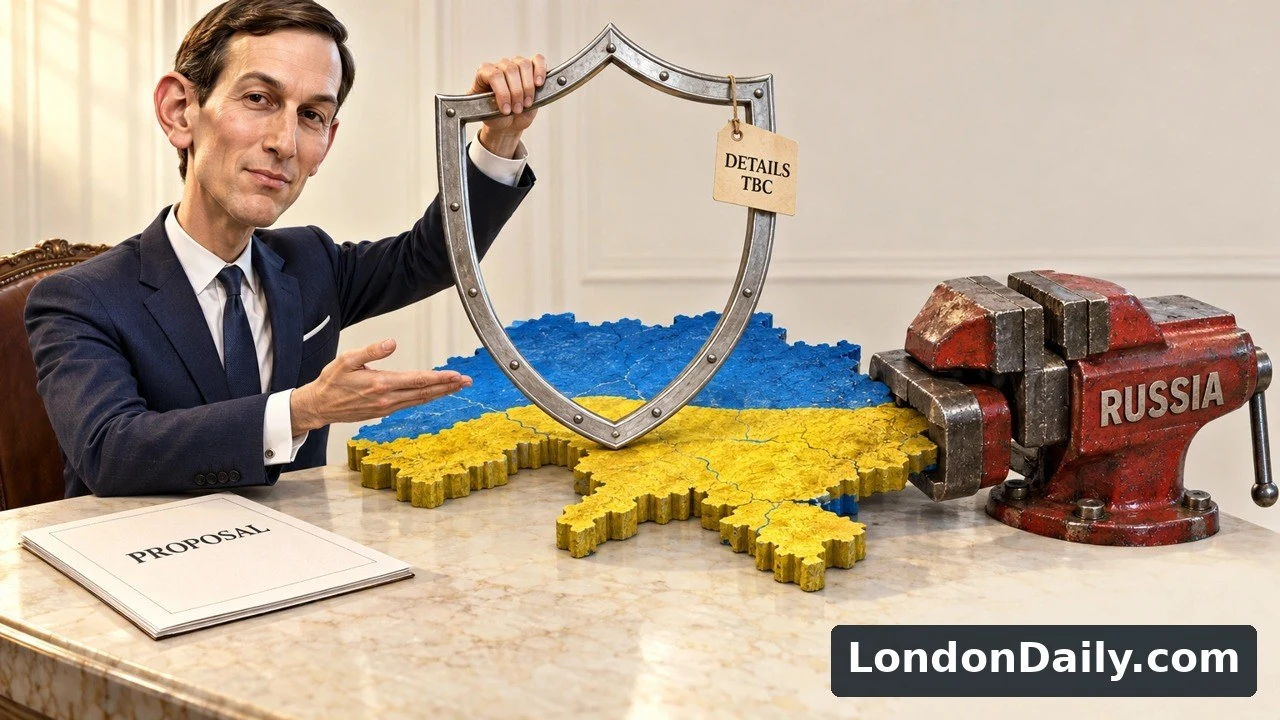
Jared Kushner has backed a settlement allowing Russia to retain seized Ukrainian territory in exchange for a reshaped European security order, arguing that ending the killing matters more than determining who is right or wrong.
In a 70-minute interview with Mathias Döpfner, chief executive of Axel Springer, Donald Trump’s son-in-law outlined an approach built around economic incentives, addressing Moscow’s grievances and negotiating a broader security agreement before resolving the territorial deadlock in Donbas.
“After all, most lines in Europe have changed over time and they are decided through war or peace, or concessions. It’s not about fairness or who is right or wrong. It’s about ending the killing,” Kushner said.
His proposed framework includes reviving the Russia-Nato council, a body undermined by Russia’s war, alongside European Union membership for Ukraine and security guarantees akin to Nato’s Article 5. He acknowledged that he could not yet provide the detailed assurances Kyiv seeks. Neither Moscow nor Kyiv has accepted the plan, and Europe has not endorsed it.
The distinction matters: territorial concessions would leave Russia holding land taken by force, while the protection intended to secure Ukraine’s future remains unspecified. Kushner’s reasoning is that agreement on Europe’s security arrangements could unlock a land settlement; the interview did not establish that either belligerent accepts that sequence.
A businessman and prominent US negotiator on Russia, Gaza and Iran, Kushner argued that economics and geopolitics are closely connected. Having taken on the Ukraine brief a year ago, he said he had needed to learn about Europe’s complexities and Ukraine’s local issues. His account emphasised misunderstandings and Russia’s grievances over Nato’s eastward expansion rather than responsibility for the invasion.
He called Putin “a grand master of politics” and “a historic figure”. He also argued that Putin lacked confidence that a ceasefire would produce a durable settlement, and characterised his stated intention not to use nuclear weapons as restraint.
Kushner said Europe belonged at the negotiating table, while describing its military assistance to Ukraine as a “proxy war” against Russia.
He denied that Trump had pressured Volodymyr Zelenskyy. Döpfner challenged that denial, citing examples including Trump’s suggestion the previous month that Ukraine should find a new leader. Kushner defended Trump as “a strong counter-puncher” and described relations with Kyiv as cooperative, while stressing Ukraine’s dependence on US support.
The unresolved issue is therefore more than where a border might fall: it is what enforceable protection would accompany concessions, and whether the parties would accept it.








Join the conversation