

Jeremy Hunt: Covid restrictions should stay until cases fall to 1,000 a day
Ministers should take a cautious approach to lifting lockdown in England so that new coronavirus cases can be driven down to a manageable level of 1,000 a day, Jeremy Hunt has said.
In an interview with the Guardian, the former health secretary and current chair of the health select committee said the government should aim at suppressing Covid sufficiently to make a South Korean-style approach of intensive contact tracing possible.
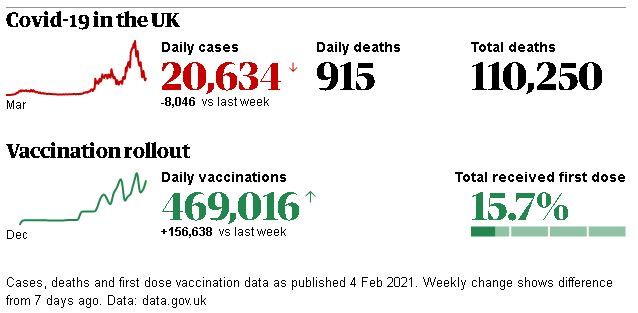
With test-confirmed Covid cases running at more than 20,000 a day, his approach would suggest some restrictions remaining in place for an extended period of time. The last time new infections were consistently below 1,000 was August.
Hunt’s intervention, made in a personal capacity, comes as debate rages in cabinet about which sectors of the economy to reopen and when. Allies of Rishi Sunak denied reports on Thursday that the chancellor has become exasperated with the government’s scientific advisers, believing them to have “moved the goalposts” on when businesses can be reopened by saying cases must fall sharply.
Hunt warned that the emergence of potentially dangerous new variants made it risky to rush ahead. “I think we have to recognise that the game has changed massively over Christmas with these new variants, and that we mustn’t make the mistake that we made last year of thinking that we’re not going to have another resurgence of the virus,” he said.
Boris Johnson and his cabinet colleagues face a series of key decisions in the weeks ahead about how to follow up the success of the vaccination programme by lifting the order to “stay at home” and reopening shops, pubs and other businesses. Schools are expected to reopen from 8 March.
An aide to Sunak said he “takes the same view as the prime minister and others across government: we should be cautious in our approach”.
But the suggestion Sunak is keen to move rapidly will not have harmed his reputation with many Conservative MPs, a large cohort of whom are pressing for restrictions to be lifted in line with the vaccination programme.
“The public health people would have the schools closed for the rest of the year,” said one frustrated former Tory minister, who said WhatsApp groups of Conservative MPs were buzzing with demands for lockdown rules to be lifted as soon as possible. “The public need to see success in vaccinations moving in lockstep with restrictions being lifted.”
By contrast, Hunt said: “I think we need to listen very carefully to the scientific advice. I never saw this as economy versus health. The Koreans and the Taiwanese have kept their economy open. All their restaurants are open, because they’ve kept case transmission low, and we just need to do what it takes to get to that point. And for me, where I’m at on that is that you just need to get it down to 1,000 new infections a day or less.”
Chris Whitty, the chief medical officer for England, said earlier this week that new infections were “coming down but they are still incredibly high” and warned that if they were to begin increasing again “from the very high levels we are at the moment the NHS will get back into trouble extraordinarily fast”.
Hunt has used his role as chair of the cross-party health select committee to scrutinise the government’s handling of the pandemic, including calling from an early stage in the outbreak for an effective test, trace and isolate system. The test and trace chief, Dido Harding, conceded to Hunt’s committee earlier this week that as many as 20,000 people every day were ignoring instructions to self-isolate.
Ministers are expected to give the go-ahead later this month to schools reopening on 8 March and No 10 is facing intense pressure from a vocal group of Tory backbenchers who want to see other restrictions lifted rapidly thereafter.
Mark Harper, the chair of the Covid Recovery Group of lockdown-sceptic backbenchers, has said all restrictions should be lifted once the first nine priority groups – including all over-50s – have received their first vaccine dose. The government has not given a target date for that to take place, but Harper suggested it could be late May or early June.
The education secretary, Gavin Williamson, was keen to open schools sooner than 8 March but was overruled by the prime minister, who has struck a cautious tone in recent public appearances.
Some of Hunt’s concerns are shared by the Cabinet Office minister, Michael Gove, and the health secretary, Matt Hancock, who are among those urging the prime minister to be wary.
Firm data is not yet available about whether new variants of the disease may be vaccine-resistant, and new mutations may yet emerge. “It all needs to be bottomed out before you move,” said a Department of Health source, who added: “Matt’s view is that if you are tough in certain key areas, that will allow you greater freedoms.”
The prime minister has promised to publish a “road map” setting out his plans for unlocking the economy in the week of 22 February.
Asked whether Johnson agreed with the assessment of the Sage member Prof Andrew Hayward – who suggested on Thursday that the country would be “more or less” back to normal for the summer – the PM’s official spokesperson said: “Obviously it remains the prime minister’s view that we want to start easing lockdown restrictions and we are keen to do that … As we have done throughout the pandemic, we will be guided by scientific evidence and data.”
Trade unions have called for the “Covid-secure” rules for workplaces to be updated before the government considers lifting the advice that says the public should work from home if possible.