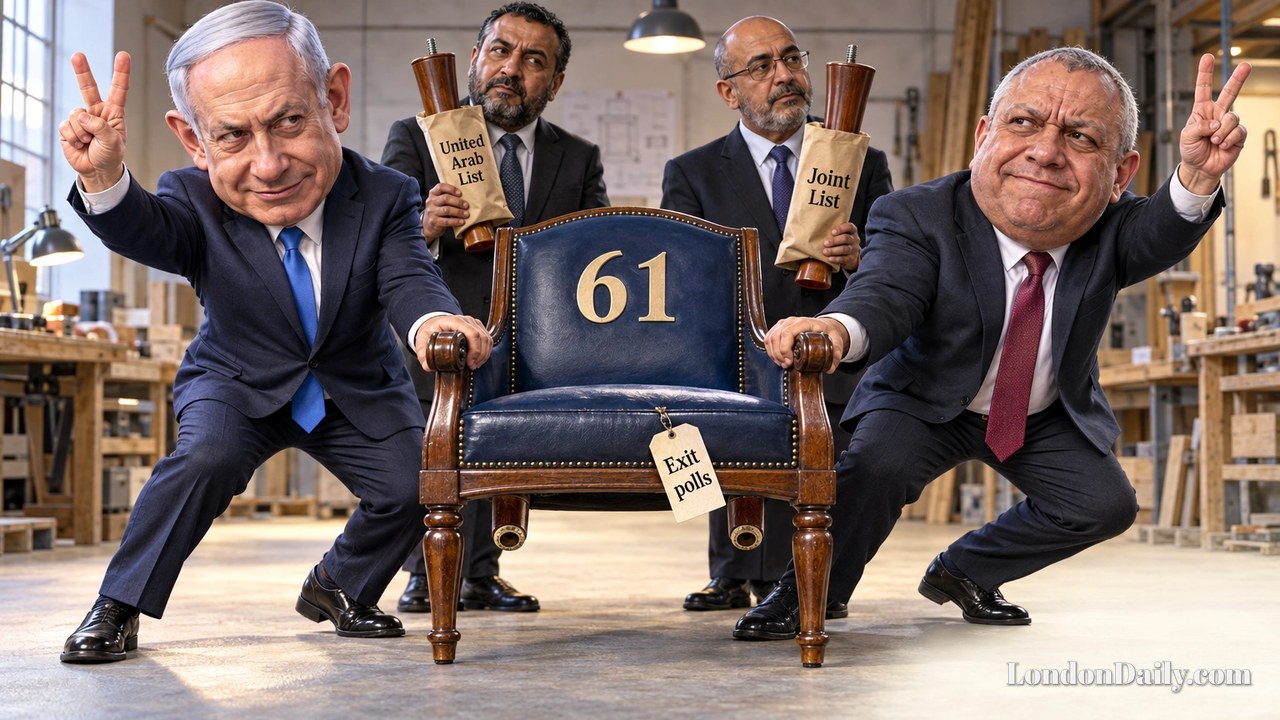
Israel’s election has produced no clear winner in exit polls, leaving Benjamin Netanyahu and challenger Gadi Eisenkot short of a parliamentary majority and putting two Arab parties in a potentially decisive position.
Updated projections early on Wednesday from Kan and Channel 13 gave each bloc 51 seats in the 120-seat Knesset. Channel 12 put Netanyahu’s bloc on 52 and Eisenkot’s on 49. The United Arab List and Joint List were projected to secure a record 18 or 19 seats between them.
Those figures reversed an initial opposition advantage: broadcasters had given Eisenkot’s Yashar party and its three Jewish opposition allies 52–53 seats, against 50 for Netanyahu’s coalition. Likud was nevertheless projected to remain the largest individual party.
Eisenkot, a former military chief, said his supporters had “made history” and promised a stable Zionist government serving all citizens. His ally, former prime minister Yair Lapid of Beyachad, described a “crushing defeat” for Netanyahu’s bloc.
Netanyahu later claimed his right-wing bloc had a “great majority” and urged a strong right-wing national government, although the projections showed no majority. Foreign Minister Gideon Saar called opposition celebrations “premature”; National Security Minister Itamar Ben-Gvir urged prayers for a “full-on right-wing government”.
Coalition arithmetic remains difficult. Only one party has openly backed governing with the Arab parties. United Arab List leader Mansour Abbas hoped his party and the Change Bloc could reach the necessary 61 seats. His party joined the Bennett–Lapid coalition after the 2021 election; it collapsed a year later. Joint List chairman Yousef Jabareen said his grouping “cannot be ignored under any political scenario”.
Reportedly strong Arab turnout helped their projected gains. Arab Israelis constitute about a fifth of the population and often identify as Palestinian citizens of Israel.
The first election since the Hamas-led attacks of 7 October 2023 and subsequent wars in Gaza, Lebanon and Iran centred on security accountability, war policy, military service, judicial reform and Israel’s international standing. It also tested the country’s hard-line, religious-nationalist direction. One Eisenkot voter accused Netanyahu of self-interest; a Netanyahu supporter praised his international leadership.
Netanyahu warned that left-wing and Arab turnout threatened his government. Election officials rejected right-wing parties’ request to extend voting beyond 22:00 local time, or 20:00 GMT. Turnout reached 77.7%, the highest at closing time since 1999.
Official results were due overnight, but about 600,000 absentee ballots, mostly military votes and roughly 10% of the total, will not be fully counted until Thursday. After final results and consultations, the president will invite the leader judged best placed to form a coalition. Negotiations could take weeks; failure could ultimately bring another election.








Join the conversation