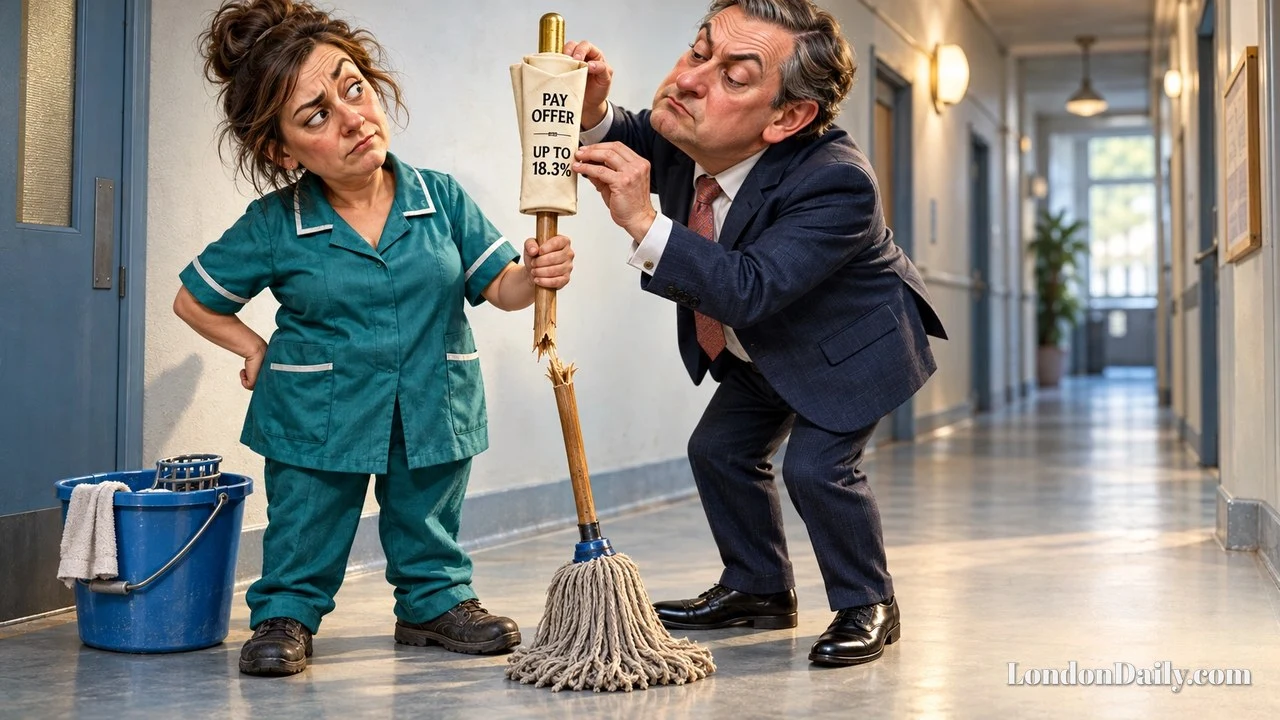
Ireland’s lowest-paid public servants would receive increases of up to 18.3% under a €5.2 billion draft pay agreement that has halted planned strike action, but a senior union leader has warned that members’ approval is far from assured.
The Government and unions reached the proposals early on Wednesday. The agreement runs for two years and nine months, ending on 31 March 2029, and now goes to unions for scrutiny and membership ballots.
Its headline pay adjustments total 10.75%. Public Expenditure Minister Jack Chambers put the minimum cumulative benefit at 11.3%, with larger percentage gains for lower earners through minimum cash increases and local bargaining provisions.
Chambers said cleaners’ starting pay would rise by 18.3%, special needs assistants’ by 17.2%, and clerical officers’ by 17.1%. General operatives and healthcare assistants would gain 15.4%; enhanced nurse starting pay would increase by 13.3%. Primary and secondary teachers would receive 13% and 12.8% respectively. Garda starting salaries would rise by €5,722, from €39,194 to €44,916.
The schedule begins on 1 September 2026 with 2% or €1,200, whichever is greater. During 2027, increases follow on 1 April at 1%, 1 August at 1% or €600, and 1 November at 1.5% or €900. In 2028, adjustments are 1% on 1 March, 1% or €600 on 1 June, and 1% on 1 October. Minimum cash amounts apply where greater.
A second local bargaining phase of 1% follows on 1 March 2029, then 1.25% or €750, whichever is greater, on 2 March. The final local bargaining phase falls within a successor agreement.
Chambers said expenditure implications extend from 2026 to 2030. He maintained the package was affordable without changing medium-term fiscal plans or the 2027 budget settlement, which retained contingency funding. The Government could seek a review after a significant economic contraction; unions could seek one following an inflationary spike.
The previous agreement expired at June’s end. Work-to-rule action began on 30 September, followed by a public-service-wide strike on 14 October. Thursday’s planned 12 November strike would have coincided with the European Political Community summit. Industrial action is suspended while unions consider the proposals.
Fórsa general secretary Kevin Callinan said he did not expect acceptance in a “landslide”. He credited collective action with making a difference, but said rejection would leave individual unions to consider their response.
His warning went beyond wages: public servants felt the Government was “out of touch”, he said, citing workplace pressure, resource shortages and increased demand. A pay offer alone, he argued, would not repair that relationship.








Join the conversation