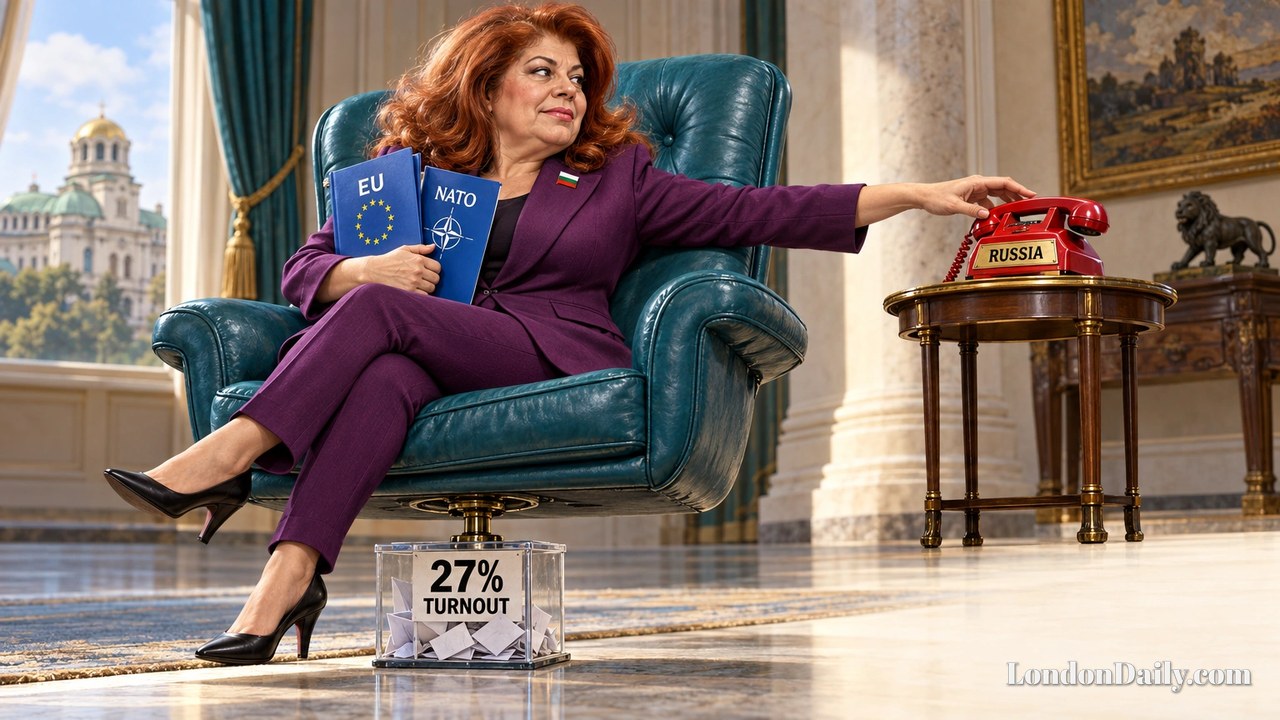
Iliana Iotova has become the first woman elected president of Bulgaria, winning on a platform of renewed dialogue with Russia and opposition to further military aid for Ukraine. Her victory strengthens Prime Minister Rumen Radev’s political camp, but turnout of about 27% limits the breadth of that endorsement.
Official results published on Monday gave Iotova 57.6% in Sunday’s run-off, against 39.5% for Andrey Gyurov, the former caretaker prime minister backed by pro-Western opposition parties. About 1.09 million people voted for her and 750,000 for him; roughly 56,000, nearly 3%, chose neither candidate.
Iotova, 62, has been acting president since January, when Radev resigned to contest parliamentary elections. His new Progressive Bulgaria party won 131 of parliament’s 240 seats in April. She is due to begin her five-year term on 22 January, with journalist and lawyer Kiril Valchev as vice-president.
The presidency has relatively limited powers, but its holder commands the armed forces, can veto legislation and has foreign-policy responsibilities. Analysts warn that control of government and presidency by the same camp could weaken institutional checks.
Iotova supports continued EU and Nato membership while seeking better relations with Moscow and the removal of sanctions. She proposed an international coalition to end the war through negotiations. After winning, she pledged national reconciliation and an independent foreign policy within a strong Europe.
Radev’s government has already stopped supplying Ukraine from Bulgarian military stocks and withdrawn from the French- and British-led coalition of the willing supporting Kyiv. Iotova’s victory could reinforce that course and deepen disagreements with European governments favouring continued military support.
Gyurov, 50, advocated stronger support for Ukraine and presented himself as a counterweight to Radev. As caretaker premier, he signed a security co-operation agreement with Kyiv. Former prime minister Boyko Borisov endorsed him; Iotova used that backing to portray him as representing the old establishment challenged by protests preceding Radev’s rise. Gyurov accepted defeat. European Commission president Ursula von der Leyen congratulated Iotova, expressing hope for co-operation on security, energy and competitiveness.
The campaign unfolded amid drone attacks on merchant ships off Bulgaria’s Black Sea coast that killed at least 24 crew members over the past month. Both candidates condemned them without directly blaming Moscow; Radev said their consequences served Russia.
Bulgaria’s historical ties with Russia sit alongside Nato membership since 2004 and EU membership since 2007. Political fatigue after eight parliamentary elections in five years, living costs, energy prices and disappointment with government promises have eroded trust. First-round turnout on 25 October was a record-low 23%, when Iotova took about 34.7% against Gyurov’s 32%. Her decisive run-off margin leaves widespread disengagement unresolved.








Join the conversation