London Daily

Focus on the big picture.
Saturday, Jun 20, 2026

Hungary records the deadliest day of the pandemic, despite its leading vaccine rollout

Hungary records the deadliest day of the pandemic, despite its leading vaccine rollout

Hungary has recorded its deadliest day of the pandemic so far, struggling to contain the latest surge of new coronavirus cases even as its vaccine rollout speeds up.

The government announced Wednesday that 302 people died in a single day, bringing the country's total death toll to 20,737. The government said in a statement that most of those who died had been elderly or chronically ill.

The record toll came just days after Prime Minister Viktor Orban said he had no doubt Hungary would have a "free summer" thanks to the number of vaccine doses it was administering.

The country is well ahead of most other European Union member states when it comes to vaccination rates, trailing only the tiny island nation of Malta.

According to data from the European Centre for Disease Prevention and Control (ECDC), 23.7% of adults in Hungary have received their first dose of the vaccine as of Wednesday, while 8.6% have been fully vaccinated with two doses.

One reason for the speedy rollout is the government's decision to authorize two coronavirus vaccines from Russia and China even though they have not yet been approved by the European Medicines Agency. Hungary became the first EU country to approve Russia's Sputnik V vaccine in January, followed by China's Sinopharm vaccine in February.

That means that while the rest of the EU has been struggling with supply issues as it relies on the BioNTech/Pfizer and AstraZeneca vaccines, Hungary has been using the AstraZeneca as well as the Russian and Chinese vaccines since the last week of February.

Earlier this month, it gave emergency approval to two more vaccines, China's Cansino Biologics Covid-19 shot and CoviShield, the version of the AstraZeneca vaccine made by the Serum Institute of India. It also ordered the Pfizer-BioNTech and Moderna vaccines through the EU, bringing the total number of vaccines it will have at its disposal to seven.

The country's chief medical officer said Wednesday that the Johnson & Johnson vaccine would also become available in the second half of April.

The worst wave yet


But Hungary's relatively successful vaccine rollout has failed to prevent the country from spiraling into a new crisis. The central European nation has seen its worst days both in terms of the number of new cases and deaths in the past week. It has the world's second-highest coronavirus death rate per capita -- 209 deaths per 100,000 people, according to data tracked by CNN. Among countries of any significant size, only the Czech Republic has a higher rate of coronavirus deaths.

Some have expressed concerns about the situation in Hungary's hospitals. Several independent news outlets have written an open letter to the government asking for access to hospitals, Covid ICUs and vaccination centers. Government spokesperson Zoltan Kovacs responded by saying "in hospitals, we should cure patients instead of filming them with cameras." He went on to accuse "left-leaning websites" of "spreading fake news."
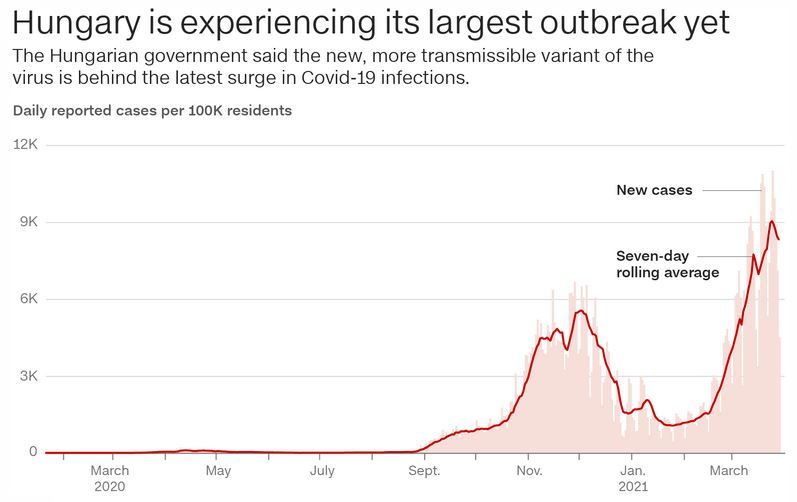

Kovacs told CNN the reason for the record number of deaths was the new, more contagious variant of the virus first identified in the United Kingdom, which he said was causing "relatively more hospitalizations and fatalities."

Asked why the country was seeing such a high death rate, he said: "All health care capacities, treatments, medicines etc are available. So it's not the shortage of equipment/personnel."

The country went into lockdown on March 8, closing non-essential stores and shifting schools to remote learning. The closure of stores lasted until March 22, while nurseries and primary schools are due to remain closed until April 7.

Hungary is not the only European country battling to contain the new wave of the pandemic. Others have also struggled, blaming the surge in cases on new mutations.

The B.1.1.7 variant is more contagious, may cause more severe disease and is rapidly infecting younger populations, epidemiologist Michael Osterholm told CNN on Tuesday night. Recent research suggests the strain may also be more deadly. The variant has become the dominant strain of the virus in France, Germany, Italy and the Czech Republic -- and experts are warning the same could soon happen in the United States.


Newsletter

Related Articles

0:00
0:00
Close
UK Health Authorities Introduce Drug Price Concessions Amid Record NHS Medicine Shortages
Sir David Attenborough Supports Sherwood Forest Conservation Efforts After Loss of Major Oak
Aardman Animations Marks 50 Years With Major Exhibition in Bristol
Drax Cleared After Investigation Into Wood Pellet Sourcing Practices
Jaguar Land Rover Shifts Toward Hybrid Vehicle Production for US Export Strategy
UK Police Arrest Liberal Democrat MP Cameron Thomas on Suspicion of Assault
Health Concerns Grow Over Elevated Kidney Cancer Rates Near Lancashire PFAS Factory
Royal Navy F-35 Jets Conduct First NATO Air Warfare Exercise from Finnish Airspace
UK NHS Issues Price Concessions for Medicines Amid Severe Drug Shortages
Heathrow Third Runway Project Faces Sharp Downward Revision in Expected Economic Benefits
Amber Heat Warning Issued Across Parts of England and Wales as Temperatures Rise
Train Collision Near Bedford Disrupts UK Rail Network and Leaves Multiple Injured
Bank of England Data Suggests Brexit Has Reduced UK Economic Output by Around Six Percent
UK Borrowing Costs Hold Near 4.8 Percent as Political Uncertainty Fuels Market Pressure
Andy Burnham Emerges as Front-Runner to Succeed Keir Starmer After Landslide Makerfield Victory
Prime Minister Keir Starmer Faces Mounting Pressure to Resign After Labour By-Election Defeat in Makerfield
Payment Fraud Losses Reach £1.28 Billion and Raise National Security Concerns
Lending to Small Businesses Climbs to Highest Level Since Late 2024
Middle East Conflict Clouds UK Economic Recovery Despite Strong First-Quarter Growth
Bank of England Moves to Simplify Capital Rules for Smaller Lenders
UK Government Fast-Tracks National Security and Cyber Resilience Legislation
Ofcom Investigates Telegram Over Alleged Role in Organising Arson Attacks
MPs Press Fujitsu to Speed Compensation for Post Office Horizon Victims
Bank of England Delays Final Basel III Implementation Changes to Support UK Banking Competitiveness
Pound Falls as Political Uncertainty and Bank of England Signals Weigh on Markets
0Andy Burnham Wins Makerfield By-Election and Emerges as Main Challenger to Keir Starmer
Dorset Council Tests AI Tools to Streamline Local Planning Applications
UK Researchers at Kew Gardens Use AI to Speed Up Identification of Threatened Plant Species
UK Gilt Yields Ease Toward 4.8% as Inflation and Labour Market Data Weigh on Bonds
Bank of England Data Shows Resilient SME Lending Despite Economic Slowdown
UK Finance Reports Weakening Services Activity as Business Confidence Softens
UK Introduces Mandatory Internal Complaints Process Under Data Use and Access Act
Bank of England Governor Andrew Bailey Flags Geopolitical Uncertainty as Key Risk to Inflation Outlook
Bank of England Holds Interest Rates at 3.75% as Policymakers Signal Cautious Stance on Inflation Risks
Cornwall Clergy Raise £40,000 for Church Repairs Through Everest-Themed Charity Challenge
UK Business and Social Landscape Reflects Strain From Geopolitical and Domestic Pressures
Tensions Grow in UK Over Sikh Kirpan and Religious Symbolism in Public Debate
Energy Price Cap Increase Set to Lift UK Household Bills by 13 Percent
University of Reading Ranked 196th in QS World University Rankings
UK Maritime Archaeologists Identify 17th-Century Dutch Shipwreck Off Devon Coast
Oxford Union Islam Debate Sparks Protest From Faith Leaders in UK
UK Social Cohesion Debate Intensifies After Religious Prejudice Survey Findings
UK SME Lending Rises Despite Geopolitical Uncertainty and Cautious Outlook
Foreign Demand for UK Gilts Remains Sensitive to Global Inflation Trends
Labour Party Faces Leadership Pressure After Weak Local Election Results in UK
Transport Costs Drive Inflation Pressure as Petrol Prices Push Up UK CPI
British Chambers of Commerce Cuts Growth Forecast as Middle East Conflict Weighs on Investment
UK Economy Grows 0.6 Percent in First Quarter but Outlook Remains Weak
Bank of England Holds Interest Rates at 3.75 Percent as Inflation Risks Persist
Energy Price Cap Rise Expected to Keep UK Inflation Above Target Through 2026
×