

How did the government meet its police pledge?
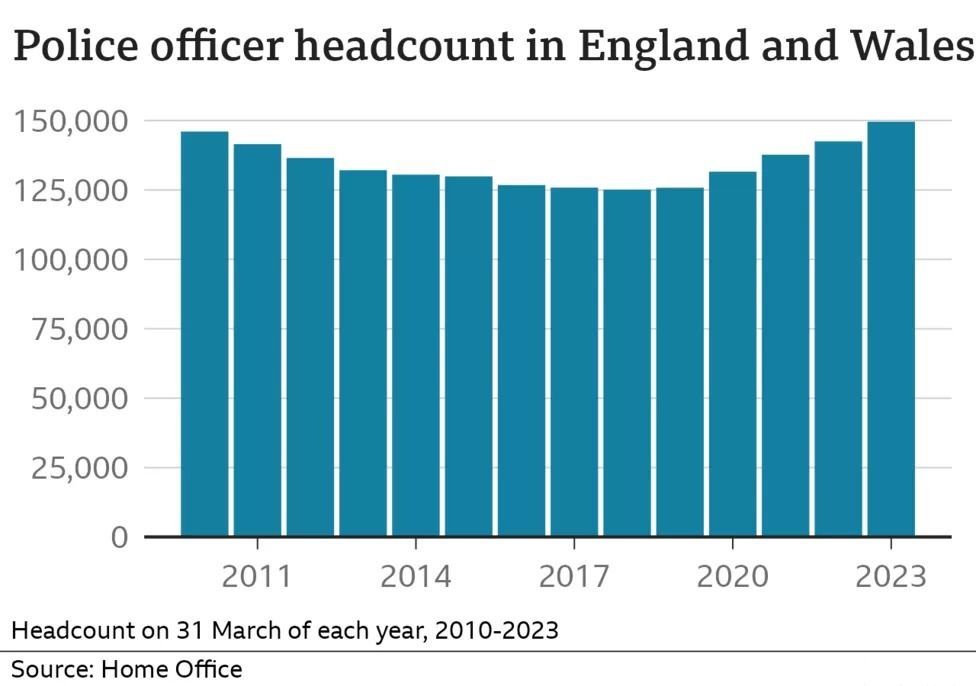
It has employed 20,951 more officers since 2019 so the total is now 149,572.
This means the number of officers is about 3,500 higher than it was in 2010, when the Conservatives and Liberal Democrats began cutting police numbers.
But there are concerns that the rise hasn't kept pace with the increase in population since 2010 and that many experienced officers have left.
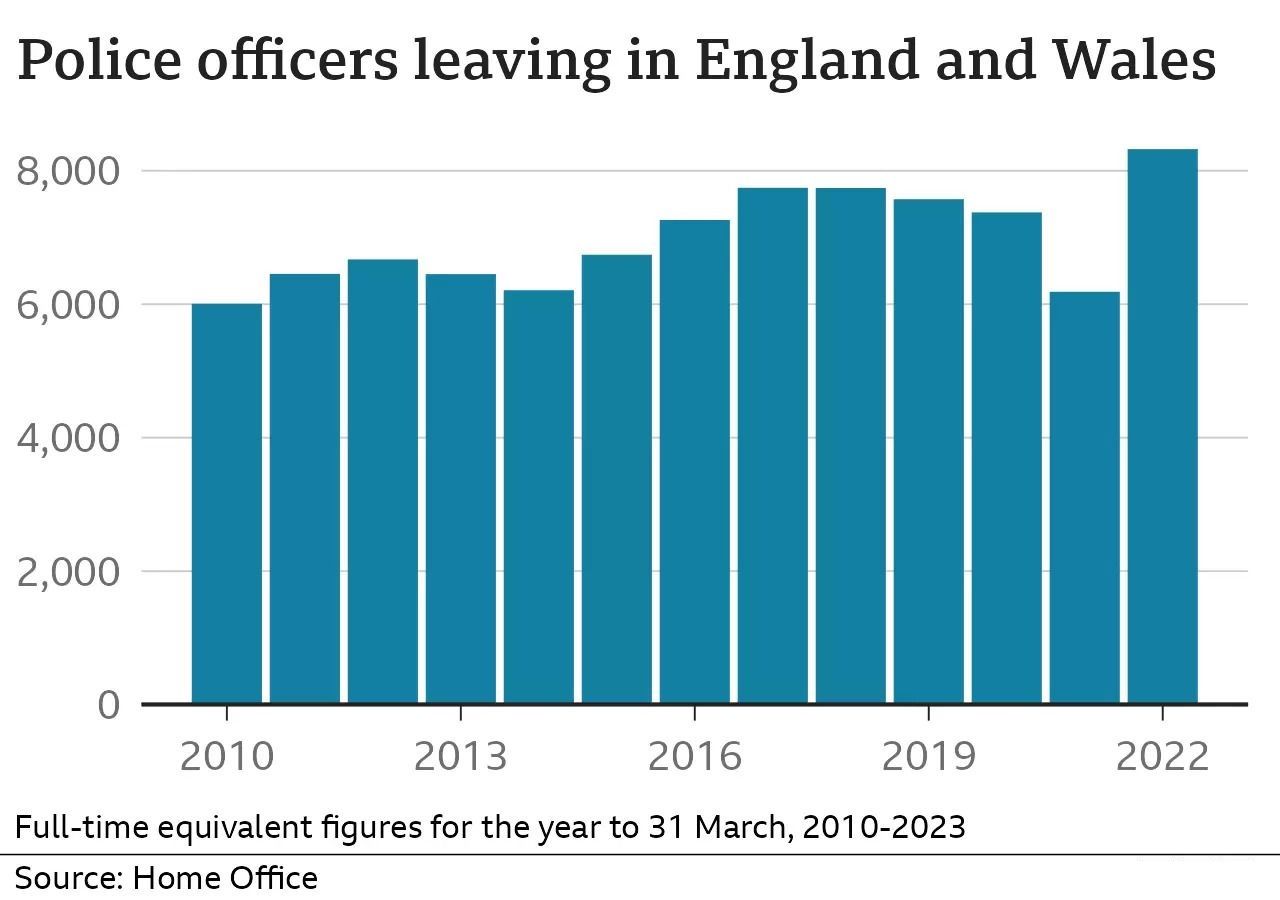
Many of the new officers are replacing the approximately 20,000 who left between 2010 and 2019.
Is this a record number of police officers?
The new headcount of 149,572 officers in England and Wales (including part-time employees) is higher than the previous record of 146,030 in 2010.
The recruitment target, pledged in the Conservatives' 2019 election manifesto, was set for March 2023.
It has been reached after a big rise in the first three months of 2023 - 4,000 extra officers - by far the biggest quarterly jump since the government's police uplift programme started.
Home Secretary Suella Braverman said: "We have delivered on the promise we made to the British people which means more police on the beat preventing violence, solving burglaries and cracking down on antisocial behaviour."
Shadow Home Secretary Yvette Cooper tweeted: "the Tories are trying to take country for fools on policing... they CUT 20,000 police officers".
That's a reference to the reduction in police numbers of about 20,000 between 2010 and 2019, after government funding was cut by 20%.
Liberal Democrat Home Affairs Spokesperson Alistair Carmichael said: "Suella Braverman's boasts will ring hollow for communities that have seen community policing decimated under this government."
Have police numbers kept up with a growing population?
While the number of police officers is a few thousand higher than 2010 levels, the population has grown - by about 7% - since then.
If the number of officers in England and Wales had risen in line with the population since 2010, there would need to be thousands more officers.
Ms Braverman told BBC News that in 2019 "we set that [20,000] target accounting for increases in population". We have asked the Home Office how they did this.
How many police officers are leaving?
In the year to March 2022, the number of full-time police officers leaving the force reached a 20-year high of 8,117.
Half of those leaving retired - police officers can claim their pensions in their 50s.
However, an increasing proportion resigned - about 40% in 2021-22, compared with a third the year before.
About 9% of newly recruited officers leave during their two-year probation periods, a report by the Public Accounts Committee, which examines government projects, found last year.
Chief Constable Ben-Julian Harrington, of Essex Police, said his force had received more than 900 new officers as part of the police uplift programme. However, he is concerned some will leave because of low salaries and the rising cost of living.
"You can't arrest your gas bill," he said. To keep new officers, he said he would "speak up for them, and make sure they are trained and supported".
Are police officers less experienced?
There are now fewer senior full-time police officers than in 2010.
The number of inspectors is down 14% to 6,245. The number of superintendents and sergeants has also fallen.
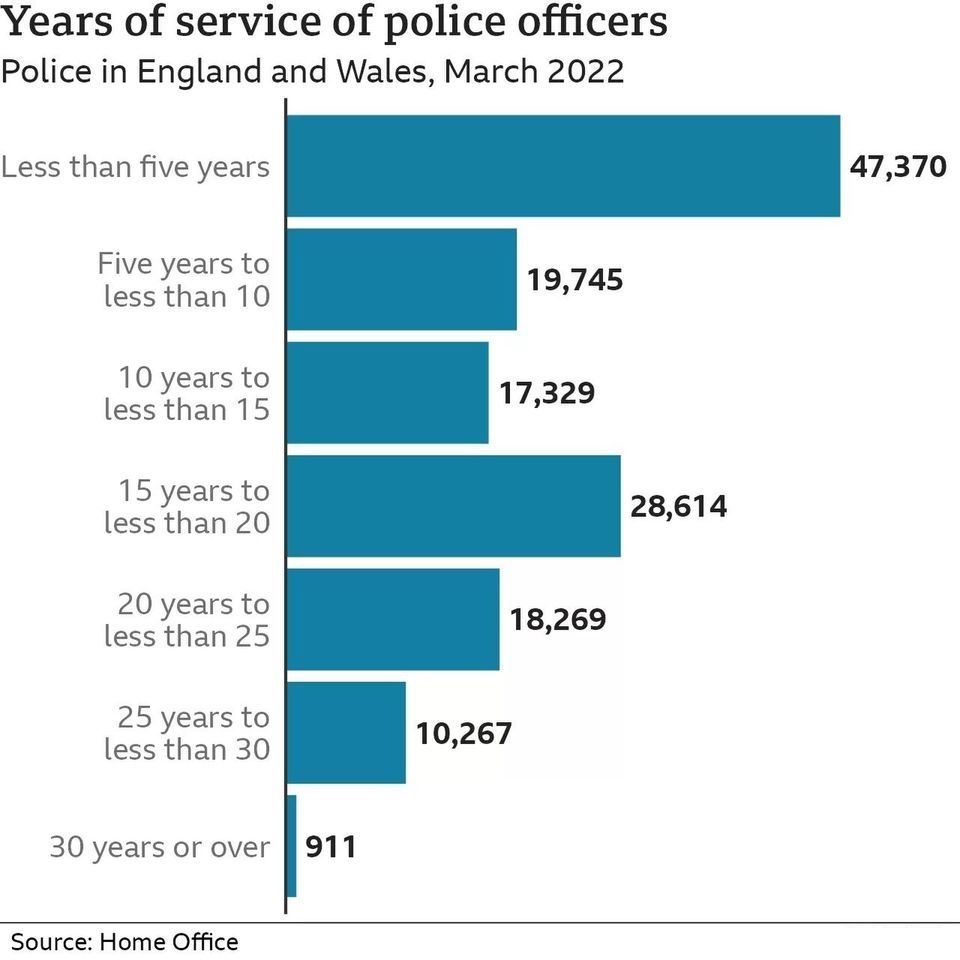
Currently, a third of all police officers in England and Wales have fewer than five years' experience where the length of service is known. This is more than double the number six years ago.
The Public Accounts Committee has linked falling levels of experience with the government's drive to recruit new officers.
Dame Meg Hillier, who heads the committee, said: "The danger is if you go up and down with police numbers and then recruit very quickly, you end up with a larger number of more junior officers, without the experienced people above them."
This could affect police force performance.
In June 2022, Her Majesty's Inspectorate of Constabulary, the police watchdog, placed the Metropolitan Police in special measures.
In a letter to the force, HM Inspector Matt Parr said systemic failures had been "amplified by the presence of a relatively young, inexperienced workforce - a consequence of the [Met's] increased recruitment enabled by the police uplift programme".
The BBC has spoken to officers who joined a Met Police scheme to recruit graduates to be detectives without first serving in uniform.
They describe being left to cope on their own with growing caseloads.
One of them - who didn't want to be named - said he was given 12 cases on his first day in CID (Criminal Investigation Department). "From that point," he said, "I was swimming upstream."
Another described his time as a detective as "the worst year of my life".
He said his CID unit was staffed almost entirely by trainees and he was worried he might make a mistake that affected a case or a victim of crime.
Both trainee detectives have now left the Met, and say about 10 of their 30 fellow recruits have done the same.
The Met was the only police force that did not meet its recruitment target. It fell short of its 4,557 target by 1,089 officers.

