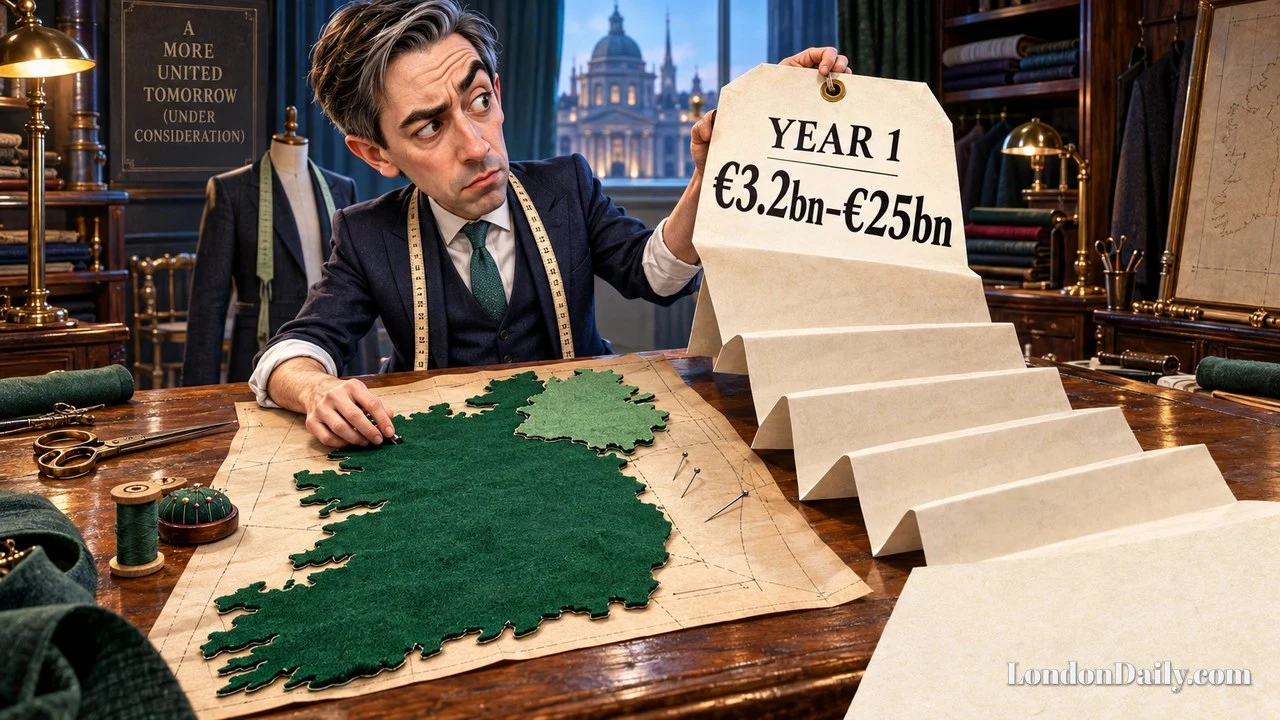
Fine Gael has put the first-year cost of Irish unity at between €3.2 billion and €25 billion in a new blueprint, with the eventual bill depending heavily on constitutional arrangements and a settlement with Britain over pensions and debt.
The governing party’s document, published for its annual Ard Fheis, favours a phased transition rather than immediate alignment of pay and welfare. Its most expensive scenario projects an annual cost of €41.2 billion by year 25, not a cumulative bill.
Professor Stephen Kinsella’s modelling stresses there is “no single fixed cost of unity”. Using existing arrangements as a baseline, it examines four designs: Unitary, Federal, Managed Integration and Higher Cost. Whether Britain retains responsibility for accrued pensions and debt interest is the largest early financial variable; over 25 years, the pay and welfare gap matters more.
Managed Integration would bring pay and welfare to Irish levels over 15 years, invest an additional €1.5 billion annually in Northern Ireland during the first decade and allocate €250 million a year to running two systems. Its projected annual cost in year 25 ranges from €4.2 billion to €24.1 billion.
The Federal model retains a separate Northern Ireland administration, phases alignment over 20 years and allows €500 million annually for two systems. The Higher Cost model assumes immediate alignment, no extra investment and €1 billion annually for parallel systems. These are conditional estimates, not an agreed transition budget.
Fine Gael proposes a North-South relations junior minister within a Constitutional Planning Unit in the Department of the Taoiseach, a Future Unified Island Fund to meet transition costs, and doubling the Reconciliation Fund. A Standing Constitutional Forum would enable discussion before any referendum. Public services, taxation, security and institutions require preparatory work; presidential voting rights for Northern Ireland citizens and stronger Seanad representation need further agreement.
Tánaiste and Fine Gael leader Simon Harris said unity required practical preparation and respect for every identity, tradition and community. Publication follows Taoiseach Micheál Martin’s proposal for a Future Studies Initiative to examine constitutional futures, amid opposition pressure for preparations.
Sinn Féin leader Mary Lou McDonald welcomed the blueprint and urged engagement with opposition parties, northern parties, civic society and the diaspora. SDLP leader Claire Hanna called for government parties to agree a shared preparation programme.
Professor Deirdre Heenan’s accompanying research draws a distinction between planning and supporting unity, describing preparation as good governance and risk management after Brexit. It identifies willingness among some unionists to engage if the outcome is not predetermined, alongside an “almost unanimous assessment” that Stormont’s current arrangements are ineffective. Reconciliation, it argues, must remain fundamental without stalling progress.








Join the conversation