European Union rules on artificial intelligence will apply to AI-enabled physical products sold in Northern Ireland, the UK government has said, but will not extend to businesses simply using online or downloadable AI tools.
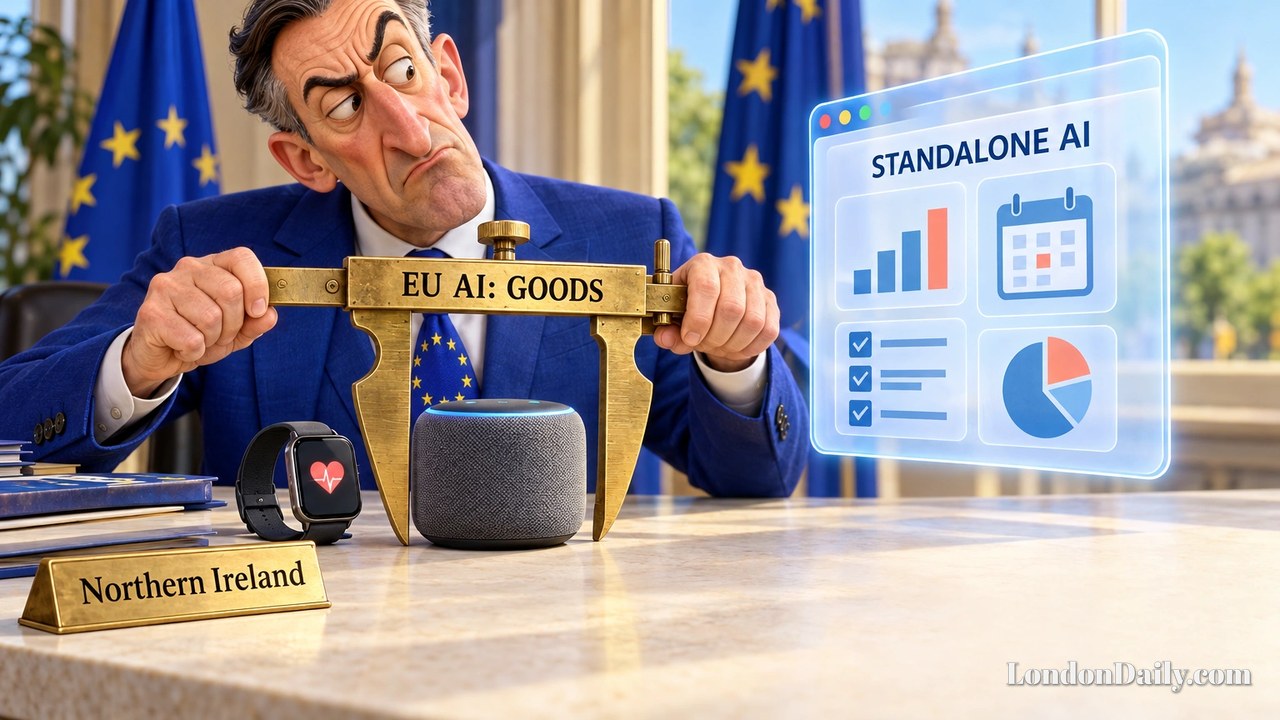
The distinction limits the reach of the EU’s AI Act: regulation of artificial intelligence in Northern Ireland will remain largely a matter for the UK government and Stormont. The European rules will apply only where an AI system is closely integrated with a tangible product placed on the Northern Ireland market.
Products covered include a smart speaker with a built-in AI voice assistant and a smartwatch requiring its manufacturer’s AI health-monitoring app. By contrast, using standalone AI tools to organise work, analyse data or perform other business functions would not bring a Northern Ireland company within the rules. Developers of those tools would not face obligations for their use there unless the AI was closely integrated into a physical product sold in the region.
The legal basis is the Windsor Framework, the Brexit agreement that keeps Northern Ireland within the EU’s single market for goods. The AI Act passed in 2024; in 2025, the European Commission proposed applying its goods-related provisions in Northern Ireland, prompting negotiations with the UK.
The Act regulates AI according to its potential to harm society, imposing stricter requirements as risk increases and banning some applications. Government examples of products that could be prohibited include an AI-enabled toy that rewards or praises children for increasingly risky activities, and an AI-connected camera with voice recognition that detects employees’ emotions.
Cabinet Office minister Hamish Falconer said in a written statement to Parliament that adding the rules to the Windsor Framework would not create a new regulatory border with the rest of the UK. He said they would mainly cover products already subject to EU law, giving manufacturers certainty over access to both the EU and UK markets.
The government also assessed that products facing prohibitions or high-risk requirements were currently relatively rare. Businesses supplying Northern Ireland in many affected sectors typically served EU markets already, Falconer said, meaning they would comply with EU requirements.
When EU goods rules change, the UK government generally has to agree which should apply in Northern Ireland. In some circumstances, the Northern Ireland Assembly also has a vote.








Join the conversation