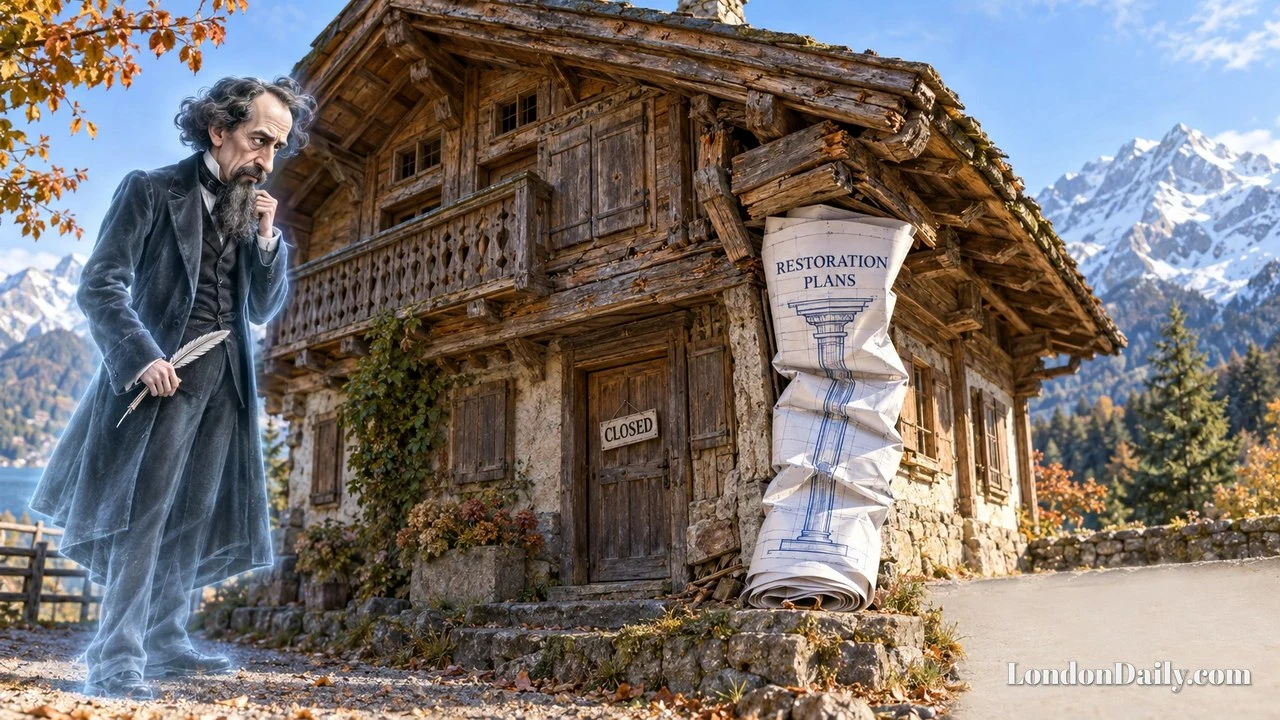
Charles Dickens’ writing chalet has been added to Historic England’s heritage at risk register, with decaying timbers and structural instability preventing public access to the building where he worked and rehearsed readings.
The Grade I-listed, two-storey Swiss chalet stands in the gardens of Eastgate House in Rochester, Kent. Given to Dickens as a Christmas present in 1864, it originally stood at Gads Hill Place in Higham before being moved in the 1960s.
Dickens worked there on Our Mutual Friend, The Uncommercial Traveller and his unfinished final novel, The Mystery of Edwin Drood. Its upper floor is believed to have been lined with mirrors for rehearsing dramatised public readings.
Medway Council has secured £240,000 from the National Lottery Heritage Fund, alongside £40,000 of council funding and £5,000 from the Dickens Fellowship. That money is for developing restoration plans and a new garden setting, rather than a completed rescue.
Hall’s Croft in Stratford-upon-Avon, Warwickshire, has also joined the register. The Grade I-listed, 17th-century home of Shakespeare’s daughter Susanna and her husband, Dr John Hall, later hosted literary figures including George Bernard Shaw. Its exterior needs conservation, including repairs after a vehicle struck the front. Playwright Ken Ludwig has donated £1 million, but Historic England says further funding is needed for the next phase.
The register contains close to 5,000 heritage sites threatened by neglect, decay or inappropriate change. New entries illustrate pressures beyond ageing buildings: Hastings Castle in East Sussex faces coastal erosion and an exposed setting. Depicted in the Bayeux Tapestry, it was among William the Conqueror’s first three castles.
At Fylingdales, North Yorkshire, moorland has been listed after last year’s wildfire damaged 20 scheduled monuments, six listed buildings and landscapes including important peatlands.
Other sites have been removed following successful conservation. They include Edward Jenner’s hut at The Chantry in Berkeley, Gloucestershire, added only last year. Jenner carried out the first smallpox vaccinations there in 1796 and called it the “Temple of Vaccinia”. National Lottery Heritage Fund support helped save the building, regarded as the birthplace of vaccination and immunology.
Newlyn Harbour in Cornwall, Loftus conservation area in Redcar and Cleveland, the Grade II*-listed Severn Wharf Building at Shropshire’s Ironbridge Gorge Museum, and Norfolk’s Wolterton Hall Park and Gardens have also been saved.
Heritage minister Baroness Twycross cited the £1.5 billion Arts Everywhere Fund’s support for efforts to save more than 1,000 cultural and heritage venues across England. Welcoming Newlyn’s removal after a Heritage at Risk Capital Fund grant, she acknowledged continuing pressures from structural deterioration and extreme weather. For Dickens’ chalet and Hall’s Croft, securing plans or donations has not yet resolved the conservation challenge.








Join the conversation