Delhi has tightened emergency pollution controls days before Diwali, as India’s Supreme Court permits limited use of certified green firecrackers despite persistent difficulties keeping conventional fireworks off the market.
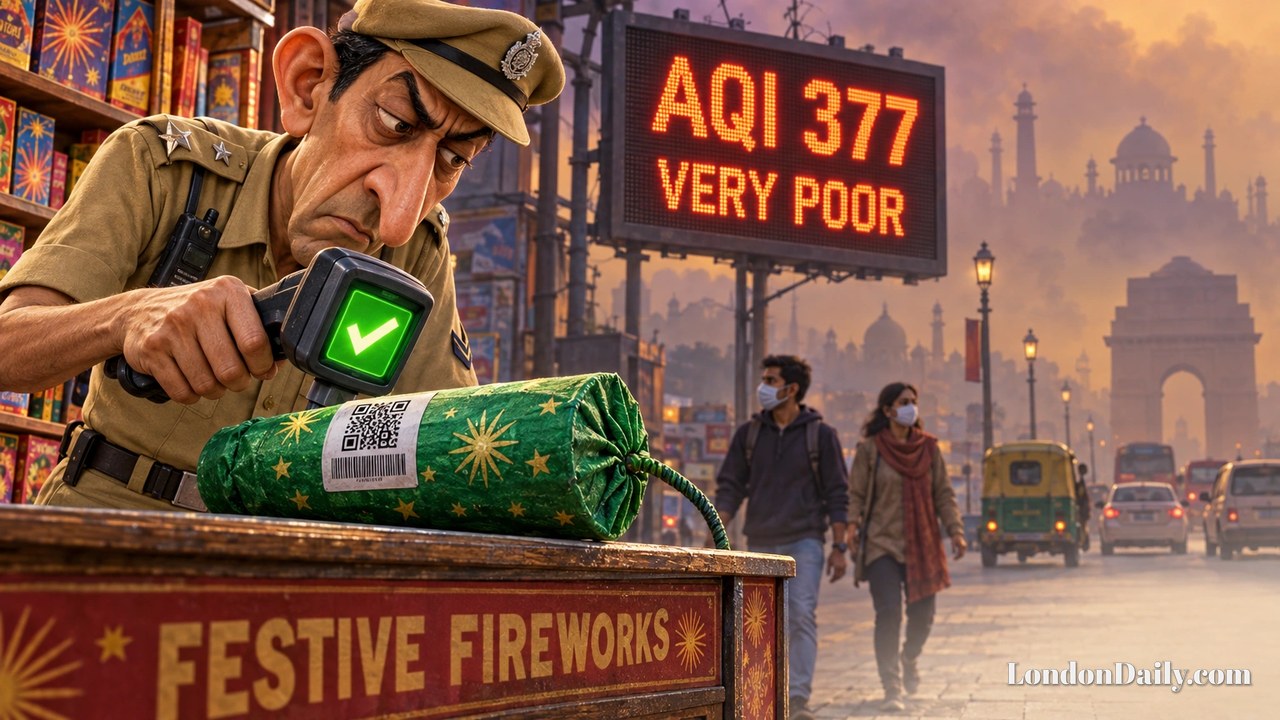
The capital’s air quality index reached 377 on Wednesday morning, within the pollution watchdog’s ‘very poor’ range of 301–400. Readings above 400 are classified as ‘severe’. Officials said forecasts of continuing very poor air prompted Stage II of the Graded Response Action Plan, which imposes progressively stricter controls as pollution rises.
Measures include intensified road cleaning, higher parking charges to discourage private vehicle use and expanded public transport. Delhi Metro has added 20 weekday train trips, while authorities have been directed to stagger government office hours to reduce congestion.
On Monday, the Supreme Court allowed certified green firecrackers to be manufactured, sold and used in Delhi and neighbouring areas for a limited period. They may be set off on 7 and 8 November only between 06:00 and 07:00 and between 20:00 and 22:00 local time. Fireworks are prohibited within 300 metres of hospitals, care homes, schools and other designated silence zones.
Green firecrackers use modified chemicals designed to reduce emissions. Mandatory QR codes identify their manufacturer and certification. Yet the court acknowledged that conventional fireworks had been sold as green alternatives even under a complete ban. Police must patrol designated sales areas, conduct random code checks and seize illegal stock.
Last year, Delhi experienced heavy haze after Diwali despite a court directive allowing less-polluting firecrackers. Fireworks add fine particles and harmful gases to pollution already generated by traffic, industry and crop-stubble burning.
The deterioration follows Delhi’s lowest average October air quality index in eight years. Experts attribute the reversal to falling temperatures, slow winds and increased crop-residue burning in Punjab and Haryana. Rain and stronger winds briefly cleared the air; returning northwesterlies then carried smoke towards Delhi.
The index covers eight pollutants, including PM2.5: particles about 30 times smaller than a human hair’s width that penetrate deep into the lungs. Prolonged exposure can cause respiratory problems and aggravate existing illnesses, particularly among children and older people. During especially severe episodes, authorities have used hybrid schooling, home working and vehicle restrictions.
Mumbai, despite its coastal winds, reached 322 on 24 October amid low winds, construction dust, rubbish burning, fireworks and pollution from neighbouring regions. After nearly two weeks of smog, its reading improved to a ‘satisfactory’ 89 on Wednesday; neighbouring Navi Mumbai recorded a ‘moderate’ 118.
For Delhi, the immediate test is whether tighter pollution controls and firework checks can prevent a further deterioration during Diwali.








Join the conversation