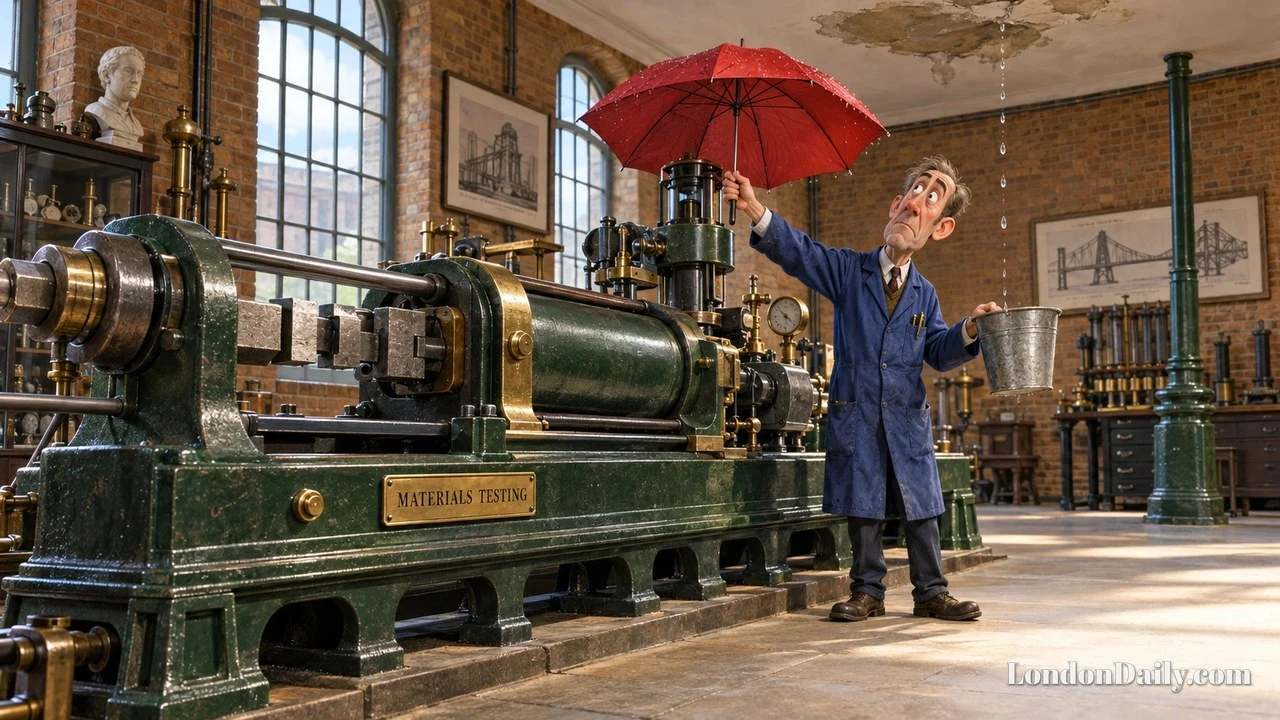
A Victorian laboratory that helped establish modern construction-materials testing is suffering from water penetration and extensive damp, placing it among 16 London sites newly added to Historic England’s 2026 Heritage at Risk Register.
Kirkaldy’s Testing Works in Southwark, built in 1873 for engineer David Kirkaldy, is regarded as the world’s earliest purpose-built independent commercial materials-testing laboratory. Its giant hydraulic testing machine remains largely original and operational. Components for major Victorian engineering projects were tested there, and investigations included the Tay Bridge disaster. Historic England assesses the Grade II*-listed building as poor and declining.
The additions bring London’s total to 596 at-risk heritage assets. However, 24 sites were rescued and removed from the register last year: inclusion identifies danger, rather than an inevitable loss.
At Fulham Palace, both the Grade I-listed South Range and William Butterfield’s 1866 chapel receive Priority A, Historic England’s highest concern category. The South Range incorporates a great hall dating from around 1480. For the chapel, the assessment records an “immediate risk of further rapid deterioration or loss of fabric; no solution agreed.”
Gallows Tamkin, hidden within Coombe Wood Golf Course in Kingston upon Thames, served Henry VIII’s Hampton Court water supply. Built between 1538 and 1540, the surviving inspection building faces high vulnerability and a declining outlook.
Several additions expose the difficulty of securing lasting uses for historic buildings. Lewisham’s former Coroner’s Court and mortuary has been largely empty since the mortuary closed in 2009, despite temporary use as a cinema. The council declared it surplus in 2024, opening the possibility of sale. Conversely, Tower Hamlets Local History Library and Archives remains open, but its building is rated poor: continued use alone does not prevent deterioration.
Other additions include Chelsea’s former Walton Street police station, assessed as in “very bad” condition; King Edward Hall in Finchley; Croydon’s House of Reeves; the Livesey Hall Boundary Wall in Lewisham; and 16 Lonsdale Square, Islington.
Warren Farm Barn in Chadwell Heath and Dagenham’s former Rainham Road South police station face slow decay. Croydon’s Elis David Almshouse remains broadly stable despite deterioration. At 68 Silver Street, Enfield, accessibility and fire-safety improvements must preserve historic fabric. College Farm Trust aims to refurbish and partly rebuild Finchley’s College Farm, whose Foreman’s House is another addition.
Historic England chiefs Claudia Kenyatta and Emma Squire advocate bringing buildings back into use. The immediate challenge varies considerably: stopping water damage, adapting former workplaces or agreeing a viable future where none yet exists.








Join the conversation