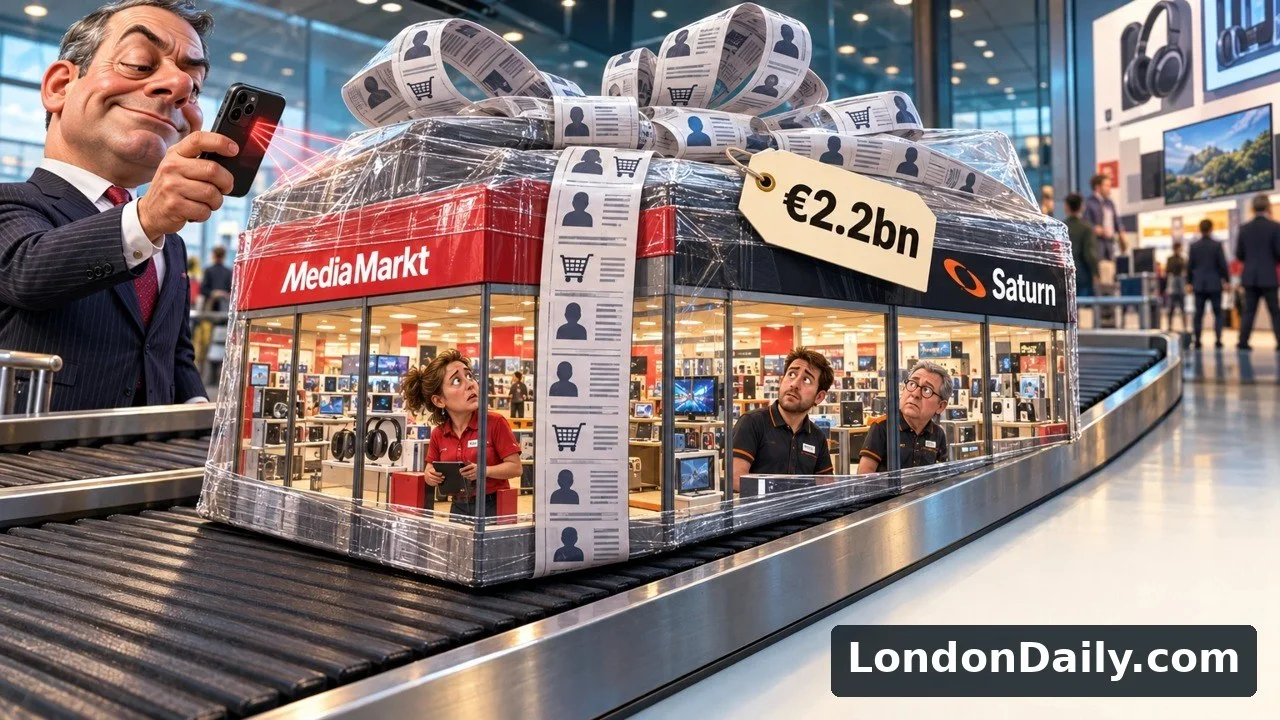
MediaMarkt and Saturn’s parent company, Ceconomy, has been sold to a Chinese e-commerce group for €2.2bn, giving an online retailer more than 1,000 European shops and extensive customer data while prompting fears over jobs.
Together, the chains constitute Europe’s largest electronics retailer, with about 400 shops in Germany and sales of €22bn last year. Their apparently competing brands already share ownership, and increasing numbers of Saturn branches have recently been renamed MediaMarkt.
At Berlin’s Alexanderplatz, their scale is evident: a road separates two branches, each with four floors measuring 2,000 square metres apiece. Ceconomy’s vast premises and workforce have squeezed margins, while ageing online platforms have hampered its response to digital competition.
The Beijing-based buyer, founded by Richard Liu in 1998, moved online in 2004. Automated warehouses, autonomous vehicles and delivery drones help it fulfil most Chinese orders the same day or the next. Weaker domestic demand and fierce price competition, including with Alibaba, have driven its European expansion. An earlier attempt to buy Britain’s Currys stalled for political reasons.
The commercial rationale combines advanced logistics with recognised European brands and established customers. The buyer sees European online retail, including Germany’s, as underdeveloped compared with China. Last year, it sold $187bn of property, principally large logistics centres in Britain, Germany, France, the Netherlands and Poland.
Many German economists fear widespread branch closures and redundancies among more than 50,000 employees. That concern reflects the tension between a costly shop network and the drive towards online sales; it does not establish that either chain will disappear.
European Union regulators approved the acquisition after establishing that the buyer had not received excessive state subsidies to finance it. Nevertheless, reservations persist over German companies’ declining market share in China, Chinese expansion in Europe and acquisitions such as industrial robot manufacturer Kuka, whose sensitive technology attracted criticism.
Jonas Shofman, a consultant at a German investment company, points to MediaMarkt’s entry into China in 2010 and withdrawal three years later. He argues that a comparable German takeover there would never be permitted, and alleges that China threatened consequences if the EU rejected this purchase.
For customers, the unresolved questions concern both products and information: whether cheaper Chinese-made appliances will displace Western goods, whether their durability will match brands such as Bosch and Siemens, and whether the ownership change will weaken trust. Regulatory approval settles the subsidy assessment, not how the new owner will use its extensive database of European purchasing habits.








Join the conversation