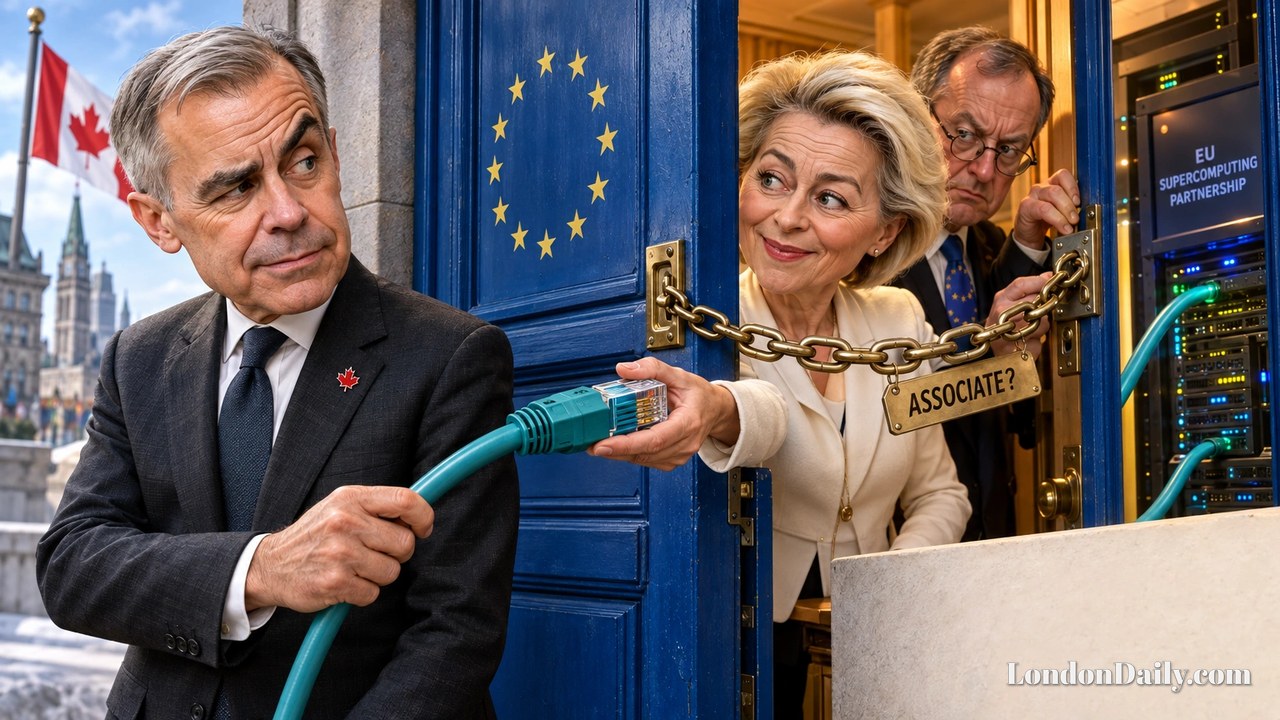
Canada and the European Union have launched an Alliance for the Future, inviting other like-minded countries to join a partnership intended to strengthen economic security and reduce exposure to geopolitical pressure.
Prime Minister Mark Carney and European Commission president Ursula von der Leyen announced the initiative in Montreal on Friday, concluding a two-day summit. Canada also agreed to contribute to a €90bn support loan for Ukraine.
The leaders said further negotiations would pursue a more integrated market worth tens of billions of dollars, fewer trade and travel restrictions, and educational opportunities. These remain ambitions rather than completed arrangements.
Carney cited climate change, the erosion of democratic norms and the use of trade as a weapon. Von der Leyen argued that economic pressure falls on households through supermarket prices and car costs, while energy, critical minerals and semiconductor suppliers increasingly become instruments of leverage. Carney said closer co-operation could strengthen supply chains against shocks.
A trade war with the United States has driven Canada’s search for partners. Carney has also warned that reliance on American defence technology leaves Canada exposed to companies or political actors with conflicting interests. The backdrop includes Elon Musk’s reduction of Starlink and Starshield speeds over Ukraine in mid-October, severely disrupting Ukrainian military operations. Musk, a dual Canadian citizen, opposes the governing Liberals and has advocated provincial separation.
Technology agreements give the partnership a practical dimension. A planned merger between Canada’s Cohere and Germany’s Aleph Alpha would create an artificial intelligence company with headquarters in Toronto and Berlin. Canada has announced a stake in Cohere worth up to C$1.6bn. Friday’s supercomputing agreement would give Canadians access to European machines for training AI models.
The proposed designation of Canada as an EU associate member is less settled. Von der Leyen described it as uncharted territory and said the partnership was not directed against anyone else. European Council president Antonio Costa called Canada “by far the most European of the non-European countries”.
Some EU members, however, fear a legally meaningless designation would confuse countries seeking membership. Germany and other states sought to remove the phrase from the draft summit statement. Carney and von der Leyen nevertheless used it again; its scope is due to become clearer at a 2027 summit.
The gathering also exposed a domestic dispute. Quebec premier Paul St-Pierre Plamondon, whose separatist Parti Québécois recently won minority government, stayed away after Ottawa refused him a public speaking role. He argued that a reception invitation and a place at the head table offered visibility without meaningful influence over Quebec’s interests.








Join the conversation