

Brazilian variant: Hancock denies quarantine delays put lives at risk
It comes as officials seek a person in England who has been infected with a concerning variant of the virus which causes Covid-19 first found in Brazil.
They are one of six cases of the P1 variant found in the UK in February.
Mr Hancock said there was "no evidence" the infected person had not followed home quarantine rules.
Asked by BBC political editor Laura Kuenssberg if the delay to hotel quarantine measures could have put lives at risk, the health secretary said "no".
Mr Hancock said home quarantine measures and travel restrictions on Brazil had already been in place before the hotel policy was implemented.
He told a Downing Street press conference there had not been "any further knock-on transmissions in the data" and he hoped the evidence that the five known cases had followed the rules was "very reassuring to people".
He added the government intended to go ahead as planned with the reopening of schools in England on 8 March.
The person infected with the variant who has not been traced is understood to have used a home testing kit, but did not complete their registration form properly.
It has prompted an appeal for anyone without a result from a test on 12 or 13 February to come forward immediately by calling 119.
As the person has not been identified officials do not know if they have recently travelled abroad or if they have been self-isolating, as they will not have received their test result.
Public Health England's Dr Susan Hopkins said they were tracking the Brazilian variant "very closely" and said it was "extremely rare" for someone not to provide their full contact details.
She added PHE was doing "everything they can to track down the individual".
On Monday, a further 104 deaths within 28 days of a positive coronavirus test were reported, with 5,455 new cases identified across the UK.
While figures are often lower at the start of the week due to reporting lags, cases are down by 49% compared with last Monday.
More than 20.2 million people have received a first dose of a Covid vaccine, according to the latest government figures.
Labour leader Sir Keir Starmer said the search for the infected individual demonstrated the "slowness of the government to close off even the major routes" and said he still thought "we have not secured our borders in the way that we should have done".
During a visit to a school in Stoke-on-Trent, Prime Minister Boris Johnson said the UK had one of the "toughest border regimes anywhere in the world" and said the government had moved "as fast as we could" with introducing hotel quarantine measures.

It is tempting to think that, if officials can identify the one missing case, the UK will be able to stamp out the Brazil variant.
But it's unlikely this will be possible. There will no doubt be more cases either of this variant or others circulating with the E484 mutation that allows the virus to escape some of the effect of the vaccines.
That's because not all positive cases can be checked for variants. The UK carries out nearly half of the genomic sequencing in the world and can check around 25,000 positive tests a week for variants.
That means about a quarter of positive cases were checked last week, but a month ago - with infection rates higher - it was under one in 10.
What is more, not everyone who is positive comes forward for a test in the first place. We are seeing just the tip of the iceberg.
So what is the strategy? Keep cases low, and where possible try to limit the spread of these variants.
And in the future, update the vaccines to work better against the variants - if that is needed.
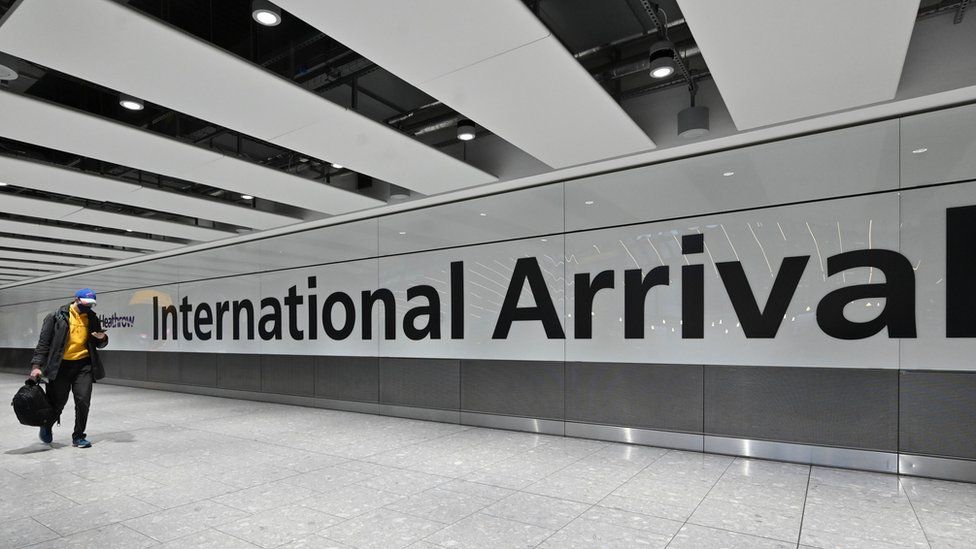
The hotel quarantine rule came into force on 15 February. It means that travellers coming to England from 33 countries - including Brazil - must pay to quarantine in a hotel for 10 days, while in Scotland the rule applies to international travellers from all countries.
Before that date, travellers arriving into the UK still needed to self-isolate in their homes for 10 days.
All travellers to the UK also need to present a negative Covid test result, taken a maximum of 72 hours before their departure.
Why is it difficult to track the infected person?

Health officials believe the missing person may have used a home testing kit.
Every home testing kit has a unique barcode on it.
People must register this barcode online to link the test to a person's contact details.
Without doing this, the test will effectively be anonymous.
So, what is likely an error in that registration process meant the positive result has been picked up but there is no one to send it to.
Tests done in person at drive-thru or walk-in centres are less likely to see this occur, as much of the information is filled in before the person arrives and there are staff on hand to make sure it is done correctly.
In any given week, around 1.5% of cases passed on to contact tracers do not have the person's contact details.
Where are the other five cases?
The unidentified England case of the Brazil variant is not currently linked to five other UK cases.
Two of the cases are from the same household in South Gloucestershire. They tested positive after someone returned from Brazil on 10 February - five days before the government's hotel quarantine rule came into force. Everyone in five postcode areas of South Gloucestershire is now being invited to take a Covid test, even if they do not have symptoms.
Two other people in the same household have also since tested positive for Covid - but tests are still ongoing to check if it is the same variant.
The other three cases are Scottish residents who flew to Aberdeen from Brazil via Paris and London, the Scottish government said.
Holyrood said the three people tested positive while self-isolating. Other passengers who were on the same flight to Aberdeen are now being contacted and there is no reason to believe the variant is in circulation in Scotland, Health Secretary Jeane Freeman said.