London Daily

Focus on the big picture.
Saturday, Jul 04, 2026

Bank of England will not hit panic button yet over rising inflation

Bank of England will not hit panic button yet over rising inflation

Analysis: it will not be long before UK inflation is above the official 2% target

A doubling of the annual inflation rate to 1.5% in April means the UK government’s preferred measure of the cost of living is rising at its fastest rate in more than a year. The lifting of restrictions on the economy mean further increases are nailed on over the coming months and it won’t be long before inflation is above the official 2% target.

This will not come as a surprise to the Bank of England, which predicted as much in its monetary policy report earlier this month. Despite forecasting this year the strongest growth since the second world war, Threadneedle Street sees rising inflation as temporary. It is certainly not hitting the panic button yet.

There are three main reasons why the inflation rate has risen. First, the figure is influenced by what happened this time last year, and in April 2020 prices didn’t rise because the economy was in its first, brutal coronavirus lockdown. What happened back then is no longer having a downward impact on the annual inflation rate.
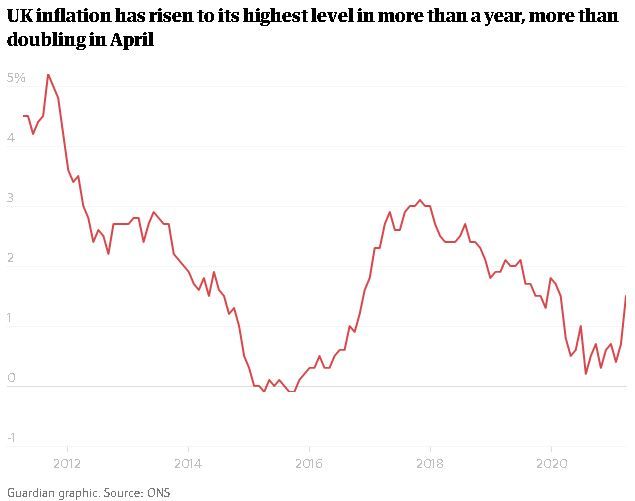

Second, energy costs have risen for motorists and for domestic fuel users. Rising prices at petrol stations added 0.3 percentage points to the annual inflation rate last month, and the raising of Ofgem’s gas and electricity price cap added a further 0.3 points. Taken together, energy accounts for 75% of the 0.8 percentage point increase in inflation from 0.7% to 1.5%.

Finally, prices rose in sectors of the economy that opened up in April, notably clothing and footwear. Retailers had been offering big discounts during the lockdown but did not feel the need to be so generous as the shops were opened up.

The annual rate of clothing inflation rose from –3.5% in March to +0.5% in April, and similar upward moves in the cost of restaurant meals, accommodation and air fares can be expected as restrictions are gradually lifted on those sectors.

Each month the Office for National Statistics publishes data for core inflation – a measure that strips out food, alcohol, tobacco and energy. This measure, closely watched by the Bank of England, did rise in April but only from 1.1% to 1.3%.

There are some signs from producer prices – which provide early warning signs of inflation to come – of a pickup in industry’s costs. But those would have to feed through into much stronger core inflation for the Bank to really start thinking about a change of policy.

Newsletter

Related Articles

0:00
0:00
Close
Cornwall Van Dwellers Face Homelessness Risk as Council Tightens Enforcement
Police Investigate Stabbing of Iranian Journalist in London
Rare Copy of US Declaration of Independence Discovered in UK Archive
Department for Education Data Shows Persistent Literacy Gap Among Disadvantaged White Pupils
London Casino Faces Legal Action Over Alleged Tip Distribution Practices
England Records Hottest June on Record as Heatwave Disrupts Services Nationwide
UK Foreign Office Ends Overseas Education Programme for Women and Girls After Shortfall
UK Lawmakers Call for Urgent Action to Preserve Historic Outdoor Lidos
Police Criticise Extended Pub Opening Hours for England World Cup Fixture in Mexico
UK Safety Authorities Warn Parents Over AI-Generated Child Abuse Imagery Risks
Reform UK-Led Council Struggles to Attract Sponsors for Union Flag Promotion Scheme
OpenAI UK Investment Uncertainty Grows After Reported Setback on Stargate Data Centre Site
British Medical Association Warns of Severe Financial Crisis and Possible Staff Cuts
UK Devolution Debate Intensifies as Celtic Nations Prepare Breakup Contingency Plans
Starmer Signals Labour Transition as Burnham Emerges as Potential Successor
UK Government Consults International Partners on Maritime Trade Security and Energy Market Stability
Rare Revolutionary-Era Documents Discovered by UK Archives and Undergoing Authentication
UK Consumer Confidence Remains Deep in Negative Territory as Household Spending Stays Cautious
Transport for London Warns of Severe Disruption as Major Events Converge in Central London
NHS and Social Care Sectors Face Ongoing Recruitment Shortages Amid Persistent Workforce Gaps
Rising Energy Costs Drive Price Pressures Across UK Retail and Service Sectors
Competition and Markets Authority Expands Review of Artificial Intelligence Impact on UK Media Markets
UK Parliamentary Committees Intensify Scrutiny of National Security and Industrial Policy Legislation
Bank of England Faces Persistent Inflation Pressure as Rate Cut Expectations Fade
UK Public Finances Under Pressure as Borrowing Exceeds Forecast and Debt Nears 95% of GDP
Major Police Deployment Across Central London as Mass Demonstrations and Pride Parade Converge
Large-Scale Police Dispersal Powers Activated in Liverpool Ahead of Anti-Immigration Protests and Counter-Demonstrations
Luxury bags take over the World Cup: style, status symbol, or just showing off?
National Productivity Institute Highlights Weak Business Investment Outside Southern England
UK High Court Orders Reassessment of Environmental Impact in Major Highway Project
UK Cyber Security Centre Warns of Rising Threat From State-Sponsored Digital Espionage
UK Education Secretary Launches National Reform of Apprenticeships and Vocational Training
Financial Conduct Authority Tightens Climate Risk Disclosure Requirements for Listed Firms
Rail Union Suspends Planned Strike Action to Enter Formal Negotiations With Operators
Northern Ireland Businesses Seek Clarity Over Post-Brexit Trade Rules
Welsh Government Launches Regional Growth Plan Targeting Transport and Digital Infrastructure
North Sea Wind Sector Attracts £5 Billion Investment Amid Expansion of Offshore Capacity
Scotland and UK Governments Establish New Framework for Coordinated Investment in Energy and Infrastructure
UK Government Launches Major Immigration and Border Policy Overhaul Review
Bank of England Signals Interest Rates to Remain Elevated Despite Easing Inflation Pressures
National Health Service Warns of Severe Winter Capacity Strain Across Hospital Trusts
Chancellor Orders Urgent Treasury Review Amid Concerns Over Structural Public Finance Gap
Prime Minister Unveils Sweeping Legislative Programme Focused on Housing, Health Service Reform and State Energy Plan
UK Parliamentary Committee Launches Inquiry Into Falling Primary School Rolls and Public Service Impact
UK House of Lords Debates Electoral Commission Powers and Political Finance Reform
UK Parliament Considers Expanding Carbon Rules to International Aviation and Shipping Emissions
UK Traffic Commissioner Revokes Hampshire Haulage Operator Licence Over Regulatory Failures
UK Parliament Examines Risks in Public Contracts Awarded to Technology Firm Palantir
UK Competition Watchdog Moves Toward More Flexible Merger Rules to Support Efficiency and Growth
UK Government Seeks Approval for £1.15 Trillion Public Spending Plan Amid Scrutiny Over Department Budgets
×