Australia has designated a storage site beneath the seabed off its northern coast where a Japanese company plans to store vast quantities of carbon dioxide. The site, with capacity for up to 488 million tonnes, has become part of a global debate over whether carbon capture and storage can help tackle climate change or will prolong the use of fossil fuels.
Supporters say the project will play an important role in reducing emissions from industries that are difficult to decarbonise, such as steelmaking and shipping. Critics argue that it will damage vital habitats and endangered wildlife while promoting a technology that extends the use of highly polluting gas, oil and coal.
Carbon capture and storage involves three stages: capturing carbon dioxide, transporting it and storing it. When released into the atmosphere, the gas contributes to climate change. Some governments and fossil fuel giants, including Exxon Mobil and Shell, promote the approach as a climate solution that gives countries and industries more time to move to cleaner energy.
The International Energy Agency regards carbon capture, utilisation and storage as a tool for limiting climate change. However, its scenario for reaching net zero envisages the technology accounting for less than 5% of emissions reductions by 2050.
Opponents argue that the approach will slow global efforts to cut emissions, which are already off track. They say it allows power stations and industrial facilities to continue burning fossil fuels on the promise that the resulting pollution will be captured later.
Several such projects are already operating in the United States and Japan. In September, the European Union’s first offshore facility was inaugurated in the North Sea, near Denmark.
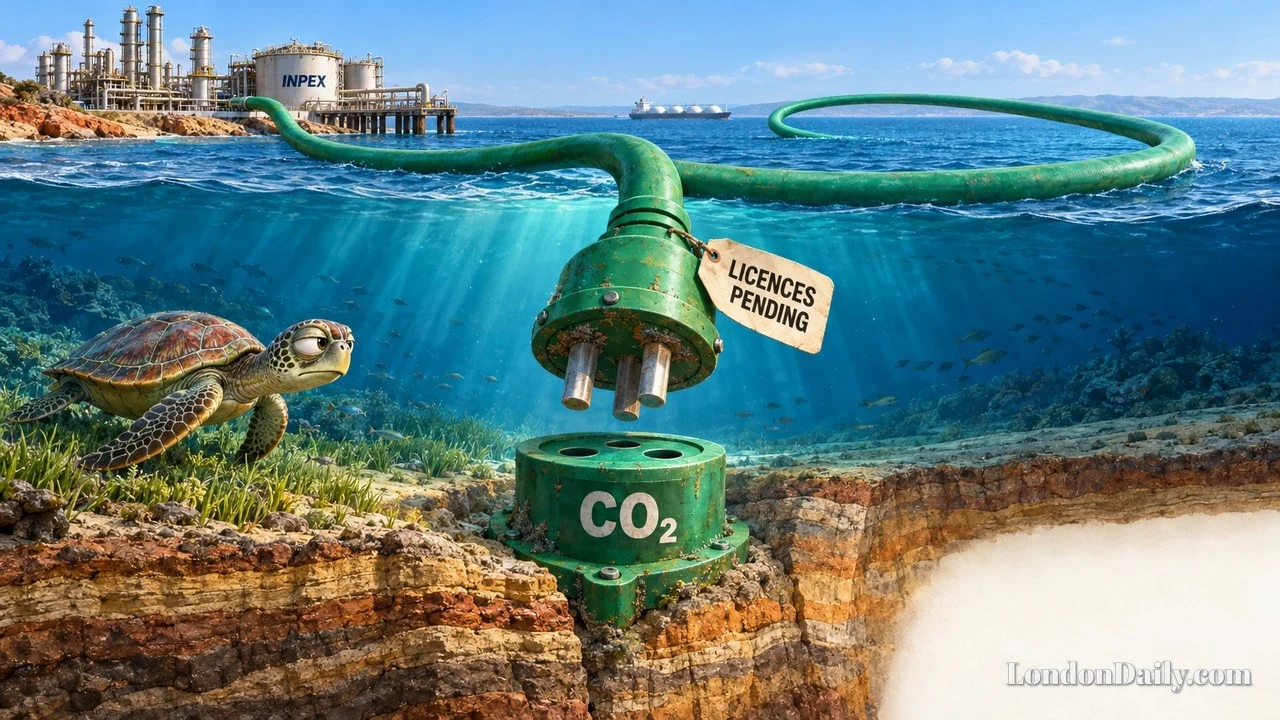
The Australian project will be led by the Japanese energy company Inpex, which is carrying out environmental impact assessments. The company must obtain further government licences before a final decision is made and the injection of carbon dioxide into underground storage reservoirs can begin.
The project will start in Darwin, the Northern Territory capital on the Timor Sea, and extend 260 kilometres offshore. Inpex says its main customer will be the Ichthys liquefied natural gas facility, in which it holds a majority stake. The facility exports most of its gas to Japan.
Other companies could eventually store their carbon dioxide at the site, which Inpex says can hold almost 500 million tonnes over 35 years.
Australia’s resources minister, Madeleine King, said the site’s designation was an important step and demonstrated the government’s support for technologies that help reduce emissions.
“Carbon capture and storage will play an important role in reducing emissions from hard-to-abate industries, helping Australia’s transition to net zero,” King said.
Environmental organisations, however, are concerned about the project’s effects on marine, coastal and terrestrial ecosystems. The area overlaps with habitats used by numerous endangered or migratory species, including dugongs, turtles and seabirds.
“The project will cause significant harm to these ecosystems,” said Chelsea Dang, a campaigner with the Australian Marine Conservation Society. “Much of this involves excavation, drilling and driving piles into ocean waters. This will inevitably damage water quality through the release of chemicals and also generate considerable underwater noise.”
Once the project is operating, she said, increased vessel traffic will cause further disturbance. Routine underwater surveys carried out by the Japanese company to detect leaks would also cause additional harm to the local ecosystem, she argued.
“The project has significant and harmful short- and long-term impacts, particularly for whale species. But it could adversely affect a range of organisms, including plankton, which have been documented dying up to 1.2 kilometres from sites of activity,” Dang said.
Japan, one of the world’s biggest polluters, has set ambitious targets for cutting its carbon emissions: a 60% reduction by 2035 compared with 2013 levels, and a 73% reduction by 2040. Yet heavily polluting industries, including steel and cement production, oil refining and shipping, are essential to its economy. Fossil fuels supply the overwhelming majority of its energy.
To bridge that gap, the Japanese government has described carbon capture and storage as essential.
“It enables decarbonisation in areas where switching to alternatives that do not rely on fossil fuels, such as electrification or hydrogen, presents difficulties. As a result, carbon capture and storage technology has become essential to achieving a stable energy supply, economic growth and decarbonisation simultaneously,” a document published last year by Japan’s Ministry of Economy, Trade and Industry stated.
Dang rejected that justification. “We see this as a greenwashing tactic that fossil fuel companies use to continue polluting the environment, rather than making the necessary choice to reduce production and phase out fossil fuels,” she said.








Join the conversation