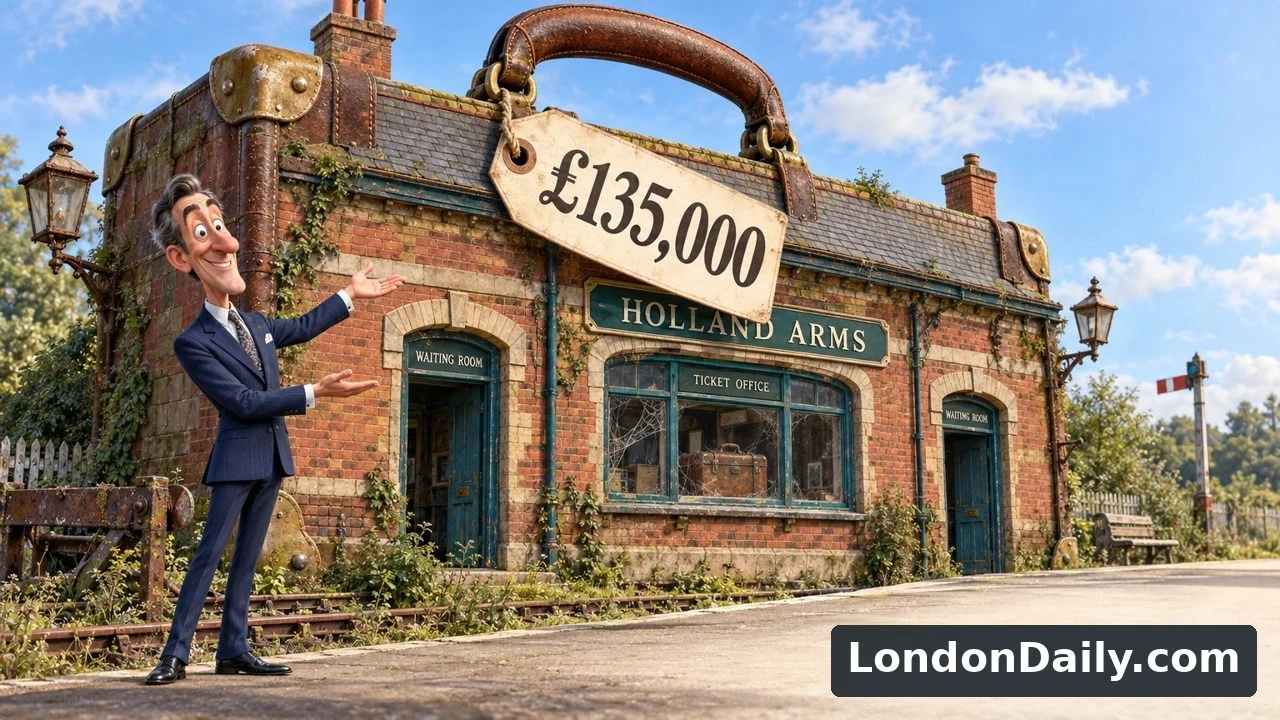
A Victorian railway station on Anglesey is on the market for £135,000 after standing empty for more than 70 years, with its ticket office, separate waiting rooms and a cobweb-covered suitcase still inside.
Holland Arms station in Pentre Berw opened on 12 March 1865 and closed on 4 August 1952 as traffic dwindled. The largely intact building retains features that explain both how the railway operated and the social conventions of its time, including separate male and female waiting rooms.
Selling agent Williams and Goodwin says the property could become something “truly individual”, including a home, subject to planning permission. It also presents the sale as an opportunity to preserve part of the island’s railway history. Residential conversion is a possibility, not an approved use.
Among the surviving details is a staff-only lamp room, where oil lamps were serviced and flammable fuel kept away from passengers before gas and electric lighting became widespread. Rusted signal lamps remain; red tail lamps marked the back of trains for those following. A Welsh-language sign dated 1883 warns trespassers on the tracks of a 40-shilling fine. Old suitcases and even a bathtub occupy one room.
Named after the nearby Holland Arms Hotel, the station was the second stop on the Anglesey Central Railway between Gaerwen and Amlwch, Wales’s most northerly town. It also served the branch to Red Wharf Bay, which lost passenger services in 1930 and freight in 1950, weakening Holland Arms’s traffic before its closure.
Residents had championed the central railway, financed independently of the established North Wales Main Line. It opened in stages between 1864 and 1867, but financial difficulties led to its purchase by the London and North Western Railway in 1876.
Passenger services on the central line survived until 1964, ending during the controversial national closures following Dr Richard Beeching’s recommendation to cut a third of Britain’s network to restore British Railways to profitability. Much of the Anglesey route remains, although vegetation obscures the track at Holland Arms.
Its future has competing possibilities. In 2021, Lein Amlwch secured a 99-year lease from Network Rail allowing it to work towards restoring railway use. Lôn Las Môn instead hopes to create a walking and cycling trail.
Volunteer restoration elsewhere offers a precedent: sections of the former Ruabon–Corwen route, closed in the late 1960s, now carry steam and diesel services on the Llangollen Railway in Denbighshire. At Holland Arms, the building’s next use and the wider route’s future remain separate, unresolved matters.








Join the conversation