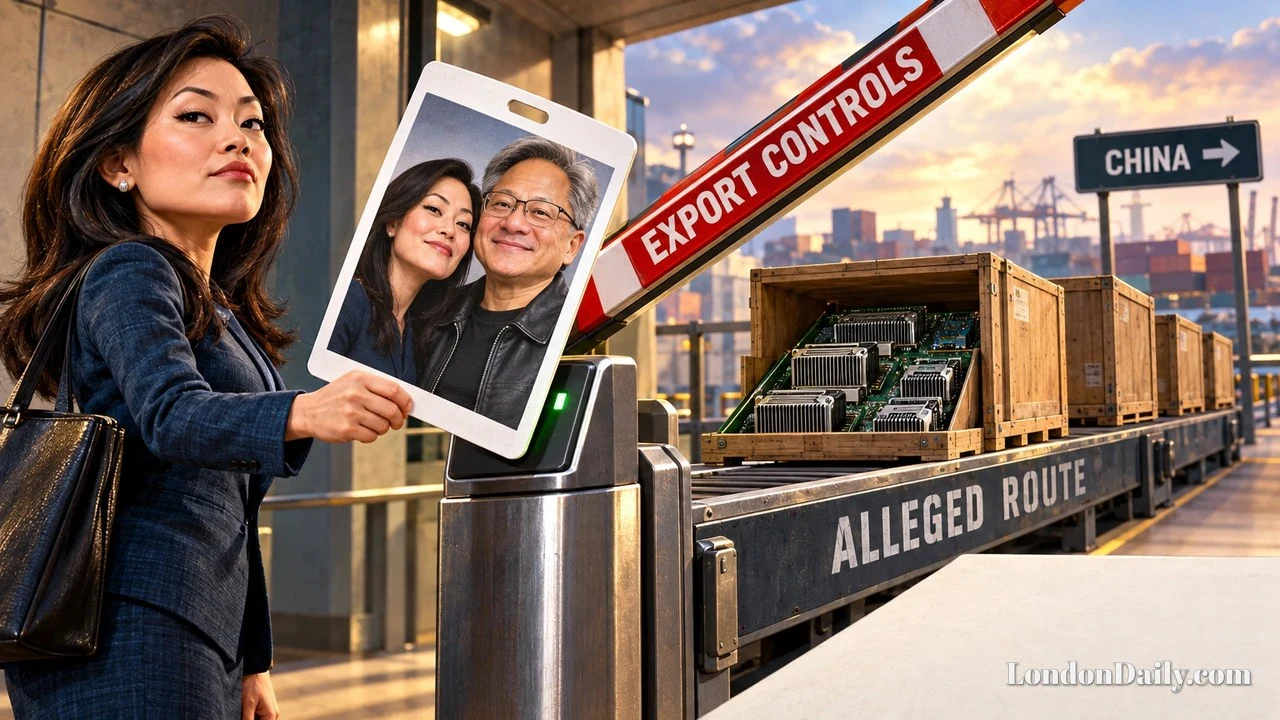
Chinese businesswoman Alice Huang allegedly used her relationship with Nvidia chief executive Jensen Huang to help secure advanced artificial intelligence chips through a corporate network whose purchases totalled about $7.5bn, an investigation alleges.
Two insiders alleged that she personally helped move around 240,000 advanced processors into China, mainly H100 and H200 models, alongside A100 chips. Whether Jensen Huang participated in the transactions or knew chips were destined for customers subject to American restrictions remains unclear.
Alice Huang, also known as Huang Le, allegedly showed prospective customers photographs of herself with the chief executive, promoted their closeness and intervened when orders or deliveries stalled. Their appearances together included California’s CordeValle golf resort in September 2024 and a Taipei restaurant during Computex in May 2025.
The investigation links her, her husband Kang Wei and her sister Huang Yu to companies across China and South-east Asia. It estimates that Singapore-based Megaspeed imported $4.6bn of chips between 2023 and 2025, with another $2bn imported through Malaysia’s Speedmatrix. Purchases attributed to Shanghai Century Litong brought the total to about $7.5bn.
Huang became Megaspeed’s chief executive and a director in March 2023. Corporate records traced ownership through Huang Le Limited in the British Virgin Islands before its transfer to Singapore’s Swiftdata in November, when she left the board. Megaspeed gained Nvidia cloud-partner status around that ownership change; industry figures alleged she remained involved afterwards.
Century Litong, indirectly controlled by her sister according to records examined in the investigation, gained preferred cloud-partner status in October 2023. That month, Washington widened restrictions to cover Nvidia’s China-focused A800 and H800 processors, although distributors still held existing stocks.
American investigators reportedly found advanced Nvidia hardware still boxed at Speedmatrix facilities in Malaysia, prompting suspicion that the sites also served as transit points. Nvidia’s general counsel, Tim Teter, subsequently reportedly asked a Commerce Department official about Huang’s alleged questioning in Singapore. Restrictions on investigators followed and the case moved to the Justice Department; no causal connection has been established.
On 31 October, Singapore’s home affairs ministry confirmed a Megaspeed investigation but denied that its government had investigated Huang over her relationship or suspected Chinese intelligence links. Reported American suspicions that she worked for China’s Ministry of State Security remain publicly unproven.
The case also exposes a distinction between moving chips and selling access to them. Overseas data centres can rent computing power to Chinese customers without physically exporting processors to China; such services are not necessarily unlawful. Washington’s concern is that advanced AI computing can support military and intelligence uses. Establishing which transactions breached restrictions remains separate from proving espionage.








Join the conversation