Italian police recovered a stolen 17th-century painting after an artificial intelligence system recognised it beneath alterations designed, apparently, to disguise its identity. The case illustrates how image-matching software can find artworks that conventional searches miss, without necessarily bringing their thieves to justice.
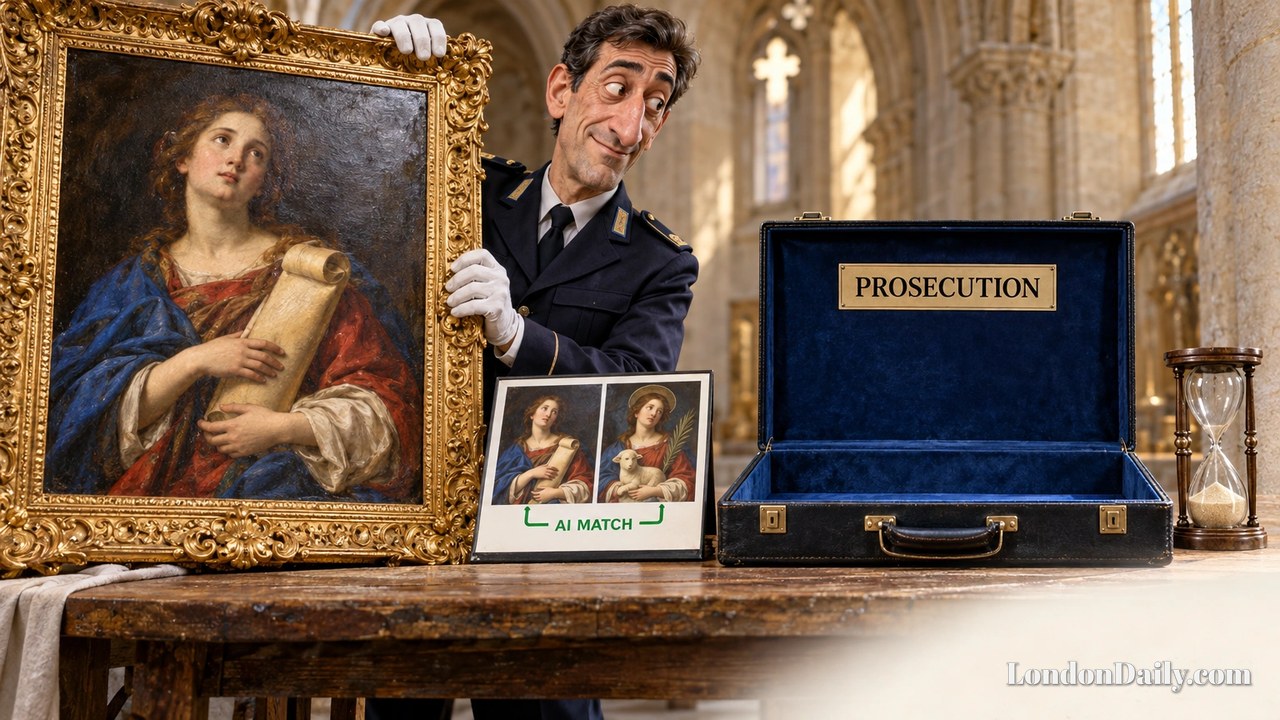
Officers photographed the metre-high painting of Saint Agnese at an antiquities fair in Parma in October 2024. Within hours, their Stolen Works of Art Detection System, known as Swoads, flagged a possible match. Police seized it the following day for examination.
The painting had disappeared from the Virgo Potens church on 11 August 2004. Its lamb had apparently been painted over to resemble a parchment scroll, while the saint’s halo and palm branch had been erased. A keyword search for a woman holding a scroll would therefore have missed the original record. The software instead identified similarities in colour, pattern and composition.
Italy’s stolen-art database, maintained since 1969, contains more than a million items, though not all have photographs. Older images can be blurred, poorly lit or black and white. Swoads also searches online listings and can recognise fragments of paintings that have been cut apart.
Lieutenant Colonel Salvatore Rapicavoli says that, since its introduction in November 2023, the system has helped recover more than 300 large paintings and statues and over 165,000 smaller objects, together worth more than €203 million (£170 million).
Those results do not make a visual match proof of authenticity or criminal responsibility. Art Recognition co-founder Carina Popovici describes AI as a “force multiplier”: it cannot identify an unrecorded theft, and recovery still requires investigators and legal co-operation.
Former FBI art-crime chief Timothy Carpenter warns that following the leads requires substantial staffing. Poor training images and different camera angles remain problems, particularly for three-dimensional objects. Copies create further uncertainty: Interpol says its records for Murillo’s The Melon Eaters concern stolen versions, not the authenticated original in Munich.
Carpenter also warns that criminals can use AI to alter images and fabricate provenance documents. Authentication researcher Steven Frank argues that high-profile stolen works may never appear in searchable sales channels. Rapicavoli likewise does not expect the system to recover every major missing masterpiece.
In the Saint Agnese case, there was insufficient evidence for a criminal case, and the elapsed time barred prosecution under Italian law. The reseller had little provenance information and probably inherited it through his family business.
Police returned the painting to the church on 20 May 2025 for restoration and rehanging. Rapicavoli recalled local delight: a recovery with community value, even without a prosecution.








Join the conversation