

WHO COVID-19 Origins Report Finds Wuhan Lab Leak Conspiracy Theory ‘Extremely Unlikely’
The long-anticipated report from a World Health Organization (WHO) mission to China’s Wuhan has found that it’s “extremely unlikely” that SARS-CoV-2, the virus that causes COVID-19, escaped from a research lab. However, it also failed to firmly point the finger at animal-to-human transmission as well, which until now was the prevailing thesis.
The report delivers few definite answers, except to say that “more timely and comprehensive data” is needed in the future. It advised further research into every area of inquiry, but noted the theory that SARS-CoV-2 escaped from the Wuhan Virology Lab has the least credibility. The scientists also suggested a new research area might be the 7th Military World Games, a huge military sports event Wuhan hosted in October 2019, two months before the first cases of the virus were detected.
The 12-nation team, which included Chinese scientists, also looked at direct zoonotic transmission to humans (possible-to-likely), introduction through an intermediate host followed by spillover (likely to very likely), and introduction through the cold food chain (possible). As Sputnik has previously reported, the lattermost field, which was raised by the Chinese government after it was proven that SARS-CoV-2 can survive in a deep freeze for significant amounts of time, was widely lambasted in the Western media, which instead pushed the lab escape theory, which has never had serious credibility.
Lab Escape Theory
In fact, the lab escape theory emerged from some media figures even before COVID-19 had reached a global pandemic phase, and by March 17, 2020, scientists had already sequenced the virus’ genome and found it impossible to have been engineered. Then-US President Donald Trump revived the conspiracy theory in May as the outbreak spiraled out of control and US deaths approached 100,000 people. Figures from his administration have continued to push the discredited theory, with former Centers for Disease Control and Prevention Director Robert Redfield making the claim just last week.
The administration of US President Joe Biden, who took office in January, has continued Trump’s line of attack, demanding Beijing hand over all its data on COVID-19 origins after the WHO team dismissed the lab escape theory last month. Trump’s secretary of state and former CIA director, Mike Pompeo, made the same comments just days earlier.
On Monday, WHO Director General Tedros Adhanom Ghebreyesus also urged continued follow-up on the lab escape thesis, due to the team’s inconclusive results.
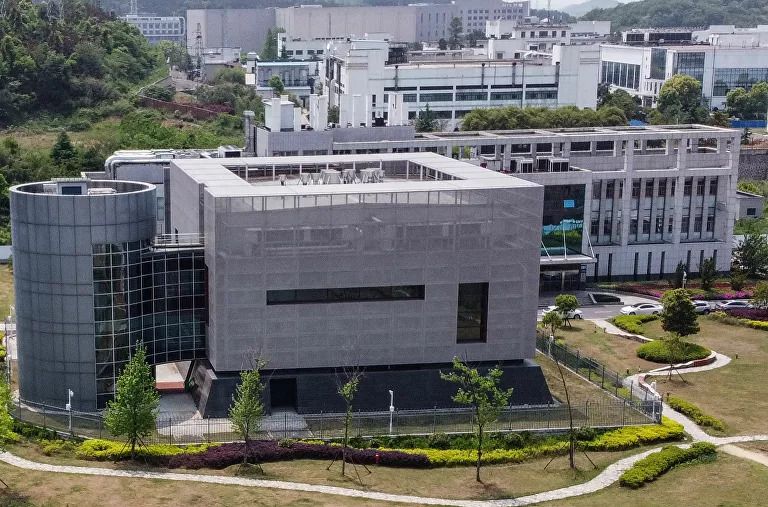 This file photo taken on April 17, 2020 shows an aerial view of the P4
laboratory at the Wuhan Institute of Virology in Wuhan in China's
central Hubei province
This file photo taken on April 17, 2020 shows an aerial view of the P4
laboratory at the Wuhan Institute of Virology in Wuhan in China's
central Hubei province
Animal Source Uncertain
Interestingly, the WHO report also failed to zero in on an animal source for the virus. An early and prevailing theory since the virus was discovered is that SARS-CoV-2 came from a species of bat that had been hunted and sold at the Huanan wet market in Wuhan, much as several prior coronaviruses that caused deadly outbreaks have.
“Evidence from surveys and targeted studies so far have shown that the coronaviruses most highly related to SARS-CoV-2 are found in bats and pangolins, suggesting that these mammals may be the reservoir of the virus that causes COVID-19,” the report notes. “However, neither of the viruses identified so far from these mammalian species is sufficiently similar to SARS-CoV-2 to serve as its direct progenitor. In addition to these findings, the high susceptibility of mink and cats to SARS-CoV2 suggests that additional species of animals may act as a potential reservoir.”
The team’s animal and environment working group looked at a number of animals, including horseshoe bats and pangolins, and examined more than 80,000 wildlife, livestock and poultry samples from 31 Chinese provinces; none showed SARS-CoV-2 antibody or nucleic acid either before or after the SARS-CoV-2 outbreak in China. However, they did find that the Huanan market was highly contaminated, with 73 of 923 environmental samples from the market testing positive. That is perhaps unsurprising, since many early human cases came from the market.
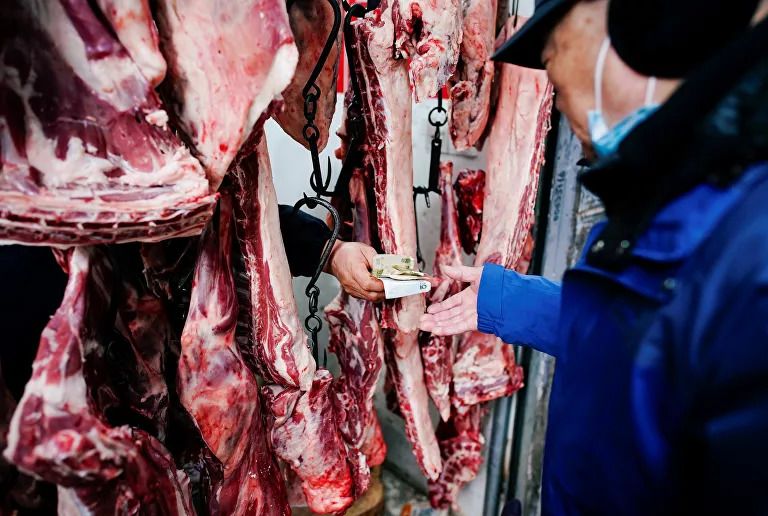 A vendor holds Chinese yuan notes as a customer pays for lamb at a wet
market almost a year after the global outbreak of the coronavirus
disease (COVID-19) in Wuhan, Hubei province, China December 7, 2020
A vendor holds Chinese yuan notes as a customer pays for lamb at a wet
market almost a year after the global outbreak of the coronavirus
disease (COVID-19) in Wuhan, Hubei province, China December 7, 2020
“There is evidence that some domesticated wildlife the products of which were sold in the market are susceptible to SARS-CoV, but none of the animal products sampled in the market tested positive in this study,” they noted. However, other samples from “upstream suppliers” of the market, as well as samples from other markets, did not reveal evidence of the virus circulating in animals.
Earlier Date for Outbreak
Their findings have also pushed back the data of the earliest known COVID-19 cases. Citing molecular sequence data, which they note “can be considered estimates,” the scientists suggest the outbreak might have started as early as late September 2019, but most estimates point to sometime between mid-November and mid-December, when the first definitive cases of a particularly harsh “flu” were noted in several Wuhan hospitals.
That time frame includes the October 2019 World Military Games, a 109-nation multi-sport tournament that Wuhan hosted between October 18 and October 29 of that year. More than 9,000 athletes participated in the event, with another 230,000 volunteers helping with various aspects of staging. While the WHO report noted that "no appreciable signals of clusters of fever or severe respiratory disease requiring hospitalization were identified during a review of these events," the scientists recommended a deeper review of the records of on-site clinics during the games.
On Tuesday, the US and several of its closest allies issued a joint statement calling for “transparent and independent analysis and evaluation, free from interference and undue influence,” claiming the study was “significantly delayed and lacked access to complete, original data and samples.”