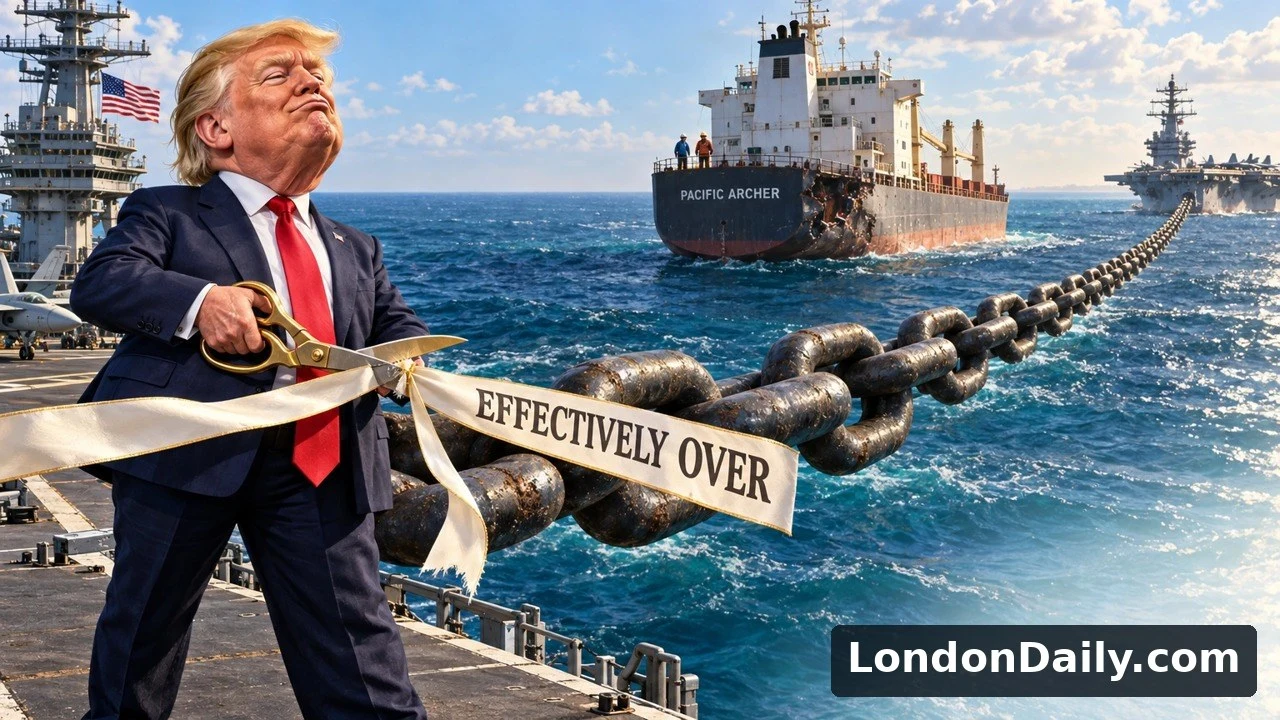
American forces disabled the merchant vessel Pacific Archer in the Gulf of Oman after it attempted to breach the blockade of Iranian ports, US Central Command said on Friday.
The command said Thursday’s air strike used precision munitions against the Palau-flagged vessel’s stern, disabling its propulsion without harming the civilian crew. The ship had departed Bandar Abbas; tracking data listed Singapore as its intended destination.
Pacific Archer is at least the 15th vessel immobilised since the blockade began in April and the sixth since enforcement resumed in July after a suspension during summer talks with Tehran. The previous disabling strike was on 7 November. US military authorities say they have diverted 158 commercial vessels and disable ships that refuse instructions.
Central Command says merchant ships receive repeated warnings before being targeted. The tactic nevertheless carries demonstrated risks: Indian officials confirmed that three Indian sailors died when American forces struck the tanker Settebello in June. That attack drew international criticism and condemnation from the head of the International Maritime Organization.
The latest strike comes as Washington weighs whether to renew a wider conflict that began in late February and has settled into stalemate. Regional officials said earlier in November that Israeli Prime Minister Benjamin Netanyahu was pressing Washington to restart the war or permit Israeli strikes on Iran’s nuclear facilities and missile capabilities.
Gulf governments, Pakistan and Turkey have pursued coordinated diplomacy, including calls with senior US officials, to prevent renewed regional warfare. Donald Trump has alternated between threatening large-scale bombardment and saying the conflict “militarily is effectively over”. Two American aircraft carriers and numerous supporting warships remain deployed in the region.
Iran’s Revolutionary Guard said on Friday that one tanker struck a naval mine while attempting an unauthorised route through the Strait of Hormuz and another was turned back. Those accounts could not be independently verified. The Guard also claimed unauthorised tanker movements had fallen significantly; Tehran continues to demand permission for passage.
Rystad Energy put crude flows in November’s first fortnight at about 13 million barrels a day, roughly 20 per cent below October, when exports broadly matched prewar levels of 15–16 million barrels daily. Contributing factors include Iranian attacks deterring tankers and reduced flows through the Saudi pipeline to Yanbu, which has also suffered attacks.
The economic effects extend beyond this blockade. UN Trade and Development says disruption across Hormuz, the Red Sea, Black Sea and Panama Canal is lengthening routes, increasing fuel costs and creating port bottlenecks and market instability. Alternative ports and inland routes have kept trade moving, but at greater expense.








Join the conversation