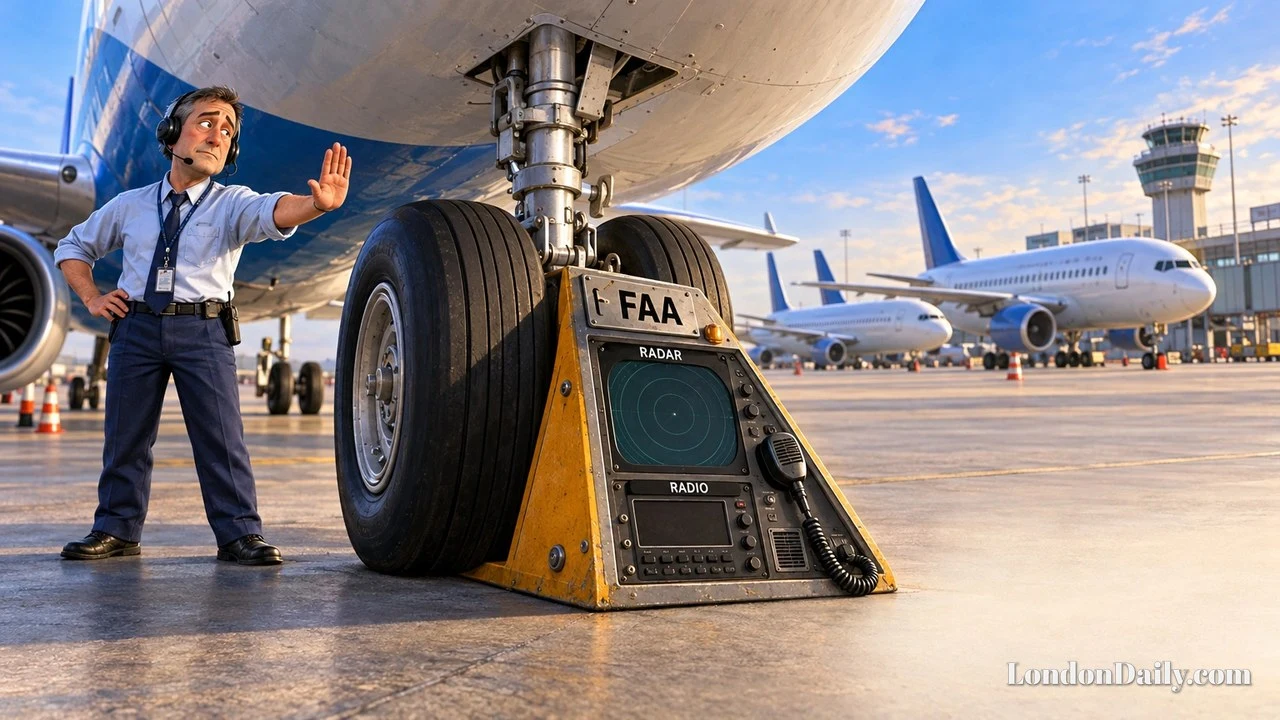
The Federal Aviation Administration ordered all departures from US airports to stop last night, Friday, after a widespread failure in the radar and communications systems used by American air traffic control.
The extraordinary shutdown, the first on this scale since January 2023, caused severe disruption to air travel and also affected flights to Israel. More than 9,000 flights in the United States were delayed during the day, according to flight-tracking company FlightAware, although not all those delays were necessarily caused by the failure.
The cause remains unclear. The US administration said there was no indication at this stage of a cyberattack.
An aviation source familiar with the situation told CNN that the widespread disruption affected both the radar systems used by air traffic controllers and the radio frequencies through which they communicate with pilots. Both systems were hit simultaneously at different locations across the country.
According to the source, even air traffic controllers themselves did not yet know what had caused the disruption or precisely what was happening within the systems.
The failure prompted the exceptional decision to halt departures nationwide on safety grounds while the extent of the problem was established. In a notice to airlines, the FAA said the decision had been taken because of “extraordinary circumstances and safety considerations”.
The order covered all flights scheduled to depart from US airports, both domestic and international, including services to Israel. Aircraft already airborne were allowed to continue their journeys and land under controllers’ instructions, while international flights heading towards the United States were being handled individually.
The shutdown began shortly before 4pm New York time and was initially scheduled to remain in place until 11pm. The FAA stressed, however, that this was the period covered by the order, not an estimate of how long the fault would last. Departures could resume earlier, or the shutdown could be extended. No official time for the resumption of operations had been announced.
US Transport Secretary Sean Duffy confirmed that the failure was affecting all 22 regional air traffic control centres, which manage aircraft movements between airports across the country. He said FAA technicians were working to identify and resolve the source of the disruption.
Homeland Security Secretary Markwayne Mullin also addressed the incident, seeking to reassure the public. He said there was no indication at this stage of a cyberattack or hostile action against the United States.
“It’s simply a communications failure,” he said, making clear that the investigation was continuing.
Mullin stressed that there was no known danger to passengers already in the air: “Everyone is safe. There is no reason to worry about your loved ones if they are flying.”
The central concern is that the longer departures remain suspended, the greater the disruption to airline schedules will become, even after operations resume. Such incidents create a knock-on effect: aircraft and crews fail to reach their planned destinations, potentially causing further delays and cancellations even at airports not directly affected by the fault.
The failure that traumatised controllers — and the new AI system
The current shutdown sharpens concerns about the state of US air traffic control infrastructure, some of which relies on equipment that is decades old.
Last year, a series of serious failures hit the radar and communications systems used by controllers responsible for aircraft taking off from and landing at Newark Liberty International Airport in New Jersey.
According to CNN, the disruption originated in a copper cable carrying information to the control centre. A fault in the cable caused losses of radar coverage and radio contact with aircraft.
Several controllers subsequently took special leave because of the trauma they had experienced. Their absence worsened existing staff shortages and led to prolonged delays and flight cancellations.
The US Department of Transportation said the faulty copper cable was later replaced with a fibre-optic cable to prevent similar failures recurring.
Another failure in the US air traffic control communications network last September affected air traffic in the north-east of the country and disrupted hundreds of flights.
Aviation experts believe the current incident could also be linked to ageing infrastructure, but stress that there is not yet enough information to establish what caused the nationwide failure.
Another line of inquiry will be a possible connection to a new artificial intelligence-based system whose use was expanded across the United States only this week.
The system, known as SMART, is designed to help manage air traffic by analysing information from around 200 different sources. These include flight paths, weather conditions, airport congestion and staffing levels at control centres.
On Tuesday, the FAA announced that use of the system would be extended to all 22 regional air traffic control centres in the country.
There is, however, no evidence at this stage linking the new system to the failure. It operates from a single centre in the Washington area and provides recommendations for managing air traffic; it does not directly control aircraft or radar and communications systems.
Mullin confirmed that investigators would also examine whether there was any connection between the expanded use of the system and the current disruption.
The previous nationwide shutdown took place in January 2023, when a failure in the NOTAM system, which provides notices and alerts to pilots, halted departures across the United States for about an hour and a half.
Before that, a nationwide flight ban was imposed following the terrorist attacks of 11 September 2001. Unlike on 11 September, however, aircraft already airborne this time were not required to land immediately.
Against this backdrop, the White House and the US Department of Transportation are seeking additional funding to upgrade the country’s air traffic control network.
Last year, Congress approved $12.5 billion to modernise the system, including replacing old copper cables with fibre optics and upgrading communications equipment and computer systems.
Duffy says completing the project will require a further investment of around $30 billion. The administration warns that, without a substantial infrastructure upgrade, the US air traffic control network will remain vulnerable to failures and disruption.








Join the conversation