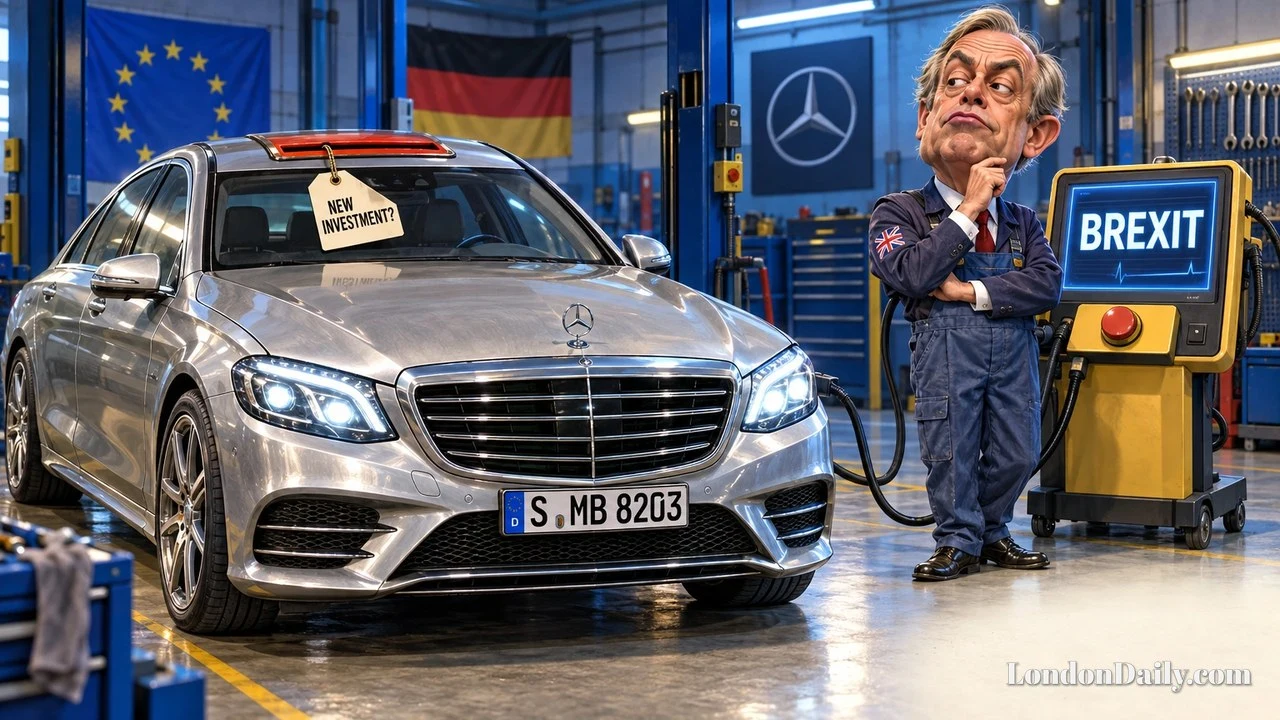
Mercedes-Benz’s reported announcement that it will stop new investment in Germany should puncture the comforting idea that Britain’s economic difficulties can all be filed under Brexit. Germany did not leave the European Union. Trouble in its industrial heartland demands an explanation that reaches beyond Britain’s departure.
The reported position is severe: no further investment in Germany, no new cars to be built there, and a review of whether continued German operations are affordable. Those are claims about the company’s intentions, not evidence that its existing German production has already stopped. Even with that distinction, the prospect is serious enough. A country can retain its factories while losing the investment that gives them a future.
Volkswagen’s difficulties add to the concern. The claim that BASF has cut 100,000 jobs needs confirmation and should not be treated as an established figure. But the central argument does not require every alarming number to be true: industrial weakness in Germany cannot sensibly be explained by Britain having left the EU.
That does not make Brexit a triumph. Nor does German weakness prove that Brexit imposed no costs on Britain. Both propositions would be evasions. The narrower, stronger point is that membership has not insulated Germany from industrial trouble. Britain’s problems belong partly within a wider European problem, and an explanation confined to Brexit cannot account for that.
The policy response therefore needs more ambition than another argument about the referendum or another assumption that higher taxes will supply the answer. Taxation can raise revenue. It cannot, by itself, make a manufacturer judge that its next factory or model belongs in Europe. The crucial decision is where the next investment goes.
My fear is that China could eventually make something like 90% of the world’s cars. That is a prediction, not an established destination. But it describes the danger plainly: if carmaking shifts overwhelmingly to China, a substantial source of European output goes with it. Europe cannot replace that production merely by finding more ingenious ways to tax what remains.
Does this mean Western civilisation ends in ten, twenty or thirty years, perhaps sooner? That is a fear, not a timetable anyone can establish. The immediate danger is concrete enough without pretending to possess one: Europe could lose the industrial capacity on which much of its prosperity depends. A factory still operating today is scant reassurance if the investment for tomorrow goes elsewhere.








Join the conversation