

UK’s progress on Covid now squandered, warns top scientist
The emergence of the Omicron variant shows that the world is “closer to the start of the pandemic than the end”, one of Britain’s most senior scientific figures has warned, as he lamented a lack of political leadership over Covid.
Sir Jeremy Farrar, the director of the Wellcome Trust who stepped down as a government scientific adviser last month, said the progress in combatting Covid-19 since its emergence was “being squandered”.
Writing in the Observer, he said rich countries had been taking “a very blinkered domestic focus, lulled into thinking that the worst of the pandemic was behind us”. He said while he was cautiously hopeful that current vaccines would protect against severe illness from Omicron, that may not be true for future variants.
“The longer this virus continues to spread in largely unvaccinated populations globally, the more likely it is that a variant that can overcome our vaccines and treatments will emerge,” he writes. “If that happens, we could be close to square one.
“This political drift and lack of leadership is prolonging the pandemic for everyone, with governments unwilling to really address inequitable access to the vaccines, tests and treatment. There have been wonderful speeches, warm words, but not the actions needed to ensure fair access to what we know works and would bring the pandemic to a close.”
He said that the urgent action needed had not changed – “wearing masks indoors, increasing testing, social distancing, isolating if positive (with support to do so) and vaccination will all help to drive down transmission and protect against illness.”
Farrar’s intervention came as a major charity raised concerns about the government’s booster jab campaign, which it sees as the best current method of combating the virus. Caroline Abrahams, charity director at Age UK, said the programme was “frankly in a mess”. She said: “It’s way behind where it should be, and to hear this week that as many as one in five care home residents have not yet had their boosters was nothing short of alarming.”
She spoke out after some targets for GPs were suspended to allow them to concentrate on administering jabs. Routine health checks for the over-75s and for new patients may be deferred under the new guidance.
“Against this context we agree that the top priority now is to turbo-charge the booster programme, to ensure as many older and vulnerable people as possible get their jabs, and fast,” said Abrahams. “In the end this situation is another demonstration of how underpowered our GP system has become. Unless and until we invest more heavily in it we will continue to see these hard choices arising whenever a crisis comes along, and that’s certainly not in any one’s interests, least of all older people’s.”
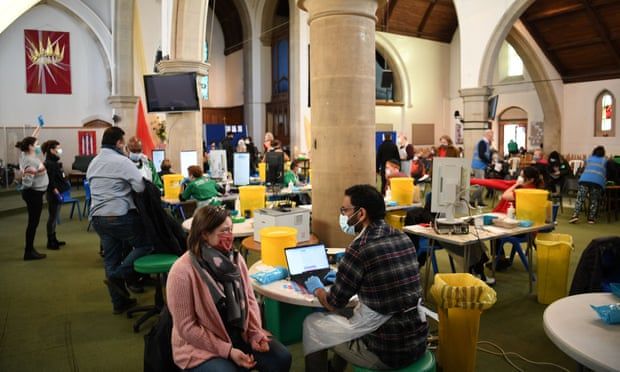 Booster jabs being administered at St John’s Church in west London on 4 December 2021.
On Saturday, On Saturday Downing Street announced that it was introducing pre-departure tests for people travelling to the UK. From 4am on Tuesday, travellers will have to complete a lateral flow or PCR test 48 hours before entering the country. Nigeria has been added to the red list, and from 4am on Monday arrivals will have to quarantine in hotels. Officials said the moves came as evidence emerged that the Omicron strain had been reported in more than 40 countries, with apparent community transmission in places such as Norway. They also said there was evidence that the incubation period was shorter than for other variants.
Labour had been pushing for the introduction of the tests. A Downing Street source said that new evidence about the spread of the variant and its characteristics had driven the decision. It will cause further frustration for the travel industry, which has been heavily affected by Covid restrictions.
The sudden spread of Omicron has dismayed many scientists. “What has really surprised me has been the rapidity of the increase in numbers of cases being reported from South Africa,” said Prof François Balloux of University College London. “Cases are doubling at a rate I have never seen before. It is very worrying.”
Early estimates have suggested this rise is being driven by the fact that the Omicron variant can infect between three and six times as many people as Delta, over the same time period. It is an alarming figure that has been balanced by early reports which have suggested the variant is, at present, less likely to lead to hospitalisation.
However, scientists last week warned caution should be taken with such data. “It is already a tight situation. Even if Omicron is less likely to cause severe illness, it may still cause more hospitalisations and put further strain on the health service, because so many more people will become infected,” said Prof Rowland Kao, of Edinburgh University.
There is also evidence that more than one in four (27%) British workers would turn up for work with symptoms of the Omicron variant because they needed the money, including 23% of those whose job puts them at increased risk of infection. Also, 16% of workers say they would be able to work from home, but are not allowed to by their employer, according to polling for the Royal Society for Arts, Manufacturers and Commerce (RSA). Just 31% say they would get support from their employer beyond statutory sick pay.
“To secure the economic recovery, workers must be economically secure,” said Anthony Painter, RSA’s chief research officer. “In the short term, we need to see an ‘auto-furlough’ system and more generous sick pay, but long term, both the Conservatives and Labour must spell out how they will address the deep economic insecurity Covid has only exposed.”
Saturday saw further demonstrations in Europe against various governments’ coronavirus measures. In Austria, the first country in the EU to announce that it is to make vaccination against Covid mandatory, more than 40,000 joined a protest in Vienna.
The Dutch city of Utrecht saw several thousand demonstrate against restrictions that were introduced last weekend. Protesters carried banners reading “Medical Freedom Now!”. Many protesters denounced what they see as increasing pressure from the Dutch government to get vaccinated if they want to participate in regular society.
In Frankfurt, Germany, police broke up a demonstration of several hundred people for failing to wear masks or maintain social distancing, using batons and pepper spray after they were attacked by a group of protesters. In Berlin, small groups gathered to protest after a large demonstration was banned.