London Daily

Focus on the big picture.
Sunday, Jul 12, 2026

UK government could restrict travel for people who refuse Covid boosters

UK government could restrict travel for people who refuse Covid boosters

Sources say plans for travel restrictions being looked at, with 10m now having received third jabs

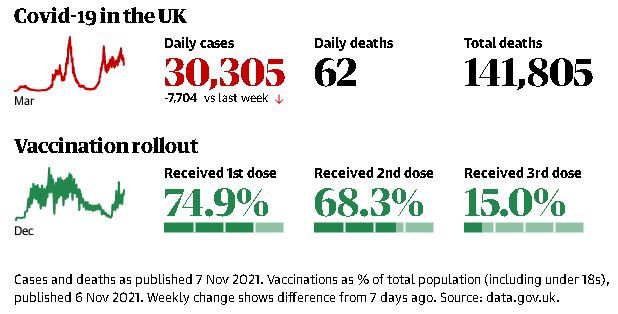
More than 10 million people in the UK have had Covid vaccine top-up shots, figures show, as government sources confirmed they are looking at plans for travel restrictions on people who do not take up the booster offer.

NHS figures for Sunday showed that 10,062,704 people in the UK had received a booster jab, or third shots for those with weakened immune systems, with the number in England reaching 8.5 million.

The milestone follows a record day for boosters on Saturday when more than 371,000 people in England had the jabs. About 30% of over-80s and more than 60% of people aged 50 and over have yet to receive the extra doses, however.

The health secretary, Sajid Javid, urged people to take up the offer of booster shots when they became eligible, describing the push as a “national mission” that would help the country “avoid a return to restrictions and enjoy Christmas”.

In a move that may further drive booster uptake, No 10 sources confirmed that ministers were considering a change in the rules on travel so that eligible people who had turned down a third dose would face quarantine and testing if they went abroad. The change was said not to be imminent.

This month official guidance was updated to say government was “reviewing the implications and requirements of boosters for international travel certification” and “looking at whether and how booster vaccinations could be included in the NHS Covid pass for travel”.

Currently, all over-50s, health and social care workers, and people who are clinically vulnerable are able to receive boosters six months after their second dose. On Monday, the booking system will change to allow people to arrange their appointment a month before they have the shot.

John Roberts, a member of the Covid-19 Actuaries Response Group, said while the number of people becoming eligible for booster shots was still growing faster than boosters were being delivered, the situation had improved in the past week.

“The really positive thing is the change that allows people to book their booster up to a month early. That will make a really big difference to things over the next few weeks,” he said. “I’ve been worried that we wouldn’t get all priority groups done before Christmas mixing takes place but I think this will make a big difference.

“The important thing for me is the number who are being jabbed is growing. The weekly rate is up to 1.8 million now, and I think we’ll see quite a step forward over the next two to three weeks as people take advantage of being able to book in advance. The only caution is we seem to be struggling to get some of the over-80s boosted and I think maybe these people are less mobile, and may rely on their GP contacting them and to go to a centre very close to them.”

Vaccines are highly effective at preventing hospitalisations and deaths but protection wanes over time, particularly in elderly people and at-risk groups. The booster programme aims to top up people’s immunity before an expected rise in cases in winter.

Evidence from Public Health England shows that protection against hospitalisation falls from 95% to 75% in the five months after the second shot of the Oxford/AstraZeneca vaccine, and from 99% to 95% for the Pfizer/BioNTech shot. Even small falls can have a major impact on hospitals, with a change from 95% to 90% protection against hospitalisation doubling the number of admissions in those vaccinated.

Newsletter

Related Articles

0:00
0:00
Close
World Cup Visitors Turn American Big-Box Stores Into Souvenir Stops
Netflix Weighs Always-On Channels, Bundles and Short-Form Video
Passenger Is Pulled Partly Outside Ryanair Jet After Window Fails Mid-Flight
Innovation-led growth strategy
Public service reform pressure
Defence and industrial security
Labour leadership transition and economic reset
Northern England Pushes for Greater Influence in Britain’s Future Economic Model
UK Technology Strategy Focuses on Life Sciences, Digital Innovation and Research Investment
Britain and United States Maintain Focus on Pharmaceuticals Cooperation and Industrial Growth
UK Public Services Face Continued Pressure as Government Promises Visible Improvements
Regional Economic Power Becomes Key Theme in Britain’s Next Political Phase
Britain Expands Support for Small Businesses as Firms Seek Better Access to Finance
UK Economy Remains Central Political Challenge as Cost of Living and Growth Concerns Persist
National Health Service Introduces New Workplace Reviews to Improve Conditions for Healthcare Staff
UK Life Sciences Sector Secures More Than Three Billion Pounds in Investment to Support Innovation
Britain Strengthens Defence Strategy as Security Concerns Reshape Military and Industrial Policy
Andy Burnham Promises Stronger UK Defence Industry and Expanded Domestic Production
UK Government Faces Difficult Spending Choices as Labour Leadership Transition Approaches
Rachel Reeves Warns Andy Burnham of Immediate Economic Challenges After Expected Leadership Change
Andy Burnham Prepares to Lead UK Government With Plans for Regional Power Shift and Economic Reset
Government Creates Emergency Support Scheme for Financially Struggling Universities
United Kingdom Replaces Traditional Farm Subsidies With Payments Linked to Environmental Performance
National Grid Reports First Week of Electricity Generation Without Fossil Fuels
United Kingdom Financial Regulator Introduces Tougher Capital Rules for Cryptocurrency Exchanges
Belfast Harbour Expands Operations to Attract Investment Through United Kingdom and European Union Market Access
Scottish Government Threatens Legal Challenge Over Westminster Cuts to North Sea Transition Funding
United Kingdom Accelerates Trans-Pennine High-Speed Rail Project Linking Northern Cities
United Kingdom Secures Ten Billion Pound Investment for Cambridge Quantum Computing Campus
Port Talbot Steelworks Wins Support for Green Hydrogen Transition and Protection of Industrial Jobs
United Kingdom Sends Royal Navy Carrier Strike Group to Indo-Pacific as Regional Security Focus Expands
National Health Service Expands Artificial Intelligence Diagnostics Across England to Reduce Screening Backlogs
United Kingdom Launches Fifty Billion Pound Infrastructure Fund to Accelerate Housing and Construction
UK Medical Chiefs Update Health Guidance to Promote Everyday Physical Activity
Office of Communications Keeps Wikipedia Under Review Under UK Online Safety Rules
UK Defence Ministry Expands Deep-Strike Capability Through Precision Missile Programme
Russell Group Universities Warn Funding Cuts Could Damage NHS Workforce Training
UK Parliament Calls for National Emergency Broadcast as Heatwave Conditions Intensify
UK and Netherlands Strengthen Naval Cooperation With New Amphibious Defence Partnership
UK Defence Ministry Joins International Missile Programme With One Hundred and Ninety Million Pound Investment
Bank of England Warns Middle East Conflict and AI Risks Could Pressure UK Economy
UK Government Introduces New Rules to Limit Foreign Influence in Political Donations
UK and France Prepare Naval Mission to Protect Shipping Through Strait of Hormuz
United States Pressures UK to Increase Defence Spending at NATO Summit
Bank of England Warns Artificial Intelligence Investment Boom Could Create Financial Stability Risks
Bank of England Begins Direct Oversight of Critical Technology Providers Supporting UK Finance
Andy Burnham Set to Become UK Prime Minister After Labour Leadership Race Clears Path to Downing Street
Scottish Fishing Industry Calls for Emergency Support Amid Rising Costs
UK Supports Stronger European Response to Russian Actions in Ukraine
Devon and Cornwall Police Release Suspect in Ann Widdecombe Murder Investigation
×