London Daily

Focus on the big picture.
Wednesday, May 13, 2026

UAE starts up Arab world's first nuclear plant

UAE starts up Arab world's first nuclear plant

The United Arab Emirates has launched operations at the Arab world's first nuclear power plant, on the Gulf coast just east of Qatar.

Nuclear fission has begun in one of four reactors at the Barakah plant, which uses South Korean technology.

The plant was due to open in 2017 but start-up was delayed for what officials said were safety requirements.

The oil-rich UAE wants Barakah to meet a quarter of its energy needs, as it adopts more sustainable energy sources.

Just two weeks ago the UAE sent a probe on a mission to Mars - another high-profile scientific first for the Gulf nation.

The UAE is also investing heavily in solar power - a plentiful energy source in the Gulf. Some energy experts question the logic of Barakah, arguing that solar power is cleaner, cheaper and makes more sense in a region plagued by political tensions and terrorism.

Last year Qatar called the Barakah plant a "flagrant threat to regional peace and environment". Qatar is a bitter regional rival of the UAE and Saudi Arabia.


Across the Gulf lies Iran, hostile to the UAE, and subject to US sanctions because of its controversial nuclear programme.


Across the Gulf lies Iran, hostile to the UAE, and subject to US sanctions because of its controversial nuclear programme.

Dr Paul Dorfman, head of the international Nuclear Consulting Group, wrote last year that "the tense geopolitical environment in the Gulf makes nuclear a more controversial issue in this region than elsewhere, as new nuclear power provides the capability to develop and make nuclear weapons".

The London-based scientist also highlighted the risk of radioactive pollution in the Gulf.

In a statement the plant's developer the Emirates Nuclear Energy Corporation (ENEC) said it was committed to the "highest standards of safety and security" and that the plant would play an important role diversifying and decarbonising the economy.

"The Barakah plant will supply clean baseload electricity to the grid - complementing intermittent renewable sources of energy such as solar and wind, which are not able to generate electricity on a continuous basis," it said.

"It will provide up to 25% of the UAE's electricity needs once fully operational and will help prevent the release of 21 million tons of carbon emissions, equivalent to removing 3.2 millions cars off the road annually."
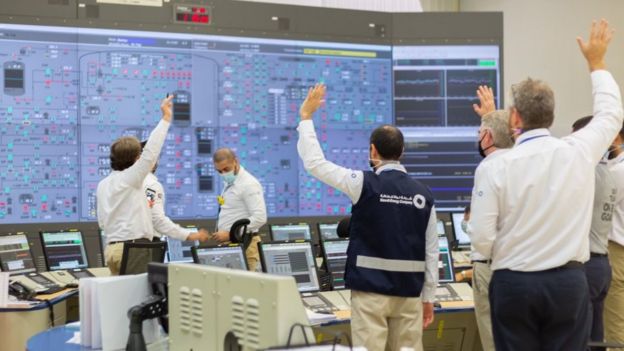

This photo, tweeted by Crown Prince Mohammed bin Zayed al-Nahyan, shows staff shortly after start up


'Important milestone'


UAE leaders hailed the start-up on Saturday as a symbol of the country's scientific progress.

The Barakah plant was developed by ENEC and Korea Electric Power Corporation (KEPCO). Energy will be generated by 1,400-megawatt pressurised water reactors, designed in South Korea, called APR-1400.

The International Atomic Energy Agency (IAEA) - the nuclear industry's main oversight body - praised Barakah in a tweet, saying the plant's Unit 1 had "achieved its first criticality" - that is, generation of a controlled fission chain reaction.

"This is an important milestone towards commercial operations and generating clean energy. IAEA has been supporting [United Arab Emirates] from the beginning of its nuclear power programme."

The leader of Abu Dhabi, Crown Prince Mohammed bin Zayed al-Nahyan, tweeted his congratulations "marking this milestone in the roadmap for sustainable development".

Newsletter

Related Articles

0:00
0:00
Close
The Great Western Exit: Why Best Citizens Are Fleeing the Rich World [PODCAST]
The New Robber Barons of Intelligence: Are AI Bosses More Powerful Than Rockefeller?
The End of the Old Order [Podcast]
Britain’s Democracy Is Now a Costume
The AI Gold Rush Is Coming for America’s Last Open Spaces [Podcast]
The Pentagon’s AI Squeeze: Eight Tech Giants Get In, Anthropic Gets Shut Out [Podcast]
The War Map: Professor Jiang’s Dark Theory of Iran, Trump, China, Russia, Israel, and the Coming Global Shock [Podcast]
Labour Is No Longer a National Party [Podcast]
AI Isn’t Stealing Your Job. It’s Dismantling It Piece by Piece.
Lawyers vs Engineers: Why China Builds While America Litigates [Podcast]
Churchill’s Glass: The Drunk, the Doctor, and the Myth Britain Refuses to Sober Up From
Apple issues an unusual warning: this is how your iPhone can be hacked without you doing anything
Kennedy’s Quiet War on Antidepressants Sparks Alarm Across America’s Medical Establishment
The Met Gala Meets the Age of Billionaire Backlash
Russian Oligarch’s Superyacht Crosses Hormuz via Iran-Controlled Route
Gunfire Disrupts White House Correspondents’ Dinner as Trump Is Evacuated
A Leak, a King, and a Fracturing Alliance
Inside the Gates Foundation Turmoil: Layoffs, Scrutiny, and the Cost of Reputational Risk
UK Biobank Breach Exposes Health Data of 500,000, Listed for Sale on Chinese Platform
KPMG Cuts Around 10% of US Audit Partners After Failed Exit Push
French Police Probe Suspected Weather-Data Tampering After Unusual Polymarket Bets on Paris Temperatures
CATL Unveils Revolutionary EV Battery Tech: 1000 km Range and 7-Minute Charging Ahead of Beijing Auto Show
Crypto Scammers Capitalize on Maritime Chaos Near the Strait of Hormuz: A Rising Threat to Shipping Companies
Changi Airport: How Singapore Engineered the World’s Most Efficient Travel Experience
Power Dynamics: Apple’s Leadership Shakeup, Geopolitical Risks in the Strait of Hormuz, and Europe's Energy Strategy Amidst Global Challenges
Apple's Leadership Transition: Can New CEO John Ternus Navigate AI Challenges and Geopolitical Pressures?
Italy’s €100K Tax Gambit: Europe’s Soft Power Tax Haven
News Roundup
Microsoft lost 2.5 millions users (French government) to Linux
Privacy Problems in Microsoft Windows OS
News roundup
Péter András Magyar and the Strategic Reset of Hungary
Hungary After the Landslide — A Strategic Reset in Europe
Meghan Markle Plans Exclusive Women-Focused Retreat During Australia Visit
Starmer and Trump Hold Strategic Talks on Securing Strait of Hormuz Amid Rising Tensions
Unofficial Australia Visit by Prince Harry and Meghan Expected to Stir Tensions with Royal Circles
Pipeline Attack Cuts Significant Share of Saudi Arabia’s Oil Export Capacity
UK Stocks Rise on Ceasefire Momentum and Renewed Focus on Diplomacy
UK to Hold Further Strategic Talks on Strait of Hormuz Security
Starmer Voices Frustration as Global Tensions Drive Up UK Energy Costs
UK Students Voice Concern Over Proposal for Automatic Military Draft Registration
Rising Volatility Drives Uncertainty in UK Fuel and Petrol Prices
UK Moves to Deploy ‘Skyhammer’ Anti-Drone System to Strengthen Airspace Defense
New Analysis Explores UK Budget Mechanics in ‘Behind the Blue’ Feature
Man Arrested After Four Die in Channel Crossing Tragedy
UK Tightens Immigration Framework with New Sponsor Rules and Fee Increases
UK Foreign Secretary Highlights Impact of Intensified Strikes in Lebanon
UK Urges Inclusion of Lebanon in US-Iran Ceasefire Framework
UK Stocks Ease as Ceasefire Doubts in Middle East Weigh on Investor Confidence
UK Reassesses Cloud Strategy Amid Criticism Over Limited Support Measures
×