

UAE is in talks with UK about 'red list' travel ban, should be off list 'soon,' Emirates chairman says
The chairman of Dubai’s flagship airline is optimistic about a return to travel between the United Arab Emirates and the U.K. — one of its top tourism and investment partners — even as a new Covid-19 variant threatens to complicate reopening plans.
The mostly-expatriate desert sheikhdom of roughly 10 million has been on the U.K.’s “red list” for travel since mid-January, requiring a mandatory hotel quarantine for anyone arriving from the UAE, which runs up a hefty price tag of £1,750 ($2,428) per person.
The UAE’s removal from the U.K.’s “safe travel” corridor early this year was triggered by an explosion of Covid-19 cases in both countries, set off by a highly contagious variant of the disease first identified in the U.K. Now as the summer months approach and vaccination rates increase, residents and executives alike are calling for a rethink of the ban.
“Our officials are already speaking and taking that very seriously; talking to the government and to the officials there to make sure that we should be very soon off the red list,” Emirates Chairman and Chief Executive Sheikh Ahmed bin Saeed Al Maktoum told CNBC at the Arabian Travel Market in Dubai on Monday.
Spokespersons for the U.K.’s Foreign Office and Transport Ministry were not immediately available for comment when contacted by CNBC. The U.K. Foreign Office currently “advises against all but essential travel to the whole of the United Arab Emirates based on the current assessment of COVID-19 risks.”
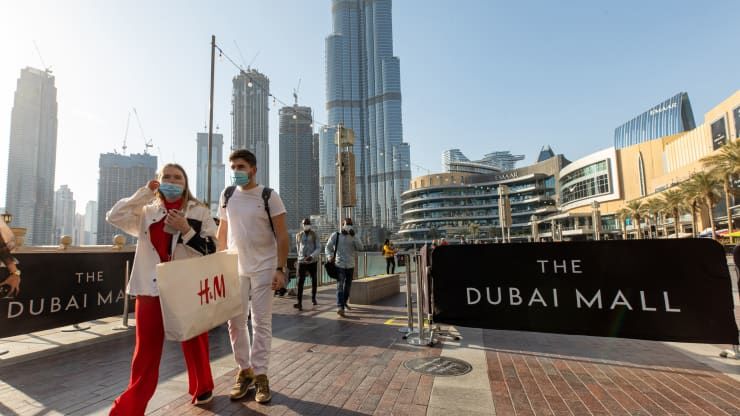 Shoppers wearing protective masks walk near the Dubai Mall and the Burj
Khalifa skyscraper in Dubai, United Arab Emirates, on Wednesday, Jan.
27, 2021.
Shoppers wearing protective masks walk near the Dubai Mall and the Burj
Khalifa skyscraper in Dubai, United Arab Emirates, on Wednesday, Jan.
27, 2021.
Asked what it would take for the ban to be lifted, Al Maktoum told CNBC’s Hadley Gamble: “I think first of all, you have to prove to the world that we are in the top three vaccinated (countries). That’s nearly 12 million people have been vaccinated so far, and in the UAE you have only nine 9.5 million people who live here. So that really should make the U.K. government think that we should be off the red list.”
The UAE currently boasts the second-fastest vaccine campaign globally, after Israel, in terms of vaccine doses per capita. According to the country’s health ministry, roughly 11.5 million vaccine doses have been administered as of Monday. Emirates in the country have authorized Sinopharm, Pfizer, AstraZeneca and Russia’s Sputnik V vaccines for use, though the jabs available vary between emirates.
Still, however, new daily Covid-19 cases per capita in the UAE are higher than those in the U.K. The reasons for this are uncertain, but have been attributed to everything from the UAE’s fully opened-up economy and more frequent testing to suspicions about the Sinopharm vaccine’s efficacy. Those suggestions have not been confirmed.
‘The issue is one of transit’
As a member of Dubai’s ruling royal family and as the head of one of the country’s largest enterprises, the Emirates chairman has particular clout — and both his company and the UAE have a significant amount at stake when it comes to the travel ban.
The UAE-U.K. flight routes were among the airlines’ most popular before the pandemic began. The red list designation also impacts many of the roughly 120,000 U.K. nationals living and working in the UAE and their family members, as well as Emiratis with properties and businesses in London and elsewhere in the U.K. Brits living in the UAE who want to visit their home country have expressed confusion and anger over Westminster’s decision, particularly over the red list’s hotel quarantine requirement.
“I’m sure they want to go back home, their kids want to go back and maybe see friends and family,” Al Maktoum said. “So I’m sure in the next six months, we will see a big moment of traffic.”
But for the U.K., which underwent one of the longest cumulative periods of lockdown in the world, caution is paramount. In late April, U.K. Transport Minister Grant Shapps said: “We’re not restricting the UAE due to the level of coronavirus in the UAE. The issue is one of transit.”
Critics of this statement say that any major city could act as a similar transit hub, and that there are ways of ensuring that people aren’t using Dubai — home to one of the world’s top airports for passenger traffic — as a travel gateway from more highly-infected countries.
The UAE banned flights from India, Pakistan, Bangladesh and Nepal in recent weeks amid a tidal wave of deadly cases sweeping South Asia. A dangerous new coronavirus variant believed to be behind the surge could complicate the U.K.’s own long-awaited reopening from lockdown, its leaders have warned.
‘Living our normal life’
The UAE began reopening from a harsh spring 2020 lockdown roughly a year ago and reopened to tourism last July, enforcing strict measures to later enable a fully reopened economy.
Just on Monday, the country’s commercial and leisure capital Dubai further relaxed rules for large events and gatherings, adding to the sense of relative “normality” that its residents have now been enjoying for months, accompanied by continued mask-wearing and social-distancing requirements.
“I think if you look here, everybody is really keeping their distance, wearing their mask,” Al Maktoum said. “The government really put very strict rules, you know, and that’s why we ended up living our normal life.”

