

Thousands protest against France COVID vaccine pass
Protesters have taken to the streets in cities across France to reject a law that would see the implementation of tighter restrictions on people not vaccinated against COVID-19, as Parliament continues to debate the draft bill.
Thousands took part in demonstrations on Saturday, with and array of disparate political groups rallying together. In the capital, Paris, where the largest single gathering set off from near the Eiffel Tower, the protest was called by anti-EU presidential candidate Florian Philippot.
Other protests harked back to the “yellow vests” movement of 2018-19 against President Emmanuel Macron’s planned economic reforms, and there were further gatherings in big cities including Bordeaux, Toulouse and Lille.
People in the crowd chanted “no to the vaccine” or “freedom for Djokovic”, seizing on the case of world men’s tennis number one Novak Djokovic, who is fighting the Australian government to compete unvaccinated in the Grand Slam Australian Open.
“Novak is kind of our standard-bearer at the moment,” demonstrator Pascal told the AFP news agency in Bordeaux.
He was marching alongside parents with children at a tennis club in the western city, where he said the coach risks losing his job for refusing vaccination.
In Paris, demonstrators bore French and regional flags, with banners bearing messages like “it’s not the virus they want to control, it’s you”.
Two demonstrators, Laurence and Claire, told AFP they were vaccinated “but we’re against the pass for teenagers, we don’t see why they’re being vaccinated because they aren’t in danger”.
While officials had not published an estimate of nationwide turnout by late afternoon, police or local authorities counted about 1,000 each in Lyon, Nantes, Bordeaux and Marseille.
Demonstrators were hoping to outstrip the 105,000 who hit the streets last weekend, some possibly mobilised by Macron’s declaration in a newspaper interview that he wanted to “p**s off” the unvaccinated with new restrictions until they accepted a coronavirus shot.
Members in the National Assembly cleared the vaccine pass bill to the upper house in the early hours of Saturday. The Senate is likely to pass it finally on Sunday after a back-and-forth between the two houses over questions like the minimum age for the pass and whether proprietors should be empowered to check customers’ identities.
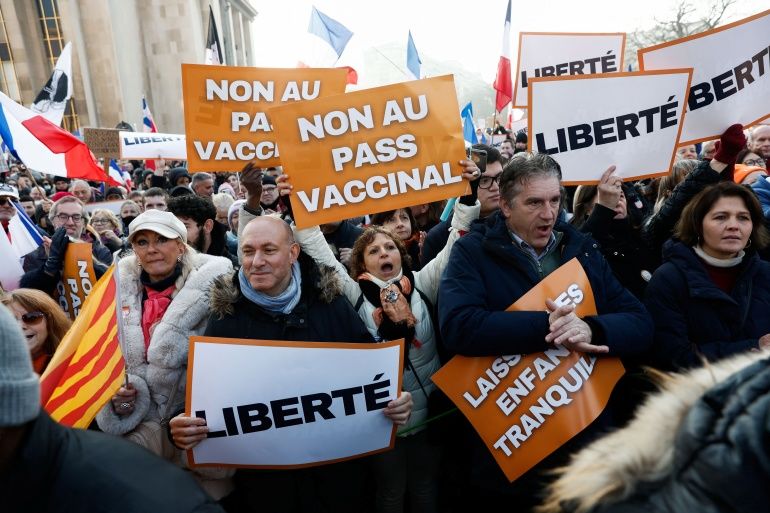 People attend a demonstration called by the French nationalist party Les
Patriotes (The Patriots) on Trocadero Plaza in Paris, France
People attend a demonstration called by the French nationalist party Les
Patriotes (The Patriots) on Trocadero Plaza in Paris, France
‘Vaccine pass’
In the first step, a measure came into force on Saturday that will deactivate the government-issued “health pass” for tens of thousands of people who have not received a booster vaccination within seven months of their first course of shots.
The pass, which grants access to public spaces like bars and restaurants, will be transformed into a “vaccine pass” under the law currently being debated in Parliament, meaning proof of having the jab will be required.
So far people have been able to keep their pass valid with negative coronavirus tests.
“It was urgent” to get jabbed, 32-year-old Juan Fernandez told AFP immediately after getting his shot on Saturday morning. “When you go out, you need the health pass every time, that’s the main reason I did it.”
The tougher measures have been pushed hard by the government as it faces a wave of infections with the faster-spreading Omicron variant.
Protests in Austria
Meanwhile, in the Austrian capital, Vienna, the government’s plan to introduce mandatory COVID-19 inoculations for all next month has come under renewed pressure as thousands of protesters took to the streets to rally against the move.
“The government must go!” crowds chanted at one rally in central Vienna in what has become a routine Saturday event. Parliament is scheduled to vote next week on the issue, which has polarised the country as coronavirus cases surge.
A poll for Profil magazine found 51 percent of those surveyed oppose making jabs mandatory from February, of whom 34 percent were against compulsory vaccination in general and 17 percent wanted to wait. The survey found 45 percent of Austrians favoured compulsory vaccination starting in February.

