

The first 100 days of Rishi Sunak’s Britain
It took one bruising campaign defeat and six weeks of exile — but on Tuesday, Rishi Sunak will finally become U.K. prime minister.
He faces the toughest in-tray of any British leader since World War II, entering No. 10 Downing Street as the country hurtles into winter with energy bills, hospital waiting lists, borrowing costs and inflation all soaring.
The challenge has been magnified by Liz Truss’ brief crash-and-burn premiership. As a result of her now-infamous mini-budget, which was scrapped almost in its entirety after causing chaos in financial markets, the Conservatives are trailing the opposition Labour Party by over 30 percentage points in opinion polls.
On Monday, Sunak told MPs he was ready to hit the ground running as he addressed them for the first time since becoming Tory leader. Over the days and months ahead, he will need to carry out his first ministerial reshuffle without further fracturing his party; oversee the first budget since the last one wreaked havoc on the economy; and determine what support to offer voters with their energy bills past this spring.
Prime ministers tend to think of their first 100 days as a way to set the tone for their premierships. For Sunak, who has just over two years to govern before he is required to face a general election, that first impression is going to be particularly important.
October 25 — Meeting with the king and first speech outside No. 10 Downing Street
Sunak will become the prime minister Tuesday after an audience with King Charles III, where he will ask the monarch for permission to form a government.
Sunak will then address the country for the first time as prime minister from the steps outside No. 10 Downing Street at around 11.35 a.m.
To much of the British public, the former chancellor is a familiar face who announced the wildly-popular furlough scheme during the coronavirus pandemic in 2020.
His task now will be to reassure people that the government will support them during another difficult economic period — only this time he is in a much tougher position. The popularity he gained during the pandemic has waned, and he is taking over after a major government crisis — the third Tory prime minister to hold office within three months.
October 25 — First reshuffle
The first big political test for Sunak will be his Cabinet reshuffle. Tory MPs believe he will learn the lesson from Truss’ first and only one, where she divvied up roles between her allies and left almost everyone who didn’t back her out in the cold.
“I think his reshuffle will be more unifying, bringing in people from all wings and will not be as destabilizing as Liz’s,” an MP who did not back Sunak predicted.
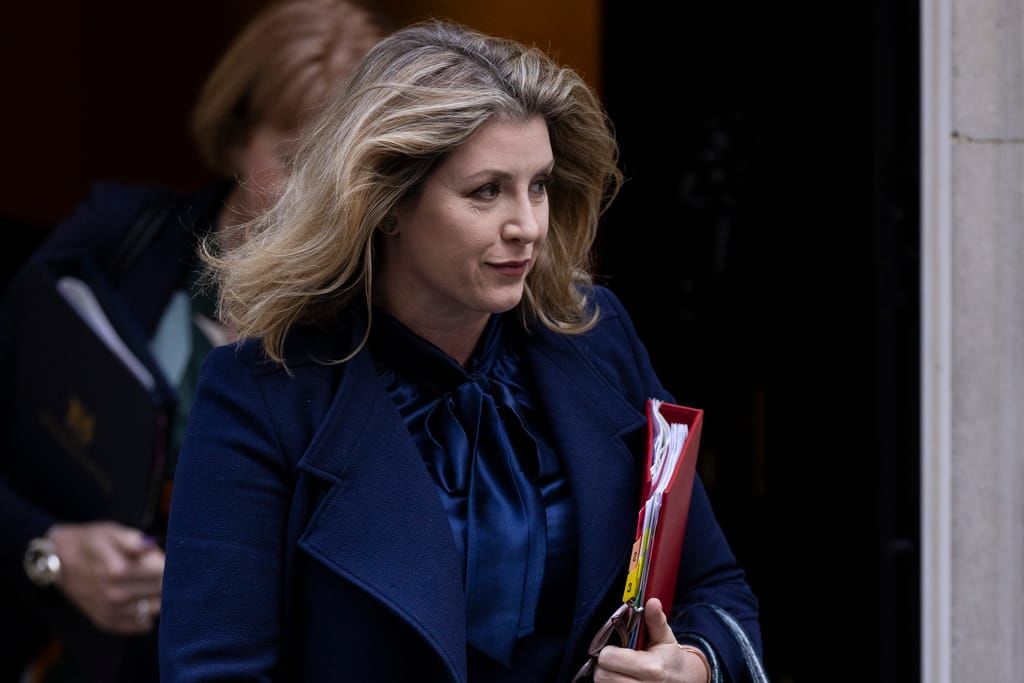 Sunak's leadership rival Penny Mordaunt is expected to be handed a major Cabinet position
Sunak is likely to make at least his major Cabinet appointments Tuesday afternoon, so they are in place to line up alongside him on the House of Commons' front bench when MPs grill him during so-called prime minister’s questions (PMQs) on Wednesday.
His biggest decision will be whether to keep Jeremy Hunt — who was drafted in by Truss in a last-ditch effort to save her premiership — as chancellor. He is also likely to hand a big job to his leadership rival Penny Mordaunt.
Close Sunak allies who are likely to get promotions include Mel Stride, the current chairman of the Treasury select committee, Craig Williams, Claire Coutinho and Laura Trott. Tory big beast Michael Gove could see a return to Cabinet.
October 26 — First PMQs
Sunak will go head-to-head as prime minister with Keir Starmer, the Labour leader, for the first time on Wednesday.
Unlike his predecessor, Sunak won’t have much to worry about from his own side — Tory MPs have largely rowed behind him since he became their leader on Monday, with many expressing relief that the perpetual state of crisis of the Truss government has ended.
But MPs will want him to demonstrate that he can land blows against Starmer at a time when Labour is streets ahead in the polls. Sunak told Tory MPs on Tuesday that their party faced an “existential threat” as a result of its low poll ratings.
October 28 — Deadline to form a government in Belfast
If a power-sharing arrangement is not in place at Stormont by Friday, a fresh set of elections to the Northern Irish assembly will have to be triggered.
Calling these elections — the second set in seven months — could be one of the Sunak government’s first acts and an indication of successive Tory prime ministers’ failure to deal with the political crisis in Northern Ireland.
The Democratic Unionist Party issued a fresh warning on Monday night that it would not participate in the assembly unless Sunak takes action on the post-Brexit Northern Ireland protocol agreed with the EU.
October 31 — First budget
The next budget was penciled in for October 31 by Kwasi Kwarteng, the Truss-era chancellor who wanted to use it to reassure financial markets still reeling from his last one.
The timing of the budget — widely derided by Tory MPs because of the optics of holding it on Halloween — was intended to give the Bank of England time to react before its own key meeting on November 3, where it will set interest rate levels for the weeks ahead.
In its biggest test so far, Sunak’s government will have to decide whether to stick with that date; what actions to take to reassure the markets; and how to fill the enormous hole in the U.K. public finances.
Carl Emmerson, deputy director of the Institute for Fiscal Studies, said: “If his chancellor is Jeremy Hunt and Sunak is comfortable with the way things are proceeding for next Monday, then going ahead has lots of advantages.
“You get the announcement out before the Bank of England makes its next inflation figure, and you get the Office for Budgetary Responsibility forecasts out there, which helps show the markets you are serious about them.
“The case for changing that date is much stronger if Sunak says, ‘Actually, I want to do something different to what Jeremy Hunt has been planning, and I need more time,’” Emmerson added.
November 3 — Bank of England rates meeting
The Bank of England’s monetary policy committee is expected to raise interest rates at its meeting on November 3, triggering a fresh hike in people’s mortgages.
This is the point when many people will realize for the first time that they will have to make much larger mortgage repayments once their current fixed-rate deals come to an end.
Sunak made combating inflation and keeping mortgages low a central theme of his leadership campaign over the summer. Reacting to the rates decision and ensuring the government works closely with the Bank of England to combat inflation will be a key test of his premiership.
November 6 — COP27 summit in Egypt
Sunak made a point of telling Tory MPs on Tuesday that he is committed to the U.K.’s goal of achieving net-zero carbon emissions by 2050.
The question now is whether he attends the COP27 climate summit in Sharm El Sheikh, Egypt. Truss reportedly planned to go, despite her skepticism of aspects of the net-zero agenda.
If Sunak does go to Egypt, it could be his first foreign trip in office (unless he decides to make a quick visit to Ukraine beforehand) and his first opportunity to present himself on the world stage.
November 8 — Boundary changes
The Boundary Commission for England will publish its new constituency map on November 8.
At this point, some Tory MPs will know with near certainty that their constituencies are being carved up between neighboring areas, with some forced to jostle with colleagues over who will get to stand where.
It will be a political headache for Sunak to deal with, and any MPs whose safe seats become marginal will sense their political careers coming to an end — and will have less of an incentive to support him in key votes in the months ahead.
November 13 — G20 meeting in Indonesia
The next big foreign trip coming down the track is the G20 summit in Bali, Indonesia.
The meeting will be an opportunity for Western powers to present a united front against Russia following its invasion of Ukraine and against China’s increased aggression toward Taiwan, but also to hold talks behind closed doors. There have been reports that both China's Xi Jinping and Russian Vladimir Putin will attend.
Sophia Gaston, the head of foreign policy at the Policy Exchange think tank, said this was shaping up to be “one of the most extraordinary summits of modern history, with a violent war raging in Ukraine and the leading protagonist, Vladimir Putin, on the guest list alongside other autocratic leaders and outraged democratic allies."
“As well as promoting free trade and the rules-based international order, Sunak would likely see the G20 as an opportunity to build support for his proposed ‘NATO-style’ technology alliance,” Gaston said. “He may well also debut a new U.K. message on the net-zero transition.”
Late November or early December — Chester by-election
Labour whips are preparing to trigger a by-election in the city of Chester in late November or December.
The by-election is taking place because the city’s MP Christian Matheson resigned after a parliamentary watchdog recommended he be suspended for sexual misconduct.
Matheson sits on a 6,164-vote majority, and the seat has traditionally been a swing seat flipping between the Tories and Labour. It was Conservative up until 2010.
Based on current polling figures, Labour should win a significantly larger majority than it currently has, though by-elections do suffer from small turnouts and so unexpected results are not uncommon. A dramatic Tory defeat would set alarm bells ringing in the party.
Another by-election could be triggered in the coming months if, as expected, Boris Johnson elevates his ally and MP Nadine Dorries to the House of Lords in his resignation honors. That would likely be the first by-election in a Tory-held seat fought with Sunak as party leader.
December 31 — U.K. deadline for joining trans-Pacific trade bloc
The U.K. government has said it hopes to conclude negotiations on joining the CPTPP — a trade agreement signed by 11 countries including Australia and New Zealand — by the end of the year.
Securing this deal was one of Truss’ priorities. For Sunak it would represent both a concrete foreign policy achievement and an indication that the U.K. is successfully building closer diplomatic ties with countries in the Indo-Pacific after Brexit.
Talks around the partnership have thrown up some diplomatic obstacles, with China reacting angrily to U.K. trade officials meeting Taiwanese counterparts. Both China and Taiwan have applied to join the CPTPP.
December or January — Johnson's probe concludes
The Commons privilege committee's probe into whether Johnson misled parliament over the so-called Partygate scandal will begin taking evidence in November and is expected to conclude in December or January — though it could drag on longer.
There have been suggestions that the evidence against him is so damning that Johnson could face temporary suspension from parliament or even be kicked out as an MP. The inquiry may have formed part of Johnson's decision not to stand for the Tory leadership contest.
If the privileges committee says Johnson should be sanctioned once it concludes its inquiry, Sunak will have to judge his response and decide whether to whip Tory MPs to back its recommendations even if that provokes Johnson's ire. There is also the risk that Sunak himself will be dragged into the probe, given he too was fined over the Partygate scandal.
Early January — COVID inquiry takes evidence
The independent inquiry into the government’s handling of the coronavirus pandemic could begin gathering evidence at the start of next year.
Among other things, the probe will examine the impact of the economic policies that Sunak designed as chancellor during the pandemic, putting his decisions under scrutiny.
His "Eat Out to Help Out" scheme — which encouraged people to dine in restaurants during the post-lockdown summer of 2020 — could become a focus, with critics claiming it drove up coronavirus-related infections and deaths.
February — Energy support nears its end
By the time Sunak’s first 100 days are up, there will be pressure on the government to explain how it will support people with their energy bills past the spring if wholesale gas prices haven't drastically fallen. Hunt has already rolled back the Truss government's two-year guarantee and instead capped people's energy bills at an average of £2,500 for just six months. That policy ends in April.
The Institute for Fiscal Studies' Emmerson said: “We’ve got a big generous offer from the government through this winter — although prices are still a lot higher than they were last year, they will be nowhere near as high as they would have otherwise been.
“The prime minister and chancellor will spend a lot of time thinking about how they replace that scheme. In some ways, it’s very similar to the kind of furlough scheme that Sunak had during the pandemic — very generous, big scheme with lots of crude edges to it,” he said.
“It’s understandable wanting to get in place quickly to support people, but how do you get out of it? Do it too quickly and that's too much pain for too many people — keep it in place for too long, and that's very expensive to the government.”
It's just one of so many enormous decisions the new PM faces in his first 100 days.