London Daily

Focus on the big picture.
Sunday, Jul 19, 2026

The 59-year-old woman who lives in a van

The 59-year-old woman who lives in a van

"I don't want to live like this, no-one should live like this - but I don't have any options," says Polly Richardson who finds herself at the sharp end of the lack of affordable homes in England.

For more than a year, she has lived out of a small camper van.

"This is my home. I've two sets of clothes in a box. I've got my cups and saucers in this drawer, my pans under this bed, and I have a little camping cooker.

"Winter time was horrendous because there was no heating."

The 59-year-old grandmother of four from east Yorkshire, is one of half-a-million households that aren't even counted as waiting for a council or housing association property, according to the National Housing Federation.

New research commissioned by the Federation from Herriot Watt University says the real number of people in England waiting for such homes is 3.8 million, representing 1.6 million households, or 500,000 more than is indicated by official government data.

"I've got belongings in people's garages," says Polly.

She spent years working as a retail manager but after taking time off to look after her sick father, and then having a big argument with her sister, she found herself being forced to move into the van in March 2019.

"Without a job, you can't have a house. Without a house, they won't give you a job. I'm hoping somebody out there will give me a job," she says.

The National Housing Federation say 90,000 homes for social rent need to be built each year for the next decade to meet demand but, according to official figures, just 6,338 such homes were completed in 2018-19, down 84% since 2010-11.
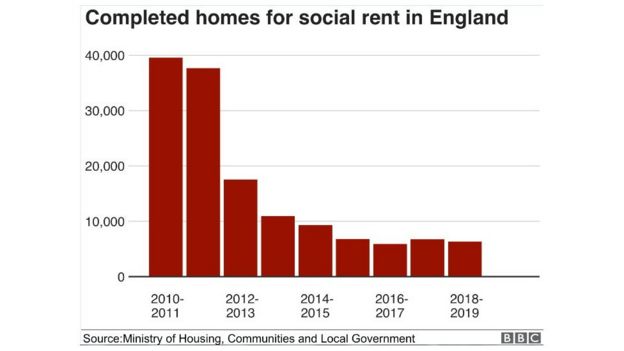


The main advantage of social housing - where either the local council or a housing association are the landlord - is that it's more affordable than private rented accommodation, typically around 50% of market rents, and usually offers a more secure tenancy.

"What we are seeing is an escalating need for social housing and a lack of supply," says Kate Henderson, chief executive of the National Housing Federation.

"Investing in social housing would boost the economy, it would create thousands of jobs, it would support supply chains in the construction industry and it would provide better, more secure, safe housing for people in need."

The lack of suitable properties leaves large numbers of families living in overcrowded accommodation.

Abigail McManus, a 27-year-old single mother lives in a two-bedroom flat in Leeds with her three young children - two daughters aged six and two and a little boy who's five months' old.

Leaving her house is a daily grind as she struggles to manoeuvre her double buggy down the stairs.

Abigail has been bidding weekly for a three-bedroomed ground floor property for years, without success.

She says the council are encouraging her to search further afield to increase her chances being allocated somewhere suitable to live.

But she says: "My whole family live on this estate, so I'd like to try and stay as close as possible.

"As a single parent, who doesn't drive, it would be hard for me to get anywhere and I'd feel more isolated than I already do, if I move too far from this area."


Mum of three Abigail McManus struggles to get her double buggy into her flat


When she was prime minister, Theresa May altered the way in which councils could use funding to allow them to build more homes.

Her government predicted the change would lead to 10,000 new council houses each year, a figure that hasn't been reached since 2013-14.

While local authorities believe building that number is possible, experts say the pandemic could create problems in the construction industry.

The Ministry of Housing said it "didn't recognise" the figures in the new analysis carried out by the National Housing Federation, describing them as a "major overestimation".

It also highlighted its £11.5bn investment in affordable homes, to be spent between 2021 and 2026, some of which will be used on building homes for social rent.


Newsletter

Related Articles

0:00
0:00
Close
Brothers Andrew and Tristan Tate Who Turned "Toxic Masculinity" Into a Brand Arrested in Miami as Britain Seeks Their Extradition
Passenger Bound for Germany Refused to Sit Beside a Woman on a Plane — Then Slapped a Flight Attendant
Ukrainian Drone Barrage Kills Eight and Strikes Russian Logistics Network
Key Trends to Watch
Financial Conduct Authority Warns Cloud and Digital Risks Are Becoming a Financial Priority
Jeffrey Donaldson Appeals Sexual Abuse Conviction as Democratic Unionist Party Opens Review
Welsh Health Authorities Launch Emergency Meningitis Vaccination Programme for Students
Scottish Business Activity Falls for Third Month as Companies Face Rising Costs
Bank of England Regulators Demand Better Access to Digital Banking Services
United Kingdom Cuts Bilateral Aid to Several African Countries by Up to Ninety Per Cent
United Kingdom Introduces Tougher Deportation Rules After Rochdale Exploitation Scandal
NHS England Launches Wearable Technology Plan to Reduce Sepsis Deaths
Amazon Web Services Billing Error Sends Trillion-Dollar Invoices to British Companies
Bank of England Takes Direct Regulatory Role Over Major Global Cloud Providers
Extreme Summer Heat Drives Record Fire Risk and Rising Deaths Across Britain
United Kingdom Nationalisation of British Steel Sparks Diplomatic Dispute With China
United Kingdom Economy Shows Weak Growth Ahead of Major Autumn Budget
Andy Burnham Set to Become United Kingdom Prime Minister After Labour Leadership Victory
The Ten World Cup Finals That Defined Football History
Smartphones Are Getting More Expensive, Sales Are Collapsing, and Even Apple Admits: "Prices Will Rise"
The Monaco Bombing Has Become a Test of Ukraine’s Intelligence Accountability
Leadership Change and Strategic Rivalry Redraw the Political Map
Energy Risk, Uneven Growth and the New Geography of Global Capital
The AI Race Enters Its Infrastructure Era
Security and resilience remain long-term national priorities
Britain balances growth ambitions with public finance pressures
Regional devolution becomes a defining theme of the next Labour era
Industrial strategy returns to the centre of British economic policy
Political Instability Remains a Challenge for UK Investment Confidence
Brexit Economic Debate Continues as Public Concerns Over Long-Term Impact Remain
UK Climate Risks Rise as Met Office Warns Extreme Weather Is Becoming More Common
Housing Shortages and Regional Inequality Become Key Priorities Under Incoming Labour Leadership
National Health Service Reform Remains One of Britain’s Biggest Political Challenges
Bank of England Remains at Centre of UK Economic Debate Over Inflation and Growth
UK Economy Shows Recovery Signs but Households and Businesses Remain Under Pressure
Britain Deepens European Defence Cooperation as NATO Allies Seek Stronger Security Capabilities
United Kingdom Expands Sanctions Against Russian Cyber Networks Over Security Threats
UK Industrial Strategy Faces Test After Government Takes Control of British Steel
British Businesses Seek Policy Clarity as Andy Burnham Prepares to Lead Labour Government
Andy Burnham’s Labour Leadership Signals Major Shift Toward Regional Power and Devolution
British Steel Nationalisation Creates New UK-China Tensions Over Control of Strategic Industry
For 36 Years, He Scammed About 300 Luxury Hotels — Until He Was Caught
England's World Cup Exit Expected to Cost Hospitality and Retail £334 Million
Former ICC Prosecutor Aide Speaks Publicly About Allegations Against Karim Khan
Opposition Raises Questions Over June Heatwave Power Grid Pressures
Mastercard Explores Sale of Majority Stake in UK Payments Operator Vocalink
Boeing Forecasts Global Commercial Aircraft Fleet Will Double by 2045
London GP Surgeries Receive £18 Million to Expand Primary Care Capacity
Health Advisers Recommend Nationwide Meningitis B Vaccination for Teenagers
OECD Warns UK Economy Faces Slower Growth and Weak Productivity
×