London Daily

Focus on the big picture.
Monday, Jul 13, 2026

Royal Mail rewards investors with £400m payday after COVID boost to parcels

Royal Mail rewards investors with £400m payday after COVID boost to parcels

The company tells investors its decision to focus on a parcel-led future is paying off as shareholders, including staff, are set for a windfall on top of an interim dividend.

Royal Mail is to hand shareholders a £400m reward after its parcels business benefited from a surge of online orders during the coronavirus crisis.

The company announced a share buyback of £200m and £200m special dividend while revealing a leap in half-year group profits on the back of a 7% rise in revenue to just above £6bn.

Pre-tax earnings for the six months to 26 September came in at £315m compared to £17m in the same period last year.

Its bottom line was also boosted by actions on costs, with £56m saved from a restructure of management alone as it continues to battle legacy systems and focus on greater use of technology.

Royal Mail, which has focused its growth on parcels amid a trend of declining letter volumes, said UK parcel volumes were up 33% on pre-pandemic levels.

Internationally, volumes took a 37% hit partly due to restricted air freight capacity - a result of the global supply woes that are hitting businesses more widely - but higher margins offset the decline, the company said.

Letters were 11% up in the period but remain down by almost a fifth on pre-COVID crisis levels.

Royal Mail also revealed that it now expected to be debt-free over the next two years.

It said that the £400m reward scheme followed a review of its retained cash balance and it believed it could fund its growth plans through existing revenue flows.

Royal Mail staff who still have stock after they were handed shares as part of the company's 2013 privatisation, will be among those to benefit.

The payments are on top of an interim dividend of 6.7 pence per share to be paid on 12 January.

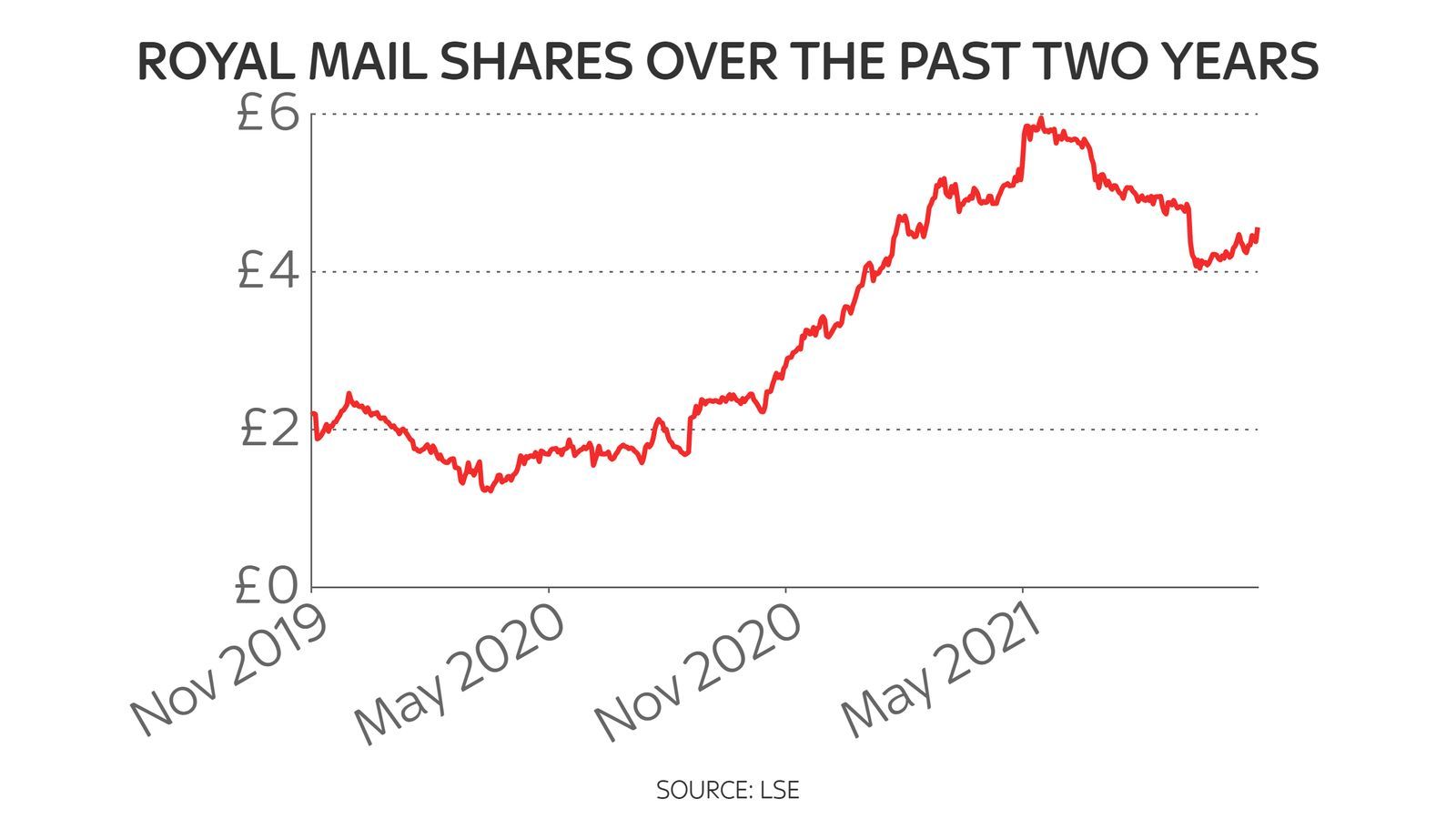
Shares rose by nearly 10%.

Simon Thompson is a former Ocado executive who also ran the NHS Test and Trace app.


Chief executive Simon Thompson told investors: "Reinvention of Royal Mail is inflight; we are making pleasing progress with our change agenda.

"We're seeing the benefits of our programmes to reduce costs, and are developing our plans to address inflationary pressures which will impact next year and beyond."

He added: "The pandemic has resulted in a structural shift and accelerated the trends we have been seeing.

"Domestic parcel volumes, excluding international, are up around a third since the pandemic, whilst addressed letter volumes, excluding elections, are down around a fifth.

"This reaffirms that our strategy to rebalance our offering more towards parcels is the right one, and demonstrates the need to start defining what a sustainable Universal Service is for the future.

"I want to thank our teams for what we have delivered so far: it is an impressive start but there is still much more to do together."

Nicholas Hyett, equity analyst at Hargreaves Lansdown, said of the figures: "The pace of Royal Mail's turnaround has hugely impressed, leaving the group in very real danger of becoming an attractive business.

"It would be easy to put the current windfall down simply to the effect of the pandemic on parcel demand. And that has played a part. But ramping up facilities to cope with the extra demand is no small achievement, and a quick glance under the hood shows a business which is in far better shape than before the pandemic.

"Overall the group is driving higher volumes with lower costs - doing wonders for margins."

Newsletter

Related Articles

0:00
0:00
Close
World Cup Visitors Turn American Big-Box Stores Into Souvenir Stops
Netflix Weighs Always-On Channels, Bundles and Short-Form Video
Passenger Is Pulled Partly Outside Ryanair Jet After Window Fails Mid-Flight
Innovation-led growth strategy
Public service reform pressure
Defence and industrial security
Labour leadership transition and economic reset
Northern England Pushes for Greater Influence in Britain’s Future Economic Model
UK Technology Strategy Focuses on Life Sciences, Digital Innovation and Research Investment
Britain and United States Maintain Focus on Pharmaceuticals Cooperation and Industrial Growth
UK Public Services Face Continued Pressure as Government Promises Visible Improvements
Regional Economic Power Becomes Key Theme in Britain’s Next Political Phase
Britain Expands Support for Small Businesses as Firms Seek Better Access to Finance
UK Economy Remains Central Political Challenge as Cost of Living and Growth Concerns Persist
National Health Service Introduces New Workplace Reviews to Improve Conditions for Healthcare Staff
UK Life Sciences Sector Secures More Than Three Billion Pounds in Investment to Support Innovation
Britain Strengthens Defence Strategy as Security Concerns Reshape Military and Industrial Policy
Andy Burnham Promises Stronger UK Defence Industry and Expanded Domestic Production
UK Government Faces Difficult Spending Choices as Labour Leadership Transition Approaches
Rachel Reeves Warns Andy Burnham of Immediate Economic Challenges After Expected Leadership Change
Andy Burnham Prepares to Lead UK Government With Plans for Regional Power Shift and Economic Reset
Government Creates Emergency Support Scheme for Financially Struggling Universities
United Kingdom Replaces Traditional Farm Subsidies With Payments Linked to Environmental Performance
National Grid Reports First Week of Electricity Generation Without Fossil Fuels
United Kingdom Financial Regulator Introduces Tougher Capital Rules for Cryptocurrency Exchanges
Belfast Harbour Expands Operations to Attract Investment Through United Kingdom and European Union Market Access
Scottish Government Threatens Legal Challenge Over Westminster Cuts to North Sea Transition Funding
United Kingdom Accelerates Trans-Pennine High-Speed Rail Project Linking Northern Cities
United Kingdom Secures Ten Billion Pound Investment for Cambridge Quantum Computing Campus
Port Talbot Steelworks Wins Support for Green Hydrogen Transition and Protection of Industrial Jobs
United Kingdom Sends Royal Navy Carrier Strike Group to Indo-Pacific as Regional Security Focus Expands
National Health Service Expands Artificial Intelligence Diagnostics Across England to Reduce Screening Backlogs
United Kingdom Launches Fifty Billion Pound Infrastructure Fund to Accelerate Housing and Construction
UK Medical Chiefs Update Health Guidance to Promote Everyday Physical Activity
Office of Communications Keeps Wikipedia Under Review Under UK Online Safety Rules
UK Defence Ministry Expands Deep-Strike Capability Through Precision Missile Programme
Russell Group Universities Warn Funding Cuts Could Damage NHS Workforce Training
UK Parliament Calls for National Emergency Broadcast as Heatwave Conditions Intensify
UK and Netherlands Strengthen Naval Cooperation With New Amphibious Defence Partnership
UK Defence Ministry Joins International Missile Programme With One Hundred and Ninety Million Pound Investment
Bank of England Warns Middle East Conflict and AI Risks Could Pressure UK Economy
UK Government Introduces New Rules to Limit Foreign Influence in Political Donations
UK and France Prepare Naval Mission to Protect Shipping Through Strait of Hormuz
United States Pressures UK to Increase Defence Spending at NATO Summit
Bank of England Warns Artificial Intelligence Investment Boom Could Create Financial Stability Risks
Bank of England Begins Direct Oversight of Critical Technology Providers Supporting UK Finance
Andy Burnham Set to Become UK Prime Minister After Labour Leadership Race Clears Path to Downing Street
Scottish Fishing Industry Calls for Emergency Support Amid Rising Costs
UK Supports Stronger European Response to Russian Actions in Ukraine
Devon and Cornwall Police Release Suspect in Ann Widdecombe Murder Investigation
×