

Putin warns world against crossing Russia's 'red lines' as Navalny supporters rally
The unauthorized marches fell short of the 500,000 protesters that Navalny's team had aimed to draw, but big crowds in Moscow, St. Petersburg and other cities has shown the dedication of his supporters, who are demanding that the hunger-striking Kremlin critic be released and allowed to receive independent medical care.
In a statement on Telegram, Navalny's team said they were confident that their "requirements will certainly be met. After all, truth and good are on our side."
Navalny's chief of staff Leonid Volkov, speaking live on Telegram, called the turnout "unprecedented" and said in Moscow "based on what we've seen 60,000 at least -- much more than we saw in January."
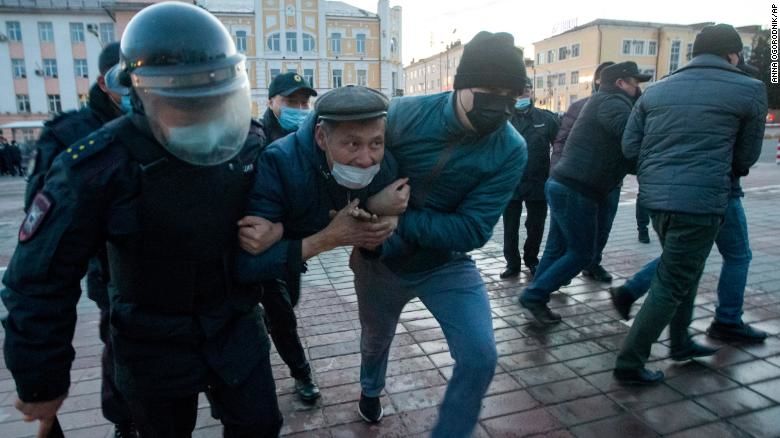 Police officers detain a protester in Ulan-Ude.
State media and the Interior Ministry had lower estimates for turnout. RIA Novosti reported about 14,400 people took part in "unauthorized protest actions in 29 cities of Russia."
The ministry put the number of protesters in Moscow at 6,000.
The nationwide protests came on the same day that President Vladimir Putin delivered his annual address to the nation, warning foreign powers not to cross Moscow's "red lines" while making no mention of Navalny.
"Whomever organizes any provocations that threaten our core security will regret this like they've never regretted anything before," Putin warned in a wide-ranging address to lawmakers in the Russian capital.
He said that "unfriendly actions against Russia do not stop" and claimed it has become "customary to pick on Russia on any possible occasion," despite it being "a welcoming country, open for real friendship."
"We behave with the utmost restraint and modesty, often do not respond at all not only to unfriendly actions, but even to outright rudeness. We want to have good relations with everyone, but we see what is happening," Putin said.
"We really don't want to burn bridges. But if someone perceives our intentions as indifference or weakness and is ready to burn or even blow up bridges, then Russia's response will be asymmetrical, swift and harsh."
His words come at a time of heightened tensions between Russia and Western powers. The US last week imposed sweeping sanctions against Russia for its interference in the 2020 US election, its massive SolarWinds cyberattack and its ongoing occupation and "severe human rights abuses" in Crimea.
The United States and European Union have also condemned Russian authorities' treatment of Navalny, who has been on hunger strike since March 31.
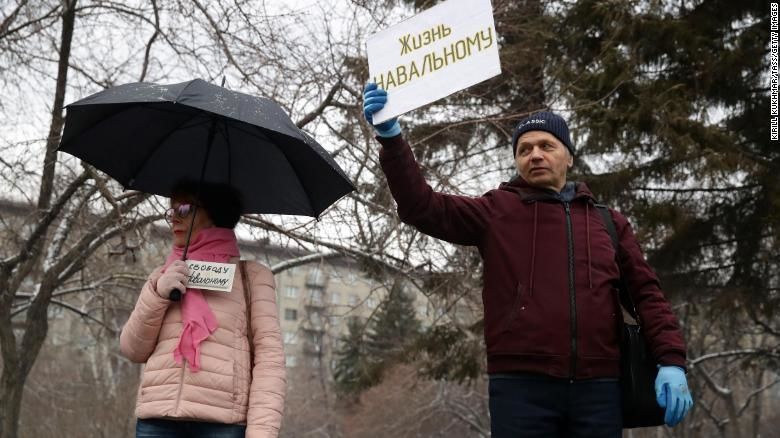
Navalny's team had called for nationwide protests Wednesday to demand the release of the opposition leader, who was moved this week from a penal colony to a regional hospital for prisoners east of Moscow, amid growing concerns over his health.
Two close Navalny allies, his press secretary Kira Yarmysh and activist Lyubov Sobol, were detained Wednesday morning in Moscow, according to their lawyers.
On Monday, Russia's Interior Ministry warned people to "refrain from participating in unauthorized actions," citing coronavirus restrictions.
For months, opposition activists have been met with a harsh show of force, demonstrated most clearly on January 31, when more than 5,000 people were detained during nationwide protests in 85 cities in support of Navalny.
Putin made no mention of Navalny in his speech but did address an alleged coup and assassination plan against Belarusian President Alexander Lukashenko, questioning why "such flagrant actions do not find condemnation of the so-called collective West."
Addressing domestic concerns, Putin called for all citizens to get vaccinated against Covid-19, saying "maximum coverage" of the population by inoculation was a priority. "It is the only way to stop the deadly pandemic," he said.
"I call for all regional governments, health ministry to continue working on it. The opportunity to get vaccinated should be widely available so by autumn we would be able to develop herd immunity."
Putin also vowed to fight climate change, saying: "We must respond to climate change and adapt agriculture and industry."
He said a carbon recycling industry should be created, while strict control and monitoring should be placed on emissions. "For the next 30 years the amount of emissions should be lower than in [the] European Union," he urged. "It's a difficult task, considering the geography of our country, its size and structure of the economy. But I am absolutely sure it's achievable."
'Walking skeleton'
Navalny has been on hunger strike for three weeks, demanding "proper medical care" and to be examined by an independent doctor -- something his team claims he was unable to get in the penal colony in Pokrov.
Russia's Federal Penitentiary Service (FSIN) said in a statement Monday that he had been moved to a prison hospital in the Vladimir region that specializes in "dynamic" observation of patients.
The statement said Navalny was in "satisfactory" condition and is being examined by a doctor every day. With Navalny's consent, he has been prescribed "vitamin therapy," the penitentiary service added.
In an Instagram post shared by his team on Tuesday, Navalny joked about his current condition, saying he looked like "a walking skeleton" who could be used to scare children who refused to eat.
"If you were to see me now, you would have a laugh. A walking skeleton, staggering around the cell," Navalny said.
Commenting on doctors' concerns about a dangerously high level of potassium in his blood, he said: "You can't just take me so easily. After 'Novichok' even potassium is not so terrible."
Navalny blames the Russian security services for his poisoning last year with the nerve agent Novichok. The US and EU largely agree and have sanctioned Russian officials for their involvement. Russia denies any involvement in the poisoning.
Navalny was sent to prison after a Moscow court on February 2 replaced his suspended sentence with jail time due to violations of his probation. He was arrested when he returned to Moscow from Germany, where he had been recovering from the poisoning.
US words 'not strong enough'
In an interview with CNN's Christiane Amanpour on Tuesday, Navalny's chief of staff said the Russian authorities did not want the Kremlin critic to "die in custody, but they want him to suffer."
Volkov said Navalny had been fed glucose but had returned to a hunger strike in protest against his captivity. "He's very weak but still able to walk... and during transportation from his colony to his prison hospital, he felt very ill, was given glucose, but now he's back on hunger strike and will keep on."
According to Volkov, Russian authorities refused to let Navalny be treated by his own medical team when they arrived earlier Tuesday at the facility where he is being kept in solitary confinement.
On Sunday, US National Security Adviser Jake Sullivan said that in the event Navalny died, Russia would be held accountable and there would be "consequences."
Volkov told CNN that Sullivan's words were "strong but not strong enough."
"He's being held in prison unlawfully, he's being tortured... he has to be immediately released and the European Court of Human Rights is part of Russia's legal system, it has to comply," he said. "I prefer Putin is held accountable for what happens now, before he dies."